A Small Man with a Big Heart: Remembering Sri Lankan Martyr Fr. Shrilal Amaratunga


"He was a true man of God who dedicated his life to Him and His people. He lived what he preached and preached what he lived. He had a big heart for the poor, the helpless, the downtrodden, the oppressed, and those deprived of their basic human rights."
These were the words often used by Fr. Terrence Fernando, an activist and friend, to describe Rev. Fr. Shrilal Amaratunga. A man of small physical stature but monumental courage, Fr. Shrilal’s life was a testament to faith in action. On January 19, 2026, the Church marks the 36th anniversary of his mysterious assassination, honoring a priest who lived—and died—for the rights of the oppressed.
Early Life and Awakening
Born Joseph Llewellyn Shrilal Perera Amaratunga on May 29, 1947, in Rilaulla, Kandana, western Sri Lanka, he was the eldest son of Henry and Mercedes Dilsie Amaratunga. Educated at Rilaulla School and later St. Joseph’s College, Maradana, he was initially a frail, unassuming youth who drew little attention.
His true calling ignited in 1964, when he entered the seminary of the Congregation of the Blessed Sacrament in Bangaluru, India. From the balconies of the grand seminary, he looked past the high walls to the sprawling slums beyond. While others saw only poverty, Shrilal saw a calling. He began secretly scaling the walls to visit the slum dwellers, bringing food and companionship.
This experience transformed him. He began questioning his superiors: “How does filling notebooks and living comfortably in this seminary prepare us to serve our people?” His persistence eventually led to official permission for seminarians to teach children in the slums.
A Shepherd Among the People
Ordained on April 30, 1972, at St. Sebastian’s Church, Kandana, Fr. Shrilal rejected the traditional, detached role of the clergy. He believed that to truly preach to the people, one must live among them.
Declining a comfortable post in Thimbirigasyaya, one of Colombo’s wealthiest parishes, he chose to serve in the impoverished fishing villages of Kalpitiya. There, he confronted powerful businessmen exploiting local laborers and labored alongside the community, hauling sand and bricks to build a school for children in Kurunjanpitiya.
His humility was legendary. During a festival at St. Anne’s Shrine, Thalawila, pilgrims complained that the temporary church shelters were leaking. Instead of offering excuses, Fr. Shrilal climbed the roof himself to repair the thatch, leaving critics humbled by his servant leadership.


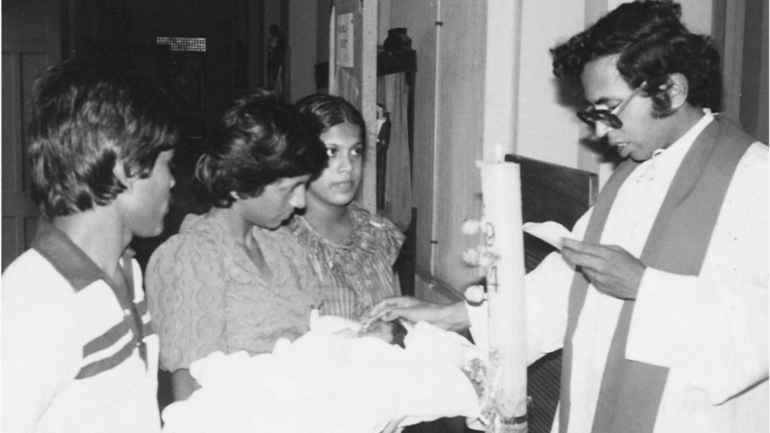

A Defender of Justice
Fr. Shrilal was a fierce opponent of injustice and racism. During the Black July ethnic riots of 1983, he opened the seminary in Thimbirigasyaya to Tamil families fleeing violence. When armed mobs demanded he hand them over, branding him a “traitor to the nation,” he stood firm: “Who is the coward? Is it those protecting the innocent, or you, who kill at the whim of others?”
In 1985, he was appointed to Kongodamulla, Katana, a parish notorious for being “troublesome.” Fr. Shrilal saw things differently: villages became troubled because of the narrow interests of political and religious leaders. He worked to restore dignity, fostering youth groups, community theater, and independent cooperatives to challenge corruption.
The Era of Terror (1988–1990)
During the late 1980s, Sri Lanka was gripped by the JVP insurrection and a brutal government counter-insurgency. As bodies appeared on roadsides, Fr. Shrilal became a vocal critic of state violence. When the government urged youth to return to “democracy,” he boldly asked: “Shouldn’t the government first ask itself if it is being democratic?”
Just 17 days before his death, two bodies were burned near his church to intimidate the community. Undeterred, Fr. Shrilal organized a dignified burial for the victims. His refusal to be silenced made him a target for pro-government paramilitaries.
The Final Sacrifice
On the morning of January 19, 1990, a fellow priest went to accompany Fr. Shrilal to a meeting with a local politician aimed at ending the cycle of violence. The door, usually open to all, was closed. Inside, the “Man of Steel” lay still.
He had been murdered during the night. A cold cup of coffee sat by his side, his neck bore marks of strangulation. Though the perpetrators remain unknown, the reason for his death was clear: he was killed for standing with God among the persecuted.
Fr. Shrilal Amaratunga lived by his own words: “Instead of breaking the people, let us break ourselves to build them up.” Thirty-six years later, his legacy as a “small man with a big heart” continues to inspire those striving for justice and compassion.