The year was 1045, and the pope committed a terrible scandal: Benedict IX sold the papacy to his godfather, who became Gregory VI, and married his cousin. With a new pontiff and a questionable succession process, the Catholic Church was in total disarray.
In the middle of this ecclesiastical mess, a letter found its way into the hands of Gregory VI, written by the prior of a monastery in Fonte-Avellana in Ravenna. Brother Peter Damian, full of joy and hope that the scandalous Benedict IX is out of office, urged the new pope to address the worsening corruption within the Church itself.
A terror against simony and clerical marriage
Before embracing the monastic life, young Peter Damian excelled in his studies and became a teacher upon completing his education. But after realizing that university life is not for him, he took a 40-day retreat at Fonte-Avellana and never looked back since.
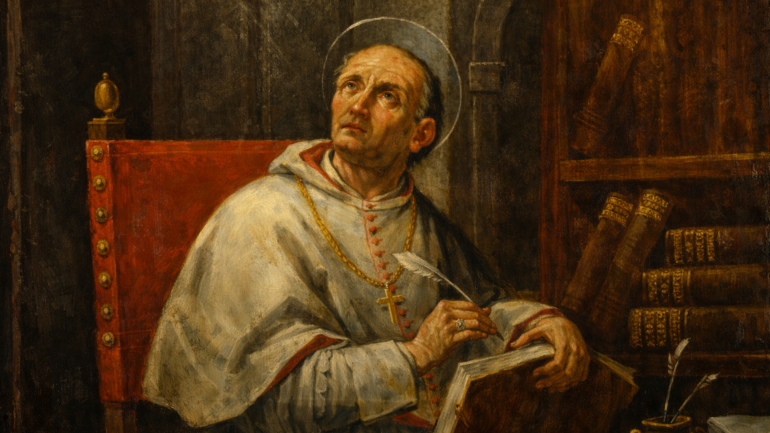
Even though he spent most of his time in prayer and penance, Peter Damian never forgot to put his intellect to good use. He translated his reflections on paper, taught his fellow monks, and founded other monasteries. When he became the prior of Fonte-Avellana, he combined the Byzantine eremitism and the Western Benedictine monasticism, giving birth to a way of life centered on “apostolic poverty.”
As Peter Damian reformed his own monastic communities, his desire to bring reform to the Universal Church also deepened. Since writing to Gregory VI, popes sought his advice because of his eminent knowledge of the Canon Law and the Word of God. During the reign of Pope Leo IX, Peter Damian helped in tackling the issue of simony, or the purchase of ecclesiastical offices, which he largely covered in his tract Liber gratissimus in 1052. He also stepped up to answer the issue of Nicolaitism, or the movement that pushed for clerical marriage.
Due to his groundbreaking efforts for Church reform during one of its most tumultuous times in history, Peter Damian was created a cardinal by Pope Stephen IX in 1057.
A key member of the cardinals
Despite being a cardinal, Peter Damian did not abandon his monastic lifestyle. In fact, he used his office to inspire fellow clergymen to adopt a life of simplicity and humility. He urged them to maintain a regular schedule for prayer and reflection, advised against needless travel, and warned about the spiritual danger of living in excess. Staying true to his reforms, Peter Damian constantly reminded priests to make a stand against simony and nicolaitism.
During the papal elections of April 1059, Peter Damian assisted in crafting a decree that solidified the independence of cardinals to select a pope and the manner in which the elections would be held.
Furthermore, Peter Damian was appointed as an ambassador or envoy for the pope several times. He acted as mediator in the struggle between the archbishop of Milan and the Patarines, served as arbiter between Abbot Hugh and Bishop Drogo in France in the matter of Cluniac exemptions from episcopal control, and represented the papacy to dissuade Henry IV of Germany from divorcing his wife.
Peter Damian’s last mission for the papacy brought him back to his birthplace of Ravenna in 1072, to mend the relationship between its see and Rome. A year later, he passed away in the monastery of Faenza.
A prolific doctor of the Church
Saint Peter Damian may have lived in the 11th century, but he left the Church many written works that immortalized his God-given wisdom. He produced 53 sermons, 7 vitae, three tracts, and countless liturgical pieces. He served using his intellect, which moved his pen, and his humility, which inspired even holy men like Saint Francis of Assisi.
May the example of Saint Peter Damian lead to the blossoming of God’s love in our hearts, pushing us to pursue holiness in today’s chaotic and fast-paced world. This hermit-turned-reform reminds us: “Nobody can fight properly and boldly for the faith if he clings to a fear of being stripped of earthly possessions."