



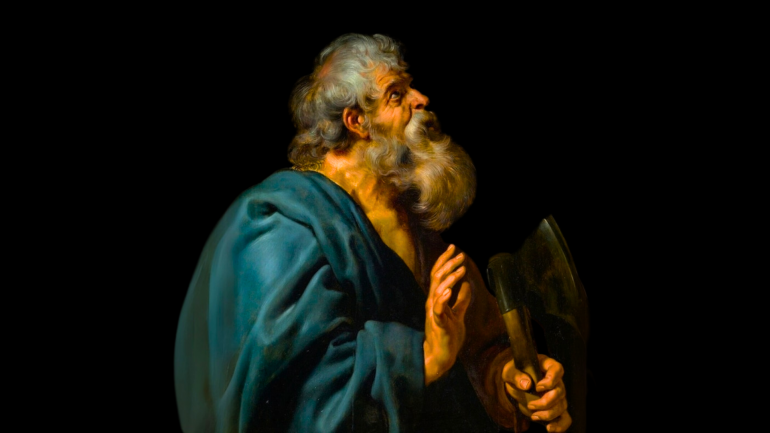
There is something almost uncomfortable about the way Saint Matthias enters the story. The disciples have gathered in an upper room in Jerusalem. Judas is dead. A vacancy has opened among the Twelve, not through retirement or natural succession, but through betrayal and catastrophe. The group nominates two men, prays, and casts lots. The lot falls to Matthias. He becomes an apostle. And then, for all practical purposes, history goes almost entirely silent about him.
No letters. No gospel. No dramatic confrontations with emperors. What we have are fragments and traditions that place him in Judaea, perhaps Ethiopia, possibly Cappadocia, and a martyrdom that most accounts associate with an axe. He is, by almost every measure, the least documented of the Twelve. And yet his feast day is celebrated, his name endures, and the Church has always counted him fully among the apostles. The question worth sitting with is: why does a man this obscured still matter?
The Psychology of the Replacement
To understand Matthias, it helps to begin with the psychological reality of the position he was stepping into. He was not filling a neutral vacancy. He was replacing Judas Iscariot, arguably the most notorious figure in all of religious history. Whatever Matthias felt in that moment when the lot fell to him, it was not a simple honour. It was an inheritance weighted with shadow.
Modern psychology has a great deal to say about what researchers call replacement identity, the particular burden borne by anyone who steps into a role vacated by someone whose departure was traumatic or marked by disgrace. Children who follow a sibling who died young, executives who take over from a fallen leader, and coaches who replace beloved predecessors. All face the same invisible problem: they are measured not only by what they do, but by what they are not. Matthias would spend his entire apostolic life in the wake of a betrayal he had nothing to do with, serving a mission whose vacancy had been created by the darkest kind of failure.
What strikes a psychologist here is not that Matthias overcame this; we have no record that he wrestled with it at all. What is striking is the radical absence of ego in the role required. To step into the place of Judas demanded a near-total indifference to how one would be perceived. And perhaps that is precisely why the lot fell the way it did.
Chosen by Chance, Called by Design
The method of his selection is itself extraordinary and frequently overlooked. Matthias is the only apostle chosen by lot, by what we might today call randomness. The early community prayed, then surrendered the decision entirely to God through chance. This is not, as it might appear to modern eyes, an abdication of responsibility. It is a theological statement of the highest order: that the human capacity to evaluate, rank, and select is sometimes the greatest obstacle to discernment.
There is a powerful psychological insight embedded here. We live in an era saturated with metrics, assessments, personal branding, and competitive self-presentation. We are encouraged to curate ourselves into the most hireable, fundable, visible version possible. The selection of Matthias is a direct rebuke to all of that. Neither candidate campaigned. Neither was ranked. The community simply named who was qualified, prayed, and let go.
The Dignity of the Hidden Life
What Matthias offers the modern world, perhaps more than any other apostle, is a theology of anonymity. He did the work, tradition holds he preached, built communities, and ultimately died for the faith, without leaving a personal monument. In an age of personal branding and documented legacy, his silence is not a failure of record-keeping. It is, on reflection, something close to an ideal.
Psychology consistently shows that intrinsic motivation, doing something because it matters, not because it will be seen, is the deepest and most sustainable form of human engagement. Matthias, by all available evidence, operated entirely within that register. His name does not attach to a theology, a famous journey, or a great dispute. It attaches only to faithfulness.
That is, quietly, an astonishing achievement.
He was chosen last, stepped into an impossible vacancy, worked in obscurity, and died without fanfare. In the apostolic band that gave us towering figures like Peter and Paul, Matthias was content to be Matthias, and the Church, to its credit, has always understood that this, too, is a form of greatness worth remembering.