The story is usually told as a miracle: a basilica in Milan packed with people praying and singing while imperial troops waited outside, unsure of their next move. But there is another way to read the scene.
The Bishop of Milan, Ambrose, had turned a house of worship into a fortress of nonviolent resistance. Outside stood the Roman Empire. Inside stood a saint who understood power. Long before anyone coined the term “political strategy,” Ambrose was practicing it with an instinct sharpened not in monasteries but in the offices of Roman administration.
The Church celebrates the feast of St. Ambrose on December 7.
Ambrose is remembered today as a theologian, mystic, and spiritual father of St. Augustine. What is less appreciated is how his political intelligence reshaped the relationship between Church and State.
From Bureaucrat to Bishop
Before he became bishop, Ambrose was a Roman official raised in a family of bureaucrats. Trained as a lawyer and eventually governor of Liguria and Emilia, he dealt daily with petitions, civil disputes, and a population divided by competing beliefs. This experience taught him to read a crowd, negotiate tension, and impose order, skills he carried into the Church. Unlike bishops formed in monastic life, Ambrose brought the instincts of a statesman.
This difference became crucial the moment he was elected bishop. During a heated conflict between Nicene and Arian Christians, Ambrose arrived as governor to mediate. In the chaos, a child shouted, “Ambrose for bishop!” The crowd took it as divine prompting. Eight days later, he was baptized, ordained, and consecrated.
Mastering Church Politics
But his strategy began after his consecration. Inheriting a divided city, he softened factional hostility without appearing partisan, built clerical loyalty, and reorganized worship to strengthen unity. A leader thrust into power, he moved first to secure legitimacy.
His most brilliant maneuver came during the “Basilica Siege.” Empress Justina, sympathetic to Arianism, demanded that Ambrose surrender a basilica. He refused, knowing he could not win by force. Instead, he asked the faithful to gather “for prayer,” turning the basilica into a peaceful occupation. He introduced antiphonal singing to maintain calm and unity. The music was not only devotion; it preserved morale and created a sense of shared purpose. His sermons framed the conflict as moral, not political. Troops hesitated to enter. Soldiers storming a church full of singing Christians would stain the empire. Justina eventually withdrew her demand.
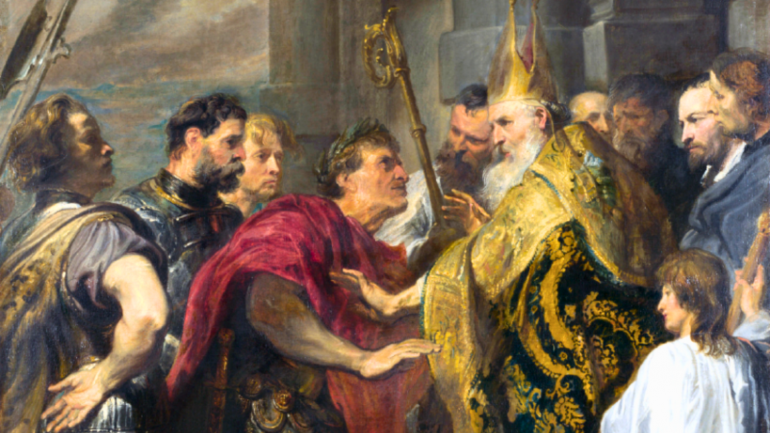
Even more consequential was Ambrose’s confrontation with Emperor Theodosius I after the Massacre of Thessalonica. Ambrose did not denounce him publicly. He wrote a private but firm letter refusing the emperor Communion. He invoked precedent and insisted the emperor kneel before God as any sinner must. Theodosius complied with public penance, a moment that redefined the limits of imperial authority.
The Power of Storytelling
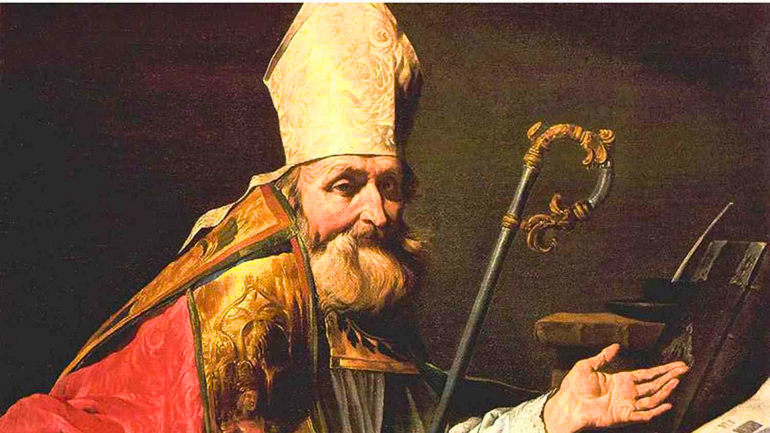
Part of Ambrose’s effectiveness came from his storytelling. His letters circulated widely. His sermons set Milan’s moral tone. His hymns shaped its emotional identity. His “discovery” of the relics of Gervasius and Protasius energized the city and strengthened Nicene unity.
Ambrose was, in every sense, a political architect. His confrontations with emperors shaped centuries of thought on moral authority. The basilica that still stands in Milan is not only a monument of faith; it is a monument to strategy. In its stones echo the chants of a community that once stood unarmed before an empire, guided by a bishop who understood power well enough to resist it.
Why Ambrose’s Political Strategy Still Matters
-
Moral authority must be earned before it confronts power. Ambrose built credibility through service and consistency.
-
Nonviolent resistance rooted in community identity endures. His basilica occupation was peaceful and unified.
-
He understood narrative warfare long before social media. Sermons, hymns, and symbols shaped public opinion.
-
He held leaders accountable without destroying institutions. Correction did not seek to humiliate the imperial office.
-
Power must kneel before conscience or become tyranny. Theodosius kneeling remains politically revolutionary.
-
Legitimacy outweighs force. Ambrose had no army; Justina did, yet she backed down.
Ambrose is relevant today because he shows how moral clarity, strategic communication, and peaceful solidarity can challenge oppressive power without becoming oppressive in return.
The Basilica di Sant’Ambrogio in Milan, Italy, and Sant’Ambrogio in Rome are only two of the churches across the world named in his honor.
Pope Benedict XVI, in a October 24, 2007 General Audience, called Ambrose “an icon for Christian living and keeping Jesus first in life.” In the same text, Benedict XVI emphasized that Ambrose “kept his teaching intimately united to his prayer and entire life.”
St. Ambrose’s life reminds us that true leadership balances moral authority with strategic wisdom. His example demonstrates the power of patience, nonviolence, and narrative in shaping society. Ambrose remains a model of how faith and strategy can coexist to guide communities through challenge and change.