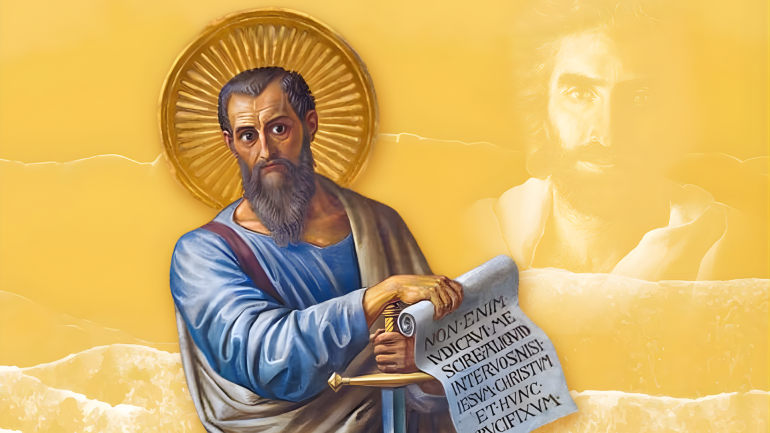
January 25 is a unique date in the Church’s liturgical calendar. Normally, the Church commemorates saints on the days of their death, or occasionally on their birth (as in the case of St. John the Baptist). But this day is exceptional—it celebrates a conversion experience.
A closer look at this event helps us understand why the Church holds it in such high regard. In the famous Road to Damascus account in Acts, Saul hears a voice: “Saul, Saul, why do you persecute me?” (Acts 9:4). Luke records Jesus saying, “I am Jesus whom you persecute” (Acts 9:5), followed by the command that would shape Saul’s life forever: “Get up and enter the city, and you will be told what to do” (Acts 9:6).
But did Saul’s conversion, recounted by him no less than three times in Acts (22, 24, and 26), occur solely on the road to Damascus? Many scholars suggest that its roots go back earlier, to the stoning of Stephen, the first martyr of the Church (Acts 6–7). Saul was present as Stephen passionately defended the faith. That the crowd laid their cloaks at Saul’s feet before stoning Stephen indicates that Saul was a recognized leader among the persecutors. The prayer of Stephen, asking God to forgive his executioners, and his radiant calm in facing death, must surely have left a profound impression on Saul. Indeed, much of Paul’s later writings testify in one way or another to Stephen’s influence.
Was Stephen the only influence on Saul’s conversion?
A careful reading of Acts shows that Saul was journeying away from the safety of his familiar surroundings, into uncharted territory, to persecute Christians. There, a blinding light and a voice only he could hear confronted him. The faith he thought he was defending turned out to be something radically new.
In those moments of confusion, brother Ananias played a crucial role, praying to remove the scales from Saul’s eyes (Acts 9:10–19). Scholars also highlight the power of the intercessory prayers of the Christians of Damascus, who knew Saul was approaching to arrest and persecute them. These prayers were answered. During the three days of fasting and prayer, Saul’s inner eyes were opened for the first time, allowing him to discern the true Light—the Living Waters.
From that moment, there was no turning back for Saul, now Paul. Despite hardships such as shipwreck off the coast of Malta and months sheltering in a cave visited by three popes before Pope Leo, he embarked on his epic missionary journeys. He wrote extensively, contributing nearly two-thirds of the New Testament with thirteen letters. His writings are deeply personal and passionate, reflecting the hardships endured, persecutions faced, moments of abandonment, courage to stand firm even before Peter, and a tender heart, as in his letter to Philemon.
What lessons can we draw from Saul’s conversion for our own Christian lives?
Have we stepped out of our comfort zones and listened for His voice?
Has someone guided us in discerning what that voice is telling us?
How often have we persecuted Him by speaking ill of priests and religious, mocking the Sacraments, or disregarding the teachings of the Church?
Do we fast and pray when we need to discern His will?
We are called to a conversion experience that sets us on our own unique Christian trajectory—one from which there is no turning back. One of the greatest tragedies would have been if Saul had heard the voice but continued on his path unchanged. By listening, he oriented his entire life to the Light. Mustn’t we do the same?