



Cardinal Tagle Calls St. Rose a “Perpetual Missionary” Ahead of Statue Inauguration at Vatican Gardens

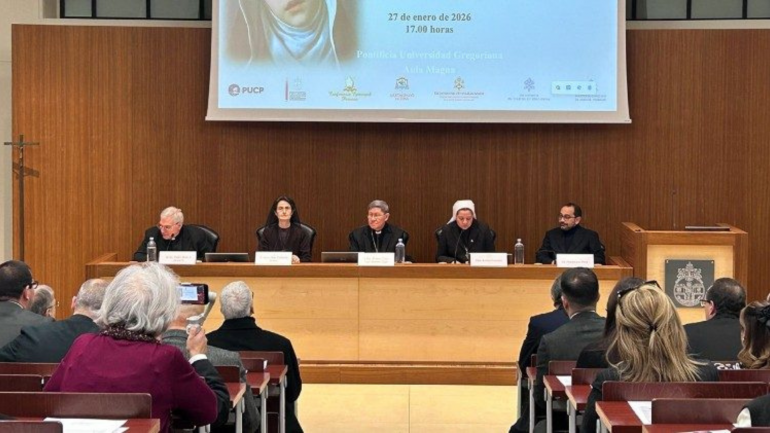
St. Rose of Lima, the first canonized saint of the Americas, continues to inspire missionary zeal far beyond Latin America, resonating deeply across Asia, particularly in the Philippines and East Asia, Cardinal Luis Antonio Tagle said at an international conference in Rome.
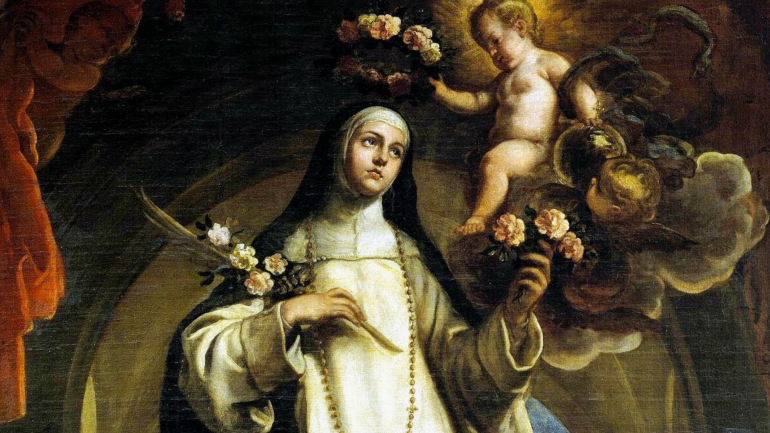
A statue of St. Rose, along with a Marian mosaic made entirely of materials from Peru, will be inaugurated in the Vatican Gardens on January 31 in the presence of Pope Leo XIV. The statue depicts the moment of St. Rose’s mystical vision of Christ, who offered her a ring and flowers—a powerful symbol of her total self-giving. An anchor and rosary crown included in the artwork evoke her earthly journey and spiritual steadfastness.
Speaking at the Pontifical Gregorian University on Jan 27, Cardinal Tagle reflected on the enduring relevance of St. Rose of Lima (1586–1617) as a model for today’s missionary Church, especially for young people seeking living examples of faith rather than abstract teachings. The conference, organized by the Embassy of Peru to the Holy See with academic support from the Pontifical Catholic University of Peru, was reported by Vatican News.
Cardinal Tagle, pro-prefect of the Dicastery for Evangelization, highlighted St. Rose’s unique role as a spiritual bridge between continents. While she is the patroness of Peru and Latin America, she is also one of the patron saints of the Philippines—an enduring sign of her influence in Asia.
“Her sanctity crossed oceans and generations,” Cardinal Tagle said, noting that one of the six façades of Manila Cathedral is dedicated to St. Rose. Her devotion, he explained, reached the Philippines through Spanish Dominican missionaries and took deep root in Filipino Catholic spirituality.
Drawing from personal experience, Cardinal Tagle recalled his years serving in a parish named after the saint. He described St. Rose as a “perpetual missionary” whose silent witness continues to speak powerfully to contemporary Asia, where faith is often transmitted through lived example and community memory.
According to Vatican News, the cardinal expressed hope that the academic gathering in Rome could plant the seeds of a renewed missionary movement—one marked by humility, holiness, and credibility—qualities urgently needed in today’s Asian Church.
St. Rose’s relevance was also highlighted by Sister Raffaella Petrini, President of the Governatorate of Vatican City State, who described the Peruvian saint as “forever young” and capable of touching hearts across cultures and eras.
Cardinal Carlos Castillo Mattasoglio, Archbishop of Lima, emphasized that St. Rose’s spirituality was rooted in daily work and interior discipline. Quoting her prayer—“My beloved spouse, help me to work”—he underlined how everyday labor became a channel of grace, a message that resonates strongly with Asia’s working poor and migrant communities.
The conference also recalled Pope Francis’ words during the 400th anniversary of St. Rose’s death, when he described her, borrowing from the Song of Songs, as “a lily among thorns”—a phrase that echoes the experience of many Asian Christians striving to live their faith amid hardship.
Closing the event, Peru’s Ambassador to the Holy See, Jorge Ponce San Román, noted that St. Rose’s influence spread across the world long before modern media. Citing historical accounts, he recalled that nearly three-quarters of Lima’s population joined her funeral procession—testimony to a holiness that transcended borders.
For Asian Catholics, Church observers say, St. Rose of Lima remains a compelling reminder that true mission begins not with power or visibility, but with fidelity, humility, and a life deeply rooted in Christ—an example Cardinal Tagle believes Asia is uniquely called to witness today.