



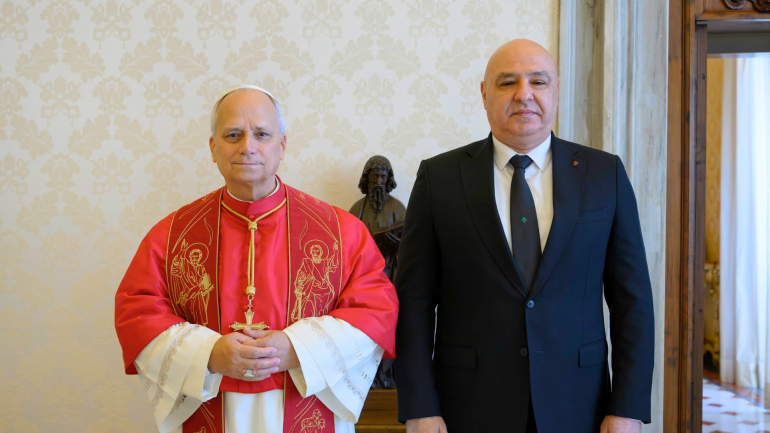
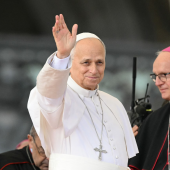
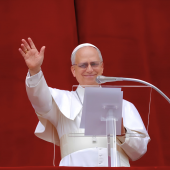
Pope Leo XIV met Lebanese President Joseph Aoun at the Vatican on August 20, with discussions focusing on efforts to stabilize southern Lebanon and advance a just and lasting peace amid continuing tensions with Israel.
According to Vatican News, Aoun later met with Holy See Secretary of State Cardinal Pietro Parolin and Archbishop Paul Richard Gallagher, secretary for relations with states and international organizations.
The talks at the Vatican Secretariat of State were described as “cordial” and centered on the Trilateral Framework Agreement signed by the United States, Israel and Lebanon to stabilize Lebanon’s southern borders and promote a lasting peace.
The Holy See welcomed the signing of the agreement but expressed concern over difficulties in implementing its provisions, the Holy See Press Office said.
“The Holy See ... voiced serious concerns about the difficulties being experienced in implementing it, and assured its support for efforts in this regard,” according to the statement cited by Vatican News.
The meeting comes as Lebanon, a Middle Eastern country with a significant Christian population, continues to face instability along its southern border with Israel.
In a statement issued by the Lebanese Presidency, Aoun thanked Pope Leo XIV and the Holy See for their support for Lebanon and urged continued diplomatic backing for Beirut’s demands.
Aoun called for Israel to implement the terms of the framework agreement, signed under U.S. auspices on June 26, and to halt attacks that he said have affected civilians, infrastructure and villages in southern Lebanon.
He also called for the withdrawal of Israeli forces from occupied Lebanese territories, reconstruction of damaged areas and the return of displaced residents.
Aoun stressed that these measures should be accompanied by the extension of Lebanese state authority throughout the country.
According to Vatican News, tensions remain particularly high in southern Lebanon, where military operations have continued despite a temporary ceasefire reached with Israel on April 17.
Israel maintains that its operations target Hezbollah infrastructure and personnel, while the Lebanese government has continued to condemn the military actions and their impact on civilian communities.
Political uncertainty also persists over the future of southern Lebanon. The eighth round of U.S.-mediated talks has yet to be scheduled as efforts continue to advance the framework agreement and establish a roadmap toward peace.
The Vatican meeting underscored the Holy See’s continuing diplomatic engagement on Lebanon, where political stability, territorial sovereignty, the protection of civilians and the return of displaced people remain central concerns.
For Lebanon’s Christian community and the wider Middle East, the appeal for a just and lasting peace comes as the region continues to face conflict, displacement and political uncertainty.
Radio Veritas Asia (RVA), a media platform of the Catholic Church, aims to share Christ. RVA started in 1969 as a continental Catholic radio station to serve Asian countries in their respective local language, thus earning the tag “the Voice of Asian Christianity.” Responding to the emerging context, RVA embraced media platforms to connect with the global Asian audience via its 21 language websites and various social media platforms.
Comments
Latest News



- Reply
Permalink