



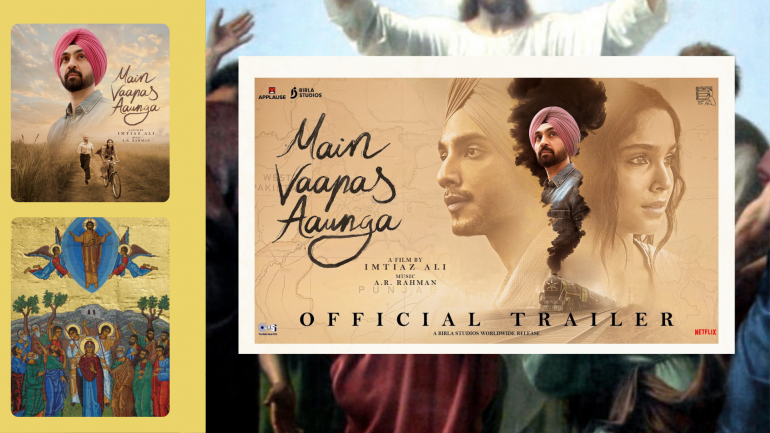
Main Vaapas Aaunga is a film that quietly builds on us, without us even realizing it.
Imtiaz Ali’s film begins with an unusual mystery. Ishar Singh Grewal, or Keenu, a 95-year-old Sikh man suffering after a stroke, appears trapped in fractured memories. His family hears dementia; his grandson Nirvair hears a story trying desperately to be told. Slowly, memories lead us back to pre-Partition Sargodha, to a young Keenu, to Afsana, and to a love interrupted by a line drawn across a map. No spoilers, but what begins as a love story gradually becomes something larger: a meditation on memory, displacement, home, and that strange human inability to stop yearning for what, or whom, we have loved.
Released on June 12, 2026, Main Vaapas Aaunga marks Imtiaz Ali’s return to the big screen after several years. He directs a screenplay co-written with Nayanika Mahtani, with Aarti Bajaj editing and Sylvester Fonseca behind the camera. Naseeruddin Shah gives the film its wounded old heart as Ishar Singh, while Vedang Raina plays his younger self. Sharvari brings warmth and confidence to Afsana, and Diljit Dosanjh plays Nirvair, the grandson trying to decipher the emotional archaeology of his grandfather’s memories. A.R. Rahman’s music, accompanied by Irshad Kamil’s poetry, does what Rahman often does best: it seems to remember emotions before the characters themselves do.
There is a reason why this film hurts. It is not really about remembering history. It is about history remembering us.
And at its centre stands one sentence:
“Main vaapas aaunga.”
“I will come back.”
That promise opens an unexpected door into the Gospel.
“I will come back…”
On the night before His death, Jesus tells His frightened disciples:
“I will come back and take you to myself.”
— John 14:3
The similarity of language is almost haunting.
Keenu says, I will come back, because love has made leaving unbearable.
Christ says, I will come back, because divine love refuses to leave humanity orphaned.
John 14 is spoken at the Last Supper. Jesus knows separation is coming. The disciples are anxious because the One they love is going somewhere they cannot immediately follow. Jesus does not pretend that separation will not hurt. Instead, He gives separation a destination: “In my Father’s house there are many dwelling places.”
In simple terms, Christianity makes an astonishing claim: beneath all our smaller longings, for a person, a place, childhood, home, belonging, there is a deeper longing to return to God.
Main Vaapas Aaunga understands this yearning almost instinctively.
Keenu survives for decades. He builds another life. Yet something within him remains unfinished. The film observes that by suppressing his earliest wounds, he also seems to suppress his capacity to love. His failing memory therefore creates one of the film’s strangest paradoxes: forgetting finally allows him to remember.
That is spiritual.
We too become experts at forgetting.
We forget people who loved us because pride entered the room. We forget friendships because nobody wants to send the first WhatsApp message. We forget God because apparently our schedule is so important that the Creator of time must make an appointment.
Yet the heart remembers.
Saint Augustine famously wrote that our hearts are restless until they rest in God. Keenu’s restlessness gives that truth a human face. Sargodha is more than a location. Afsana is more than a memory. They represent that place inside us where love once said, “This is home.”
The borders we draw
One powerful line from young Keenu asks:
“You think Hindus, Sikhs and Muslims can be separated?”
History answers: politically, perhaps.
The human heart answers differently.
Partition creates borders on land, but the film asks whether borders can truly divide memory, affection and grief. It deliberately avoids making one community the villain; instead, hatred itself becomes the enemy.
The Gospel goes even further.
In Christ, Saint Paul says, dividing walls are broken down (Ephesians 2:14). Catholic faith therefore cannot comfortably coexist with a heart obsessed with us and them. Every person bears the image of God. Before someone is Hindu, Muslim, Sikh, Christian, he or she is someone whom God desired into existence.
Perhaps that is why Main Vaapas Aaunga finally feels less like a Partition movie and more like a prayer.
Its deepest tragedy is not simply that two lovers were separated.
It is that human beings became capable of believing another human being did not belong.
And its deepest hope is that love kept remembering.
Maybe heaven itself is the fulfilment of every holy yearning, the moment when, after all our departures, wanderings and unfinished goodbyes, Christ keeps His promise:
I will come back.
And perhaps our whole life is our answer:
I am coming home.
So here is the question Main Vaapas Aaunga leaves us with:
Before life forces us to look backward and search through seventy-eight years of memories, who, or what, is love asking us to return to today?