




There was a time when a cardboard box would become a spaceship, two chairs and a bedsheet would become a castle, and a tiny car pushed across the floor would occupy an entire afternoon.
No Wi-Fi required. No charging cable. No software update at the worst possible moment.
That forgotten world lies at the moral centre of the film Toy Story 5.
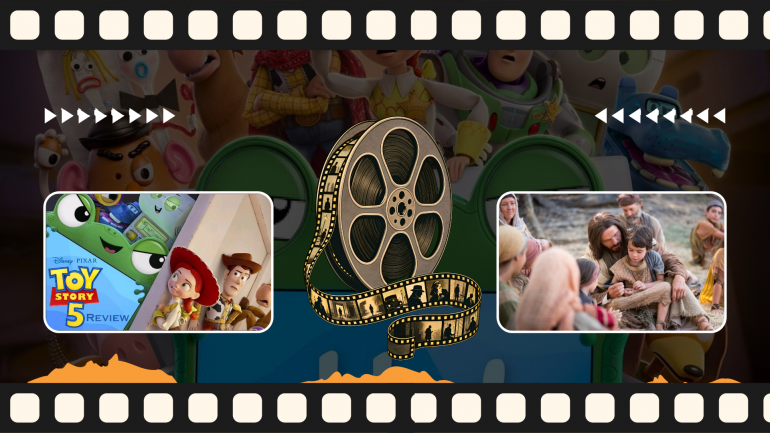
The film finds eight-year-old Bonnie struggling to make friends. She still loves toys and imaginative play, but the children around her increasingly live through screens. Into her life comes Lilypad, a cheerful frog-shaped tablet designed to help her connect with others. Jessie, Woody, Buzz and the old gang suddenly face a strange new question: What place does a toy have in a world where childhood itself is changing?
Without turning technology into a cartoon villain, the movie asks whether connection and friendship can really be downloaded.
Directed by Pixar veteran Andrew Stanton, with Kenna Harris as co-director and co-writer, the film places Jessie, wonderfully voiced by Joan Cusack, nearer the emotional centre. Tom Hanks returns as Woody, Tim Allen as Buzz, while Greta Lee gives Lilypad enough warmth that we cannot simply dislike her. Randy Newman also returns with the original score.
The film in a cute way makes an effort to make sure, adults remember how to play.
Watching Toy Story 5, I found myself remembering childhood, the simple joy of playing with little dinky cars, inventing roads that did not exist, crashes that somehow injured nobody, and stories whose budgets were approximately close to zero.
Then we grew up.
Life became calendars, passwords, notifications, appointments, deadlines and bills. Somewhere along the way, we became very sophisticated, and occasionally very miserable.
Jesus once placed a child in the middle of His disciples and said:
“Unless you turn and become like children, you will never enter the kingdom of heaven.”
(Matthew 18:3)
Jesus was not asking adults to become childish. He was inviting them to become childlike.
There is a difference.
The Greek idea behind “turn” speaks of a change of direction. Jesus is speaking about conversion. His disciples are worried about greatness, position and importance. Jesus responds by placing before them someone with little status: a child.
The Kingdom, He tells them, is received differently. Not through control, comparison and self-importance, but through trust, wonder, humility and dependence.
And strangely enough, that is exactly where Toy Story 5 becomes spiritual for me.
Lilypad offers Bonnie something enormously attractive: connection without much vulnerability. Technology can tell you who is online, who liked what, what everyone else is doing and what you might be missing. Before long, friendship can become performance.
Am I interesting enough?
Am I popular enough?
Why wasn't I invited?
Why does everyone else's life look happier than mine?
The film understands this anxiety remarkably well. It describes the danger of a culture that begins prioritizing image over being yourself, until “we’re losing something uniquely human between tabs.”
Perhaps that is not only Bonnie's problem.
Perhaps it is ours.
We scroll through other people's holidays while ignoring the person sitting beside us. We photograph dinner before tasting it. We know what someone we went to school with twenty years ago had for breakfast, but occasionally forget to ask our own family, “How are you?”
The problem is not technology itself, and wisely, the movie refuses to say that it is. Stanton, the director, himself has explained that the issue has no simple answer; screens are not disappearing, so the question becomes how we live with them well.
That is deeply Catholic.
Christianity does not normally begin by asking whether created things are evil. It asks whether they are rightly ordered.
Fire can warm a home or burn one down. Money can feed the poor or possess the person who possesses it. Technology can isolate us, but it can also bring together families separated by oceans.
The question is not simply, “Do I use technology?”
The better question is, “What is technology doing to my capacity to love?”
That is why one of the most beautiful ideas in the film comes when Buzz reminds the other toys of their mission: to make a child happy.
Suddenly, everything becomes simpler.
The toys are not fighting for relevance merely to survive. Their existence is meaningful because it is directed toward somebody else.
That sounds remarkably like a vacation.
Christian life begins to make sense when the question changes from “How important am I?” to “Whom am I called to love?”
Jessie herself must learn this. Because she has experienced abandonment before, she fears being replaced. Yet love cannot survive by clutching desperately at another person. Eventually, she must want what is good for Bonnie even when that goodness does not place Jessie at the centre.
That is Christian love: not possessing another, but willing their good.
And perhaps the film's most touching moments are the simplest, not spectacular rescues or elaborate adventures, but children finding the courage to actually meet, speak and play. Bonnie's journey toward Blaze becomes beautiful precisely because real friendship requires something an app cannot completely provide: “PRESENCE”.
Toward the end, imaginative play explodes again, even producing a wonderfully ridiculous toy wedding, with Mr. Pricklepants functioning as the bishop. Pixar apparently decided even the toy box needed clergy.
But underneath the joke is something surprisingly tender.
The toys have completed their mission when children begin imagining again.
Maybe Toy Story 5 is therefore not really asking us to throw away our phones.
It is asking us to recover something the phone can never manufacture: “WONDER”.
Perhaps becoming like children means remembering that life does not always need to be optimized. Sometimes we need to sit on the floor. Tell ridiculous stories. Laugh without checking who noticed. Look another human being in the eyes. Pray without multitasking. Receive life instead of constantly managing it.
Growing older is unavoidable.
Growing complicated is not.
And maybe the child Jesus places before us in Matthew's Gospel is quietly reminding us that the road toward God sometimes looks less like climbing upward and more like kneeling down, close enough to the floor to rediscover the things we stopped seeing.
So perhaps the question Toy Story 5 leaves us with is not merely whether our children still know how to play.
It is something more uncomfortable:
In becoming adults, becoming successful and becoming connected to everything, what simple, childlike part of ourselves have we allowed to become disconnected from God, from others, and from life itself?