
Valentine’s Day arrives each year with predictable enthusiasm. Shops turn red, restaurants fill, and love is packaged into cards, flowers, and carefully planned moments. For a brief time, it feels as though love is everywhere. Then the day passes, the decorations disappear, and ordinary life resumes.
Yet love—real love—is not a single day or a grand gesture. Love is a vocation. It is lived daily, often quietly, not performed for attention or applause.
We live in a world of constant connection. Messages arrive instantly. Faces appear on screens at any hour. And still, many people carry a quiet loneliness. Retreats, talks, podcasts, and relationship advice are everywhere, yet anxiety, burnout, and relational fatigue continue to grow.
Perhaps the problem is not a lack of information, but a lack of patience—for us, for one another, and for God’s timing.
The Weight of Endless Choice
Across the globe, online dating and hookup culture have radically changed how relationships begin—and sometimes, how they quietly end. Apps promise possibility, speed, and endless options. They show you profiles of people nearby, invite you to swipe right to “like” or left to “pass,” and make ghosting feel normal. Silence has become the easiest way to reject and disappearing the easiest way to avoid confrontation.
In the midst of all this choice, dissatisfaction and anxiety quietly rise. We start to believe that love should always be effortless, thrilling, and immediate. When difficulty appears, the instinct is often to avoid rather than to stay and work through it.
This mindset does not disappear after marriage. The habit of comparing, imagining alternatives, or withdrawing emotionally can persist. Even married couples face subtle temptations—dating apps, hookup culture, social media, or pornography—not always toward infidelity, but toward distraction and escape. It becomes easier to imagine a different life than to stay present to the one entrusted to us.
Catholic teaching reminds us that love is not sustained by novelty. It is sustained by fidelity, self-gifting, moral witness, and familial communion.
Dating as Discernment
The Church sees dating—or courtship—not as casual fun, but as a time of discernment: a chance to listen to God’s guidance. With the Holy Spirit’s help, it’s an opportunity to see what is truly good, wise, and life-giving in a relationship, and to ask honestly whether a man and a woman can journey responsibly together toward a shared vocation—ultimately, sacramental marriage.
Intentional dating asks couples to reflect honestly on important questions:
Do we share fundamental values?
Can we communicate openly?
Are we willing to face conflict rather than avoid it?
In practical terms, this discernment includes:
1. Alignment of values — faith, family life, finances, vocation, and long-term priorities
2. Honesty of intention — clarity about where the relationship is heading
3. Emotional maturity — the ability to face disappointment and difference with patience
4. Freedom and respect — allowing growth without pressure or manipulation
Dating becomes a school of love. It is less about impressing and more about discovering; less about avoiding discomfort and more about learning how to grow through it.
Chastity and the Education of Desire
Chastity is often misunderstood. In Catholic teaching, it is not denial but formation—learning how to desire well, and how to integrate our emotions, bodies, and reason according to God’s design.
For couples, chastity creates space. It allows trust and friendship to develop without confusion and helps love mature gradually. By slowing relationships down, chastity protects couples from mistaking intensity for intimacy or desire for commitment.
Far from opposing joy, chastity makes lasting joy possible. It teaches patience, respect, and self-mastery—qualities essential for any love that hopes to endure. As the Catechism reminds us, “Everyone needs to develop the virtue of chastity so as to live well in his or her own situation.”
Choosing Truth Over Performance
Today contemporary relationships often reward performance. Profiles are curated. Conversations are filtered. Vulnerability is delayed. Yet love cannot grow where truth is carefully managed.
Authenticity requires courage—the courage to speak honestly about wounds, expectations, and limitations, and to address concerns early rather than postponing them. Psychologically, this builds trust. Spiritually, it reflects integrity.
The Gospel reminds us that “the truth will set you free” (John 8: 32). This is as true in relationships as it is in matters of faith.
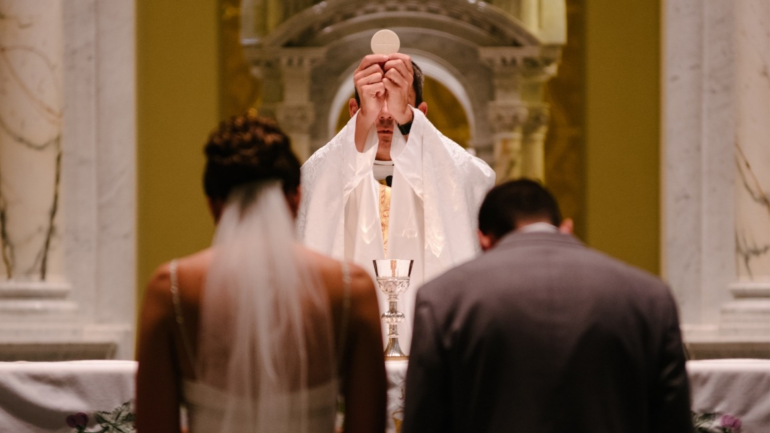
Marriage: A Daily Yes
Marriage is not the finish line of romance; it is where love demands the most intention. Couples today face pressures previous generations did not—constant distraction, financial stress, exhaustion, and the temptation of easy escape.
When intimacy weakens, the danger is often not dramatic betrayal but quiet withdrawal. Screens replace conversation. Fantasy replaces presence. Pornography, emotional distance, or constant distraction can slowly erode trust.
Healthy marriages are sustained by choice. Dating does not end with a wedding; it changes form. Love becomes choosing time together, protecting communication, praying together, and returning to one another after failure. It grows where forgiveness is practiced and effort is renewed.
For many couples, this includes:
1. Maintaining honest communication, especially when it is uncomfortable.
2. Protecting time together amid work, screens, and responsibilities.
3. Continuing shared prayer and spiritual growth.
4. Guarding intimacy by rejecting pornography and emotional infidelity.
5. Choosing patience and generosity in daily life.
The sacraments nourish these efforts, offering grace when human strength feels insufficient.
Love as Witness
Pope Francis, reflecting on St. Francis of Assisi, once said that the Gospel is preached most powerfully through the way we live. Faithful love does the same. In a culture where relationships are often treated as disposable, enduring love becomes a quiet yet powerful witness.
Pope Benedict XVI observed that the Church grows not by persuasion, but by attraction. The same can be said of love. Relationships marked by patience, humility, and fidelity speak more convincingly than words ever could.
Love Lived Every Day
Love is not sustained by emotion alone. Feelings change. Seasons shift. What remains is choice—the daily decision to stay present, to listen, to forgive, and to begin again.
Valentine’s Day may remind us of love once a year. But authentic love is lived every day, shaped by small, often unseen acts of faithfulness.
Whether preparing for marriage or living it or single, the call is the same: love is a vocation, not a performance. It asks for patience, truth, sacrifice, and grace.
The Quiet Courage of Commitment
In a world dominated by immediacy, comparison, and convenience, the Catholic vision of love remains quietly radical. Love is not measured in likes, purchases, or fleeting excitement. It is measured in commitment—lived out through faithfulness, presence, and generous self-gift.
This kind of love may never trend. But it endures.
And perhaps that is exactly what our restless world is longing for—not another promise or distraction, but the quiet assurance that love rooted in truth, fidelity, and grace is still possible.