

Archbishop Simon Poh Warns Against ‘Artificial Intimacy’ as he Marks 11th Episcopal Anniversary

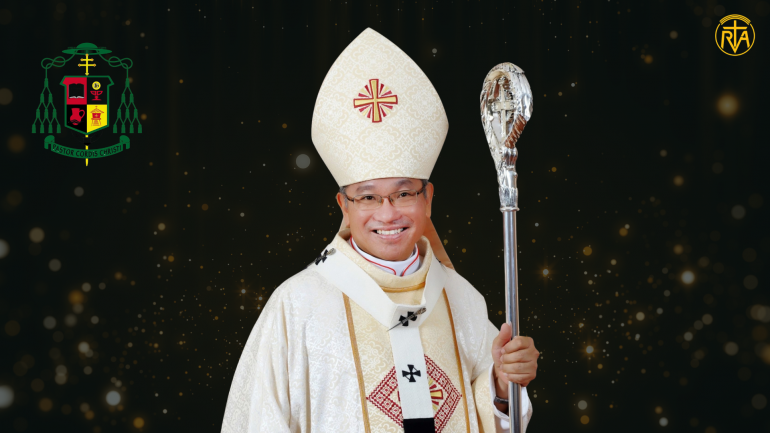
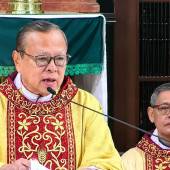
Archbishop Simon Poh of Kuching has warned against the growing use of artificial intelligence to create a sense of intimacy and companionship, saying technology must not replace genuine human relationships and personal encounters.
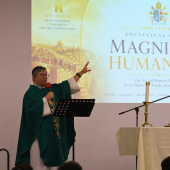
Reflecting on his pastoral ministry as he marked his 11th episcopal anniversary on September 24, Archbishop Poh said young people in particular are seeking belonging, identity and relationships at a time when AI is increasingly offering new forms of interaction.
Drawing on Pope Francis’ apostolic exhortation Christus Vivit, which emphasizes accompaniment and discernment, the archbishop said these require relationships between people.
As a bishop working with the young people, he shared that he found it easier to speak of AI by substituting the familiar words "Artificial Intelligence" with "Artificial Intimacy." He described the growing interaction between young people and AI-powered avatars or virtual companions as “Artificial Intimacy.” Such systems does provide a sense of closeness, companionship and emotional attachment as users converse with an AI persona and ask questions of life and even to seek solution and guidance in life decision.
“Underlying this sense of intimacy is actually an algorithm from a machine and not a real person,” Archbishop Poh said, distinguishing it from genuine personal relationships.
He referred to Pope Leo’s call for a human face behind artificial intelligence, emphasizing the importance of keeping human relationships at the center of pastoral engagement with young people and technology.
Archbishop Poh also reflected on the use of AI in preparing homilies, cautioning priests against relying directly on AI-generated material.
A homily, he said, must be the fruit of prayer, reflection and a living faith. Priests may use AI to help organize or give focus to their texts, but it should not replace their personal encounter with the Word of God.
“The first step has always to be the priest reading, listening and encountering the Living Word, seeking what the Lord is speaking to him and what He wants to say to His people,” he said.
If AI becomes a shortcut to preparing a homily, he warned, “it is the algorithm and thus a computer machine that is preaching to the congregation.”
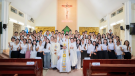
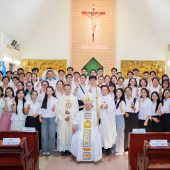
The archbishop marked his anniversary quietly, celebrating Mass with his office staff, followed by a simple lunch together. Later, he presided at the daily evening Mass in his cathedral.
He said the Archdiocese of Kuching generally marks anniversaries with larger celebrations only for the 25th, 40th and 50th anniversaries of ordination or religious profession. This practice, he said, helps avoid placing unnecessary financial burdens on parishioners.
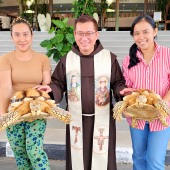
For an ordinary annual anniversary, parish communities are encouraged to attend Mass and pray for their priest. The parish can simply add a cake to the celebration for the priest.
“The focus is not to be on the priest but the community,” he said.
Archbishop Poh, who has led the Archdiocese of Kuching since 2015, is president of the Catholic Bishops’ Conference of Malaysia, Singapore and Brunei and chairs the Federation of Asian Bishops’ Conferences commission for evangelization.
He is also known for promoting care for creation and highlighting the traditional wisdom of Indigenous communities in caring for the earth.
Radio Veritas Asia (RVA), a media platform of the Catholic Church, aims to share Christ. RVA started in 1969 as a continental Catholic radio station to serve Asian countries in their respective local language, thus earning the tag “the Voice of Asian Christianity.” Responding to the emerging context, RVA embraced media platforms to connect with the global Asian audience via its 21 language websites and various social media platforms.
Latest News