


Australian Archbishop Delivers Inspiring “Go Forth” Message at Closing of Great Pilgrimage of Hope in Penang


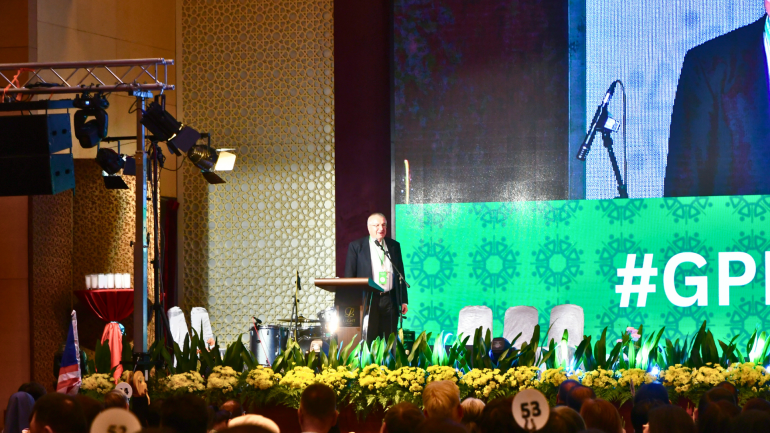
On the final day of the Great Pilgrimage of Hope, held from November 27 to 30 in Penang, participants were treated to a reflective and uplifting address by Archbishop Christopher Prowse of the Archdiocese of Canberra-Goulburn. Speaking on the theme “Go Forth” (Matthew 28:18-20), Archbishop Prowse delivered the closing message for this landmark gathering, emphasizing the universal call of Christians to live out their baptismal faith.
Archbishop Prowse began by acknowledging the unusual circumstance of an Australian bishop speaking at an Asian pilgrimage, noting with gentle humor: “It’s been lovely being with you. Just in case you didn’t appreciate it, I’m not Asian. How did I get here? Many of you wondered if I was representing the Australian Catholic Bishops or the Federation of Asian Bishops. The answer is, not really. But perhaps, in being invited to speak at the conclusion, it reminds us that ‘Go Forth’ is not just for Asia, but for the whole world.”
He used this opening to reflect on the deep connections between the Church in Asia and Oceania. Despite vast distances and differences, both regions share the life-giving waters of baptism that unite all Christians in Christ. Drawing on personal experience, Archbishop Prowse recounted returning to his home parish in Melbourne to renew his baptism at the font where he had been baptized decades earlier, reflecting on baptism as “the gateway sacrament” that allows the faithful to fully participate in the life of the Church.
Five Priorities for Synodal Going Forth
The Archbishop structured his talk around five practical priorities for carrying the Gospel in a synodal, communal manner. These principles, he explained, provide guidance for both clergy and laity as they seek to evangelize and serve their communities.
1. Start with Vulnerability, Not Triumph
Archbishop Prowse emphasized beginning ministry from places of emptiness, tragedy, or personal need rather than comfort or success. “Start with your tragedies, not with your trophies. Start where you feel dumped, not where you feel replete in God,” he said. He shared moving examples from participants who had experienced personal loss, family opposition, or cultural challenges, highlighting the power of empathy and solidarity.
2. Surrender to the Spirit
Using Mary’s fiat as a model, the Archbishop urged participants to surrender their lives to the grace of the Holy Spirit. “Not my will, but yours be done,” he said, reminding attendees that genuine proclamation flows from a daily commitment to God, not from mere cultural participation. He encouraged Christians to embrace their baptism actively, moving beyond passive or “cultural” Catholicism into a living, dynamic faith.
3. Prayer and Contemplation
Archbishop Prowse highlighted the importance of silence, stillness, and simplicity, calling these the “three S’s” of prayer. By listening to God’s whisper in daily life, Christians can discern how best to serve their communities and bear witness to Christ.
4. Propose, Don’t Impose
Faith sharing, he explained, must always respect freedom. Catholics are called to propose Jesus to the world rather than impose beliefs or practices. The Archbishop emphasized non-verbal witness through lived example, citing architecture, artistic expression, and the beauty of creation as ways to point others to God without coercion. He reminded attendees that building God’s kingdom is a process, akin to planting seeds that grow over time.
5. Serving Christ in the Poor
Drawing on Pope Leo XIV’s recent apostolic exhortation, Archbishop Prowse emphasized that the poor are “the very flesh of Christ.” Proclamation, he stressed, requires a preferential option for the marginalized, the hungry, the imprisoned, and the vulnerable. “It’s not just a matter of doing charity at the end of the line. It’s living the Gospel where Christ is most present: in those who are suffering,” he said, urging participants to embrace this integral vision.
Reflections on Mary and Synodality
Archbishop Prowse drew inspiration from Mary’s encounter with the Angel Gabriel and her subsequent visitation to Elizabeth, illustrating the synodal nature of the Church. “The first step is to get up. The second is to listen. The third is to go. Mary models this perfectly: active, attentive, and outgoing. Even when she may have felt uncertain or ‘dumped,’ she went forth to serve and bear witness,” he said.
He also reflected on the Emmaus narrative as an example of communal proclamation, emphasizing that faith grows in encounter with others and in shared experiences. Archbishop Prowse encouraged all participants to engage in ministry not as individuals, but as communities, walking together, listening together, and supporting each other in faith.
A Global Call
Throughout his talk, Archbishop Prowse wove together personal anecdotes, Scripture, and pastoral insights to underscore a universal message: the call to “Go Forth” extends beyond regional or national boundaries. He expressed gratitude to Asian Catholics who have emigrated to Australia, bringing faith, family life, and vibrant ecclesial movements with them. “You have already gone forth, and your witness enriches the Church worldwide,” he said.
Concluding with a prayer of surrender adapted from Pope Francis’ Evangelii Gaudium, Archbishop Prowse invited participants to recommit their lives to Christ and the service of the Church. He led the assembly in invoking the intercession of Mary, the Mother of Synodality, ensuring that the closing moment of the Great Pilgrimage of Hope was one of reflection, unity, and renewed commitment.
As the Pilgrimage came to a close, participants left Penang inspired by Archbishop Prowse’s message, equipped with practical principles for living out their baptismal calling, and mindful that God’s kingdom requires courage, creativity, and deep faith in the transformative power of the Gospel.