

Become the Landing Pad for God’s Word, Irish Friar Tells Delegates at Digital Missionary Assembly


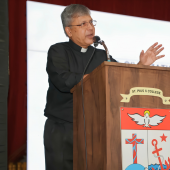
Digital missionaries should allow God to work through their personalities, gifts and lived experiences, becoming a “landing pad” through which the Word can reach others, said an Irish Franciscan friar at the First Asian Catholic Digital Missionary Assembly on September 11.
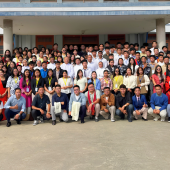
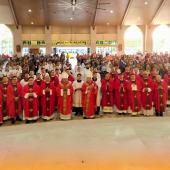
Fr. Columba Jordan, CFR, addressed more than 100 Catholic digital communicators and missionaries from across Asia during the first afternoon session of the four-day assembly at the Radio Veritas Asia (RVA) headquarters in Quezon City, Philippines.
His session, titled “From Ego to Authentic Witness,” explored how digital missionaries can move beyond self-promotion and fear of visibility to become authentic witnesses who point people to the living Christ.
The assembly, organized by the Federation of Asian Bishops’ Conferences Office of Social Communication (FABC-OSC) and RVA, in partnership with the Vatican Dicastery for Communication through the Fully Present Network, is being held from Sept. 10 to 13 under the theme “Influencers to Witnesses: Synodal Way for Digital Mission in Asia.”
Fr. Jordan, an Irish Franciscan Friar of the Renewal based in Limerick, Ireland, is known for his Little by Little video podcast and his work in digital evangelization and faith formation.
Reflecting on his own entry into digital content creation, Fr. Jordan said one of his first concerns was vanity and the temptation to make his ministry about himself. He linked this struggle to the words of St. John the Baptist: “I must decrease, and he must increase.”
But he also warned against the opposite danger, becoming so afraid of ego that one hides the gifts God has given.
“If you have that capacity, you put a camera in front of you, and you just become alive; that's a rare gift,” he said.
The answer, he said, is not to erase one's personality but to allow God to work through it.
Fr. Jordan described the Christian communicator as a kind of “landing pad” for God's Word. Pointing to the Virgin Mary, he said God chose to work through her humanity in the Incarnation. In the same way, each missionary brings unique experiences, gifts and personality through which the Gospel can be communicated.
“The Gospel always speaks through somebody,” he said.
Authentic witness, however, begins not with asking what to tell others but with allowing the Gospel to challenge the communicator personally.


Fr. Jordan recalled how his preaching had once become focused on telling others what they needed to change. A fellow friar challenged him to replace the question, “God, what do you want me to say to them?” with “What are you saying to me?”
That shift enabled him to speak from personal encounter rather than simply instructing others.
He urged digital missionaries to apply the same principle before posting or producing content: “How has this changed me? Has the Gospel actually taken flesh in my life?”
He also stressed vulnerability in communicating with young people, who can quickly recognize when someone is merely “talking at them.” Authentic witness requires sharing something real, including personal struggles, failures and experiences of faith.
Drawing on St. John Paul II's Theology of the Body and its understanding of the human person as a “gift of self,” Fr. Jordan said digital missionaries are called not merely to produce content but to offer something of themselves through which others can encounter Christ.
He pointed to the Gospel of Luke as another example of the Gospel being communicated through a particular human voice. Luke gathered what had been handed down and wrote from his own perspective and understanding, while the Church recognizes the work of the Holy Spirit through him.
Likewise, digital missionaries should communicate not only what Jesus did in the past but how Christ is alive and acting in their lives today.
“Jesus is alive today,” Fr. Jordan said. “We get to encounter him again today. And when we witness out of that, that's alive.”
He encouraged participants to notice what in Scripture or in their faith experience genuinely moves, challenges or fascinates them. Such moments, he said, can reveal where God is working and provide authentic material for digital witness.
Fr. Jordan recalled recording a video about St. Thérèse of Lisieux in which he became emotional while speaking. The moment was retained in the final video and became one of his most successful recordings.
The experience showed him that people respond when a communicator is genuinely moved by what he or she is sharing.
The movement, he said, is from ego and fear to awareness of God's presence, personal encounter and finally authentic witness.
Digital missionaries become witnesses of the living Jesus when they speak from that encounter and allow others to see how Christ is present and active in their lives.
The assembly continues in Quezon City through September 13, bringing together Catholic digital communicators from across Asia to reflect on synodality, authentic witness, digital evangelization and the Church's mission in the digital world
Radio Veritas Asia (RVA), a media platform of the Catholic Church, aims to share Christ. RVA started in 1969 as a continental Catholic radio station to serve Asian countries in their respective local language, thus earning the tag “the Voice of Asian Christianity.” Responding to the emerging context, RVA embraced media platforms to connect with the global Asian audience via its 21 language websites and various social media platforms.
Latest News