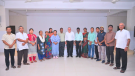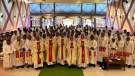
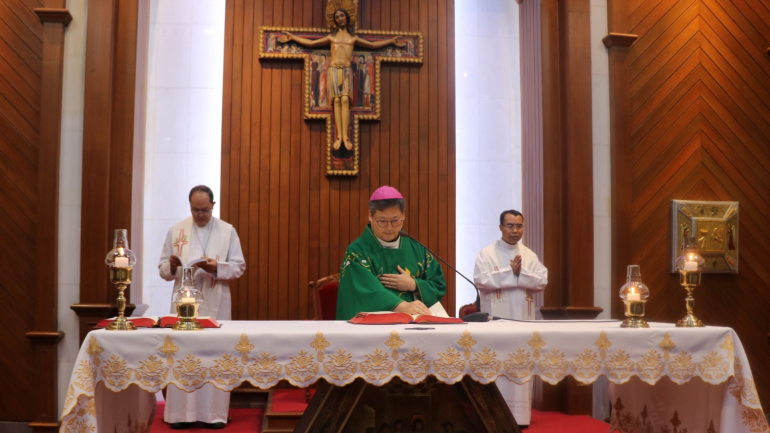
The synodal journey must move beyond documents and become a renewal of relationships, decision-making and mission, Archbishop Peter Soon-Taick Chung of Seoul told members of Asian national synod teams during a Eucharistic celebration marking the close of their first day of meeting.
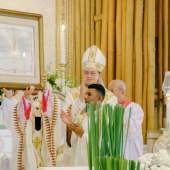
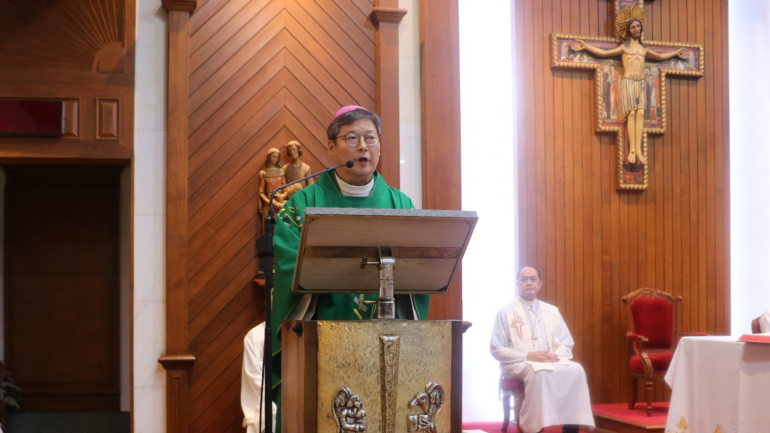
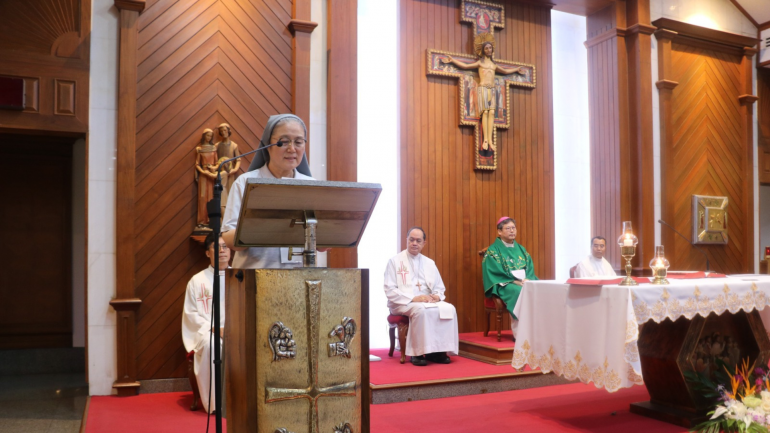
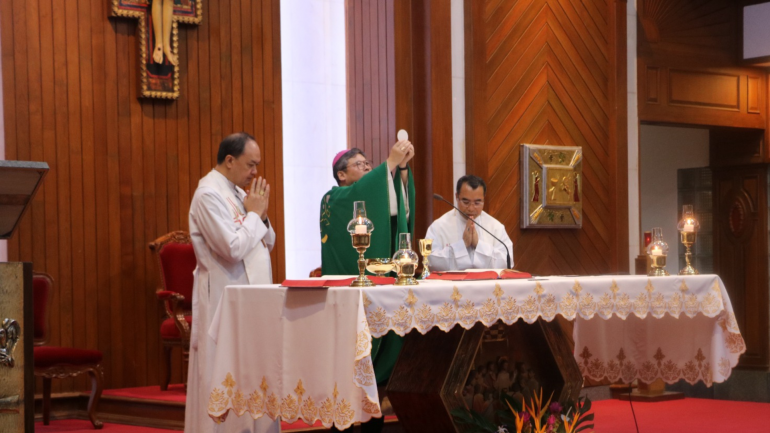
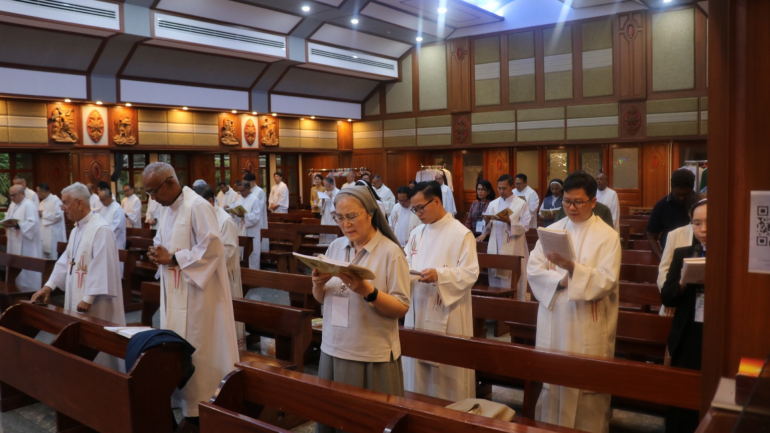
Archbishop Chung presided at the Mass on Sept. 1 in St. Michael Chapel at the Baan Phu Waan Pastoral Training Center in Bangkok. Concelebrating were Cardinal Pablo Virgilio David, vice president of the Federation of Asian Bishops’ Conferences (FABC), and the Auxiliary Bishop of Yangon, Myanmar, along with other clergy.
The liturgy, which concluded the first day of the three-day meeting, was animated by delegates from Vietnam, who led the hymns during the celebration.
In his homily, Archbishop Chung said synodality means that the entire People of God journey and work together under the guidance of the Holy Spirit. While the Synod of Bishops that began in 2021 reached an important stage with the publication of its Final Document in 2024, he emphasized that the synodal journey itself has not ended.
“A synod cannot end with a document,” Archbishop Chung said. Rather, it must lead to a renewal of relationships, attitudes, words and the life of the Church.
He outlined four areas that can help the Church live the synodal spirit during the current implementation phase.
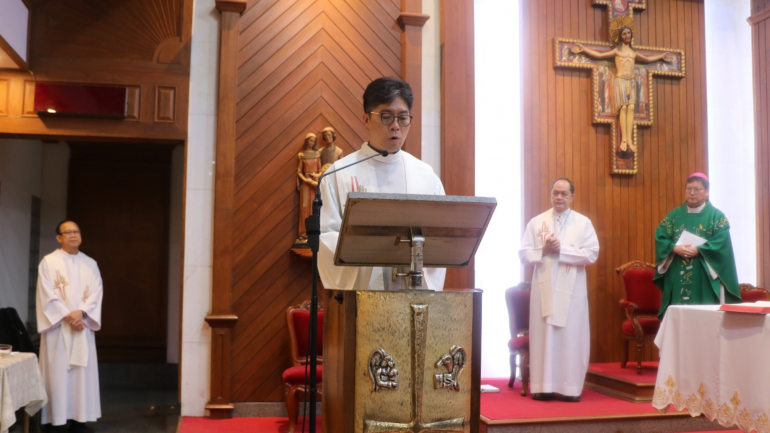
First, synodality requires a conversion of relationships and attitudes. Archbishop Chung said conversion should not be understood only as an individual change in faith. It must also transform how people relate to one another, how the Church exercises governance and how decisions are made.
The Church has legitimate authority and different ministries, he said, but a synodal approach calls people to respect and listen to one another and to discern together under the guidance of the Holy Spirit.
“A beautiful expression of a synodal church is a church that listens before making decisions, seeks to understand before judging, and prays and discerns together before reaching a decision,” he said.
Second, he emphasized learning “Conversation in the Spirit” through genuine listening. People often prepare their response or counterargument while another person is still speaking. Synodal listening, however, requires an openness to hearing what the Holy Spirit may be saying through another person.
The purpose is not to impose opinions or defeat another person in discussion, but to seek God’s will together.
Third, Archbishop Chung called for a culture of transparency and accountability. Decisions should be accompanied by an explanation of why they were made and how they were reached. Without such openness, he warned, misunderstandings can develop into distrust and eventually weaken communion within the Church.
Patience, kindness and willingness to explain decisions, he said, can help build genuine trust among bishops, priests and parishioners.
Finally, he stressed that synodality must lead to mission. Listening and discernment are not simply ways of improving relationships within the Church. They are intended to help the Church proclaim the Gospel.
A synodal Church, he said, must also listen to people beyond its own structures, particularly “the lonely, the wounded, and those who have left the church,” and bring them the joy of the Gospel.
“A synodal church is a church that works together, but it is also a church that goes forth together into the world,” Archbishop Chung said.
He encouraged the participants to begin with small changes: listening until others have finished speaking, resisting immediate judgment when opinions differ, and listening carefully before making decisions.
As the first day of the Asian synod teams meeting concluded, he invited participants to pray for the grace to leave behind old ways and become renewed disciples who listen, discern and work together in the Holy Spirit for the mission of the Church.
Radio Veritas Asia (RVA), a media platform of the Catholic Church, aims to share Christ. RVA started in 1969 as a continental Catholic radio station to serve Asian countries in their respective local language, thus earning the tag “the Voice of Asian Christianity.” Responding to the emerging context, RVA embraced media platforms to connect with the global Asian audience via its 21 language websites and various social media platforms.
Latest News