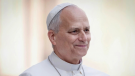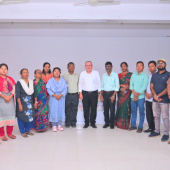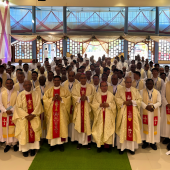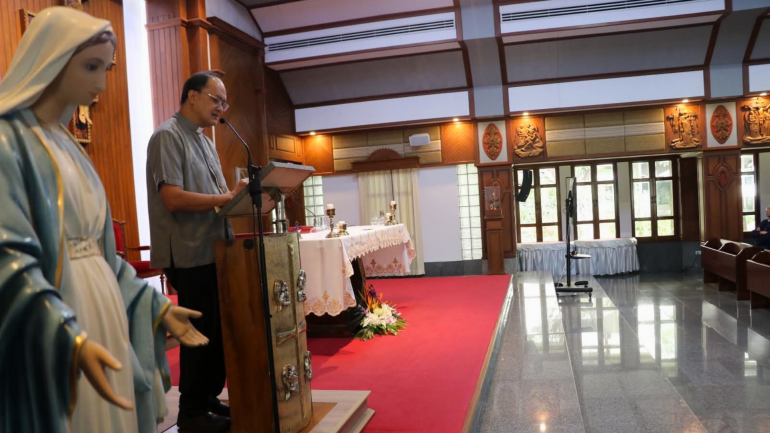
Cardinal Pablo Virgilio David, Chairman of the FABC Commission for Synodality, called on National Synod Teams from across Asia to embrace a new model of Church leadership: moving from “walking ahead” of people to learning to “walk with” them.
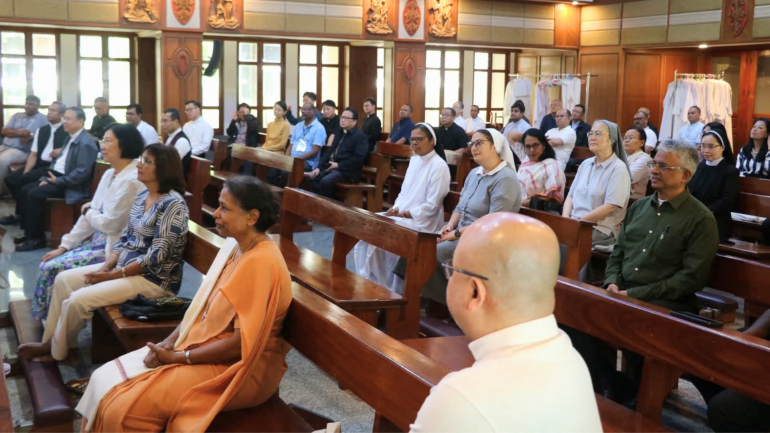
Cardinal David made the appeal during an hour-long spiritual conference at St. Michael Chapel, Baan Phu Waan, Samparan, Thailand, on September 1, for participants attending the meeting of National Synod Teams. His reflection drew on the experience of the 12th Plenary Assembly of the Federation of Asian Bishops’ Conferences (FABC), held in Jakarta in July.
He described “from walking ahead to walking with” as the second of three movements of conversion emerging from the FABC Plenary Assembly.
Cardinal David said Church leaders are often expected to know where people should go, provide direction and offer answers. Synodality, however, calls for a different understanding of leadership.
“The synodal Church asks for another image: the leader who also knows how to walk with,” he said.
Synodality does not abolish ministries or authority, Cardinal David explained. Rather, it changes how authority is exercised, calling leaders to create conditions in which the People of God can listen together for an answer that no individual possesses alone.
This requires humility, he said.
“Leadership in the Church is not simply knowing where people should go,” Cardinal David said. “Sometimes it means walking beside them long enough to recognize where the Spirit is already leading them.”
For National Synod Teams, this means going beyond organizing consultations or implementing synodal programs. Their role is also to help local Churches develop a culture of listening, discernment and shared responsibility.
Cardinal David described listening as a spiritual discipline. Listening merely to prepare an answer keeps a person in control. Listening to understand allows the other person to affect us. But listening together for what the Spirit is saying can lead to conversion.
A person who believes he or she is accompanying another may discover that the other person is actually being used by God to accompany them, he said.
Cardinal David connected this approach with Conversation in the Spirit, saying its deepest purpose is not simply to make meetings more peaceful or efficient but to cultivate spiritual availability.
He pointed to the Gospel account of the disciples on the road to Emmaus as a model. The risen Jesus allows the disappointed disciples to tell their story, listens to them and walks with them, even while they are moving in the wrong direction. Only later are their eyes opened.
For Cardinal David, accompaniment therefore requires patience. Leaders may believe they know the right direction, but immediately correcting others can close the possibility of genuine listening.
“Walking with” creates space for conversion, not only for those being accompanied but also for those who accompany them.
The cardinal challenged National Synod Teams to ask whether their listening actually allows them to be changed by what they hear.
This is particularly important for the Church in Asia, where cultures, languages, religions and social realities vary widely. Synodality must not become merely another method of organizing Church activities while leaving relationships between leaders and the People of God unchanged.
Cardinal David also envisioned National Synod Teams as bridges helping bishops and the People of God encounter one another through genuine listening and helping clergy and laity move beyond suspicion toward co-responsibility.
In Asia’s religiously plural societies, this bridge-building also extends to relationships with people of other religions.
For Cardinal David, the leadership demanded by synodality is not leadership that abandons direction. It is leadership humble enough to walk alongside the People of God, listen deeply and discern together where the Holy Spirit is leading.
Radio Veritas Asia (RVA), a media platform of the Catholic Church, aims to share Christ. RVA started in 1969 as a continental Catholic radio station to serve Asian countries in their respective local language, thus earning the tag “the Voice of Asian Christianity.” Responding to the emerging context, RVA embraced media platforms to connect with the global Asian audience via its 21 language websites and various social media platforms.
Latest News