The Church’s mission is not only to ask what it must do, but also to recognize what God is already doing.
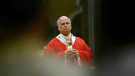
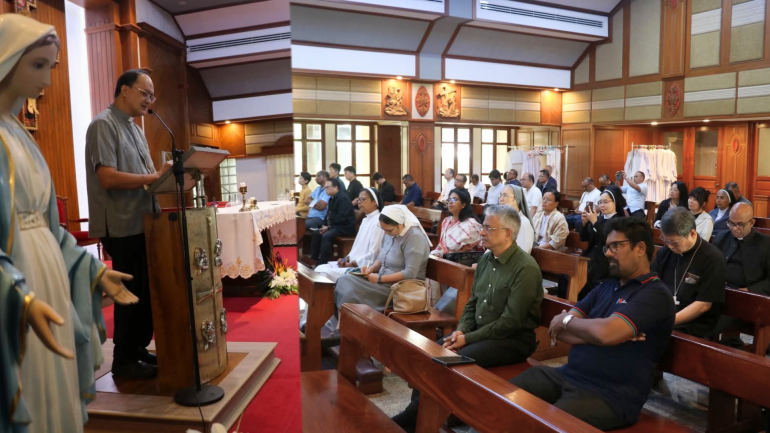
Cardinal Pablo Virgilio David, Chairman of the Federation of Asian Bishops’ Conferences (FABC) Commission for Synodality, posed this challenge to members of National Synod Teams from across Asia during a spiritual conference at St. Michael Chapel, Baan Phu Waan, Samparan, Thailand, on September 1.
The hour-long conference drew on the experience of the FABC’s 12th Plenary Assembly, held in Jakarta, Indonesia, in July.
Cardinal David identified a key movement of synodal conversion: from wanting to do great things for God to recognizing the greater things God is already doing.
“What is God already doing among us that we have not yet learned to see?” he asked.
Cardinal David began with Jesus’ words to Nathanael: “You will see greater things than these.” For him, the promise points to a missionary attitude that begins not with action but with attentive listening and discernment.
Church leaders can easily become preoccupied with programs, structures and pastoral initiatives. Yet synodality calls the Church first to learn to see.
Cardinal David described this as developing “contemplative eyes,” eyes capable of recognizing God’s presence and action in places where Christians may not expect to find them.
He illustrated this through the biblical story of Jacob at Bethel. After dreaming of a stairway connecting earth and heaven, Jacob awakens and says: “Surely the Lord is in this place and I did not know it!”
The same realization, Cardinal David suggested, can happen when the Church truly listens to communities and people.
God may already be at work in a community, speaking through a person or present amid painful experiences. The Church’s task is not always to initiate God’s action, but to recognize and accompany it.
This has important implications for synodality. If synodality is treated simply as a program to implement, the Church may overlook movements of the Spirit already emerging among the People of God. Contemplative listening, however, can reveal these quiet signs.
Cardinal David connected this vision with the FABC’s call for the Church in Asia to be a bridge-builder. This means fostering genuine listening between bishops and the People of God, encouraging co-responsibility between clergy and laity, and creating spaces where women, young people, the poor and marginalized are genuinely heard.
In Asia’s religiously plural societies, the same attitude can shape interreligious encounter. Christians can approach Buddhist, Muslim, Hindu and other religious neighbors not simply as objects of mission, but as fellow human beings whose experiences may also reveal God’s presence.
Cardinal David said this requires surrendering the desire to control outcomes. The Church cannot manufacture the connection between heaven and earth. In Jesus Christ, God has already entered human vulnerability, suffering and brokenness.
This points to another dimension of synodal conversion: from asking “What should we do?” to asking “Where is the Spirit already moving?”
Cardinal David urged National Synod Teams to return to their local Churches with renewed eyes ready to recognize the Spirit’s quiet movements, see bridges where they once saw boundaries, and discover the “greater things” already taking place.
He concluded with Jesus’ invitation to Nathanael: “Come and see. You will see greater things.”
Radio Veritas Asia (RVA), a media platform of the Catholic Church, aims to share Christ. RVA started in 1969 as a continental Catholic radio station to serve Asian countries in their respective local language, thus earning the tag “the Voice of Asian Christianity.” Responding to the emerging context, RVA embraced media platforms to connect with the global Asian audience via its 21 language websites and various social media platforms.
Latest News