

'Conversion, Conversion, Conversion': Cardinal Ignatius Suharyo's Challenge to Asian Church

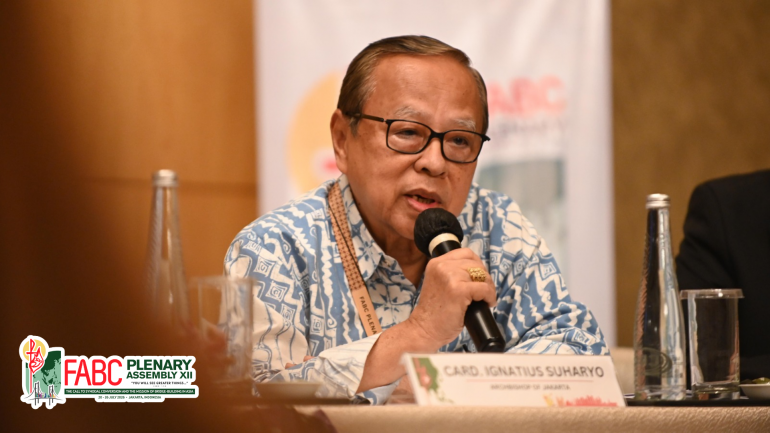
"Conversion, conversion, conversion."
Those three words captured the central message of Cardinal Ignatius Suharyo, Archbishop of Jakarta, as he reflected on the discussions of the 12th Plenary Assembly of the Federation of Asian Bishops' Conferences (FABC), saying that the Church's synodal journey begins with the conversion of hearts before any change in structures.
Speaking to national and international media during the assembly's second press conference on July 24 at the Leatris Media Room of Hotel Mulia, Cardinal Suharyo said the weeklong gathering had consistently returned to one conviction: authentic renewal starts with personal and communal conversion.
"The theme of this 12th Plenary Assembly is synodal conversion," Cardinal Suharyo said. "It is also an invitation for our brothers and sisters who are in strategic positions to exercise synodal conversion."
While many of the assembly's discussions addressed Asia's social and economic challenges, Cardinal Suharyo stressed that the bishops were not engaging in politics.
"Our meeting has nothing to do with politics," he said. "We are speaking about a moral calling."
Rather than offering political solutions, he explained, the Church seeks to awaken the moral conscience of those entrusted with leadership and public responsibility.
For Cardinal Suharyo, conversion is not merely a personal spiritual experience but one that should shape the way societies are governed. He pointed to the principles of Catholic Social Teaching as essential guides for those exercising leadership.
The first is respect for the dignity of every human person.
Across many parts of Asia, he said, human dignity is still not sufficiently protected. Genuine conversion therefore requires placing every person at the center of social, economic, and political life.
A second priority is the common good, particularly in a continent where millions continue to experience poverty.
Cardinal Suharyo noted that the widening gap between rich and poor remains one of Asia's greatest challenges and calls for renewed solidarity with those on the margins.
He also identified corruption as a serious moral concern.
Beyond its economic consequences, corruption deprives people of opportunities, weakens public trust, and undermines justice. Addressing it, he said, requires more than institutional reforms; it demands a conversion of conscience.
Environmental responsibility was another recurring theme.
Cardinal Suharyo linked ecological destruction to human greed, observing that the poorest communities often suffer the greatest consequences of environmental degradation. Caring for creation, he said, is inseparable from protecting human dignity and promoting the common good.
As he summarized the assembly's discussions, Cardinal Suharyo returned to the phrase that had become the hallmark of his remarks.
"Conversion, conversion, conversion."
The repetition, he explained, reflected the bishops' shared conviction that every lasting transformation—within the Church or in society—must begin with a change of heart.
"I feel, as a citizen of Indonesia and as a citizen of the Church, this is an invitation for everyone," Cardinal Suharyo said.
He added that the invitation extends beyond Catholics to all people serving in positions of responsibility, whether in government, business, education, or civil society. They are called to make decisions rooted in respect for human dignity, the common good, solidarity with the poor, integrity, and care for creation.
As the FABC Plenary Assembly continues its discernment on synodality, Cardinal Ignatius Suharyo's simple yet emphatic appeal offered one of its clearest messages: the future of the Church—and of society—depends not first on new programs or policies, but on hearts willing to embrace the path of conversion.
Radio Veritas Asia (RVA), a media platform of the Catholic Church, aims to share Christ. RVA started in 1969 as a continental Catholic radio station to serve Asian countries in their respective local language, thus earning the tag “the Voice of Asian Christianity.” Responding to the emerging context, RVA embraced media platforms to connect with the global Asian audience via its 21 language websites and various social media platforms.
Latest News