


“Do I have Your Permission to Change my Car Tires?” FABC Official Reflects on How to Make Laity Own the Church

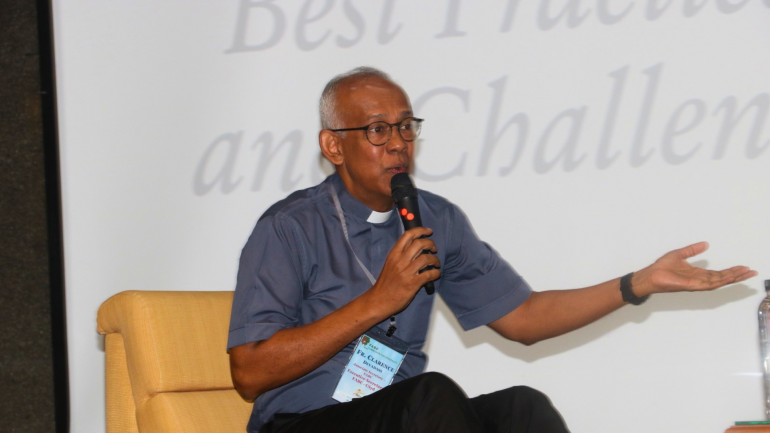
“Do I have your permission to change my car tires?”
The seemingly simple question became a practical lesson in synodality for Fr. Clarence Devadass, who used the experience to illustrate how the Church can help lay Catholics take genuine responsibility for parish life rather than remain merely recipients of decisions.
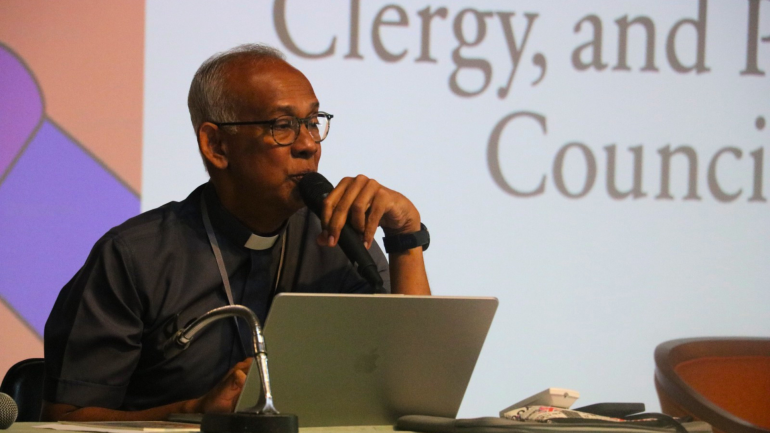
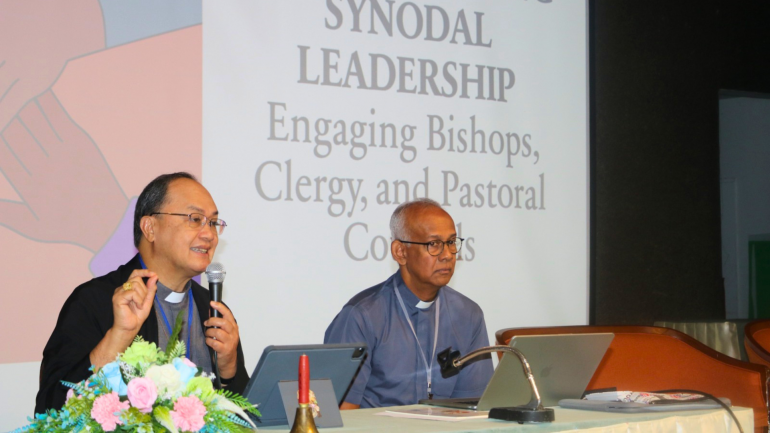
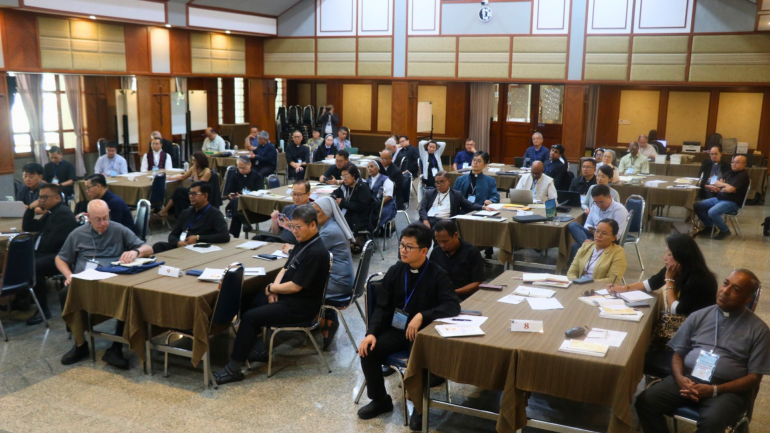
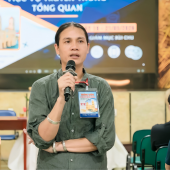
Fr. Devadass, executive secretary of the Commission for Synodality, shared the experience during the second session on the second day, Sept. 2, of a three-day meeting of national synodal teams at Baan Phu Waan in Bangkok. Held at the Joseph Nattaya Conference Hall, the session, titled “Strengthening Synodal Leadership: Engaging Bishops, Clergy, and Pastoral Councils,” was led by Fr. Devadass and Pablo Virgilio Cardinal David, Vice President of the Federation of Asian Bishops’ Conferences (FABC).
While Cardinal David focused on engaging bishops in the synodal process, Fr. Devadass addressed the challenge of engaging clergy and pastoral councils.
He said one of the clearest findings from reports prepared for the Synod in Rome was that the strongest resistance to synodality came from clergy.
Some priests continue to question whether synodality is still necessary, while others see it as another Church program requiring additional meetings, consultations and activities.
Fr. Devadass said this resistance is understandable because priests are already carrying heavy pastoral responsibilities, from celebrating Mass and the sacraments to hospital and home visits and accompanying parish communities.
The way forward, he said, is to help priests understand that synodality is not another program to add to their workload.
“Synodality is not a management program,” he said. Rather than creating new activities, priests can incorporate synodal spirituality into what they are already doing.
The change, therefore, is often not what the Church does, but how it does it.
Simple practices can make parish ministry more synodal, including the way priests celebrate Mass, conduct home visits, lead presbyteral meetings and accompany basic ecclesial communities.
Fr. Devadass cited his own practice of standing at the church entrance after Sunday Mass to greet people.
A few seconds of acknowledging people, saying hello or thanking them for coming can make parishioners feel that they are seen and heard, he said.
Such ordinary encounters can help create a Church culture based on listening and accompaniment rather than administration alone.
He then turned to pastoral councils, emphasizing that many Asian dioceses already possess structures that can support synodal participation.
Parish pastoral councils and finance councils, however, do not automatically make a parish synodal simply because they exist. The key is whether they are given a meaningful role and whether parishioners are helped to recognize their responsibility for the Church.
Fr. Devadass recalled serving a small parish where the weekly Sunday collection was less than US$20. He established a parish finance council not because the parish had substantial resources to manage, but because he wanted parishioners to understand that the resources of the parish were their responsibility.
The lesson became clearer when he needed to replace the tires on his car. Because he traveled about 100 kilometers each week to reach the parish, the tires had become worn.
He asked the finance council, “Do I have your permission to change my car tires?”
The council members were surprised. They told him that he did not need to ask their permission to use parish funds for such a basic necessity.
But for Fr. Devadass, that reaction showed that the council was beginning to understand its responsibility.
He had deliberately involved its members in financial decisions so that they would not see themselves merely as people carrying out tasks assigned by the priest. They were stakeholders in the life of the parish.
The same principle, he said, should guide pastoral councils more broadly.
Too often, Church structures become focused on completing activities, meeting targets and organizing events. A genuinely synodal pastoral council should instead ask how its work contributes to the renewal of parish life.
Synodality also does not mean that priests or bishops surrender their responsibility to make decisions.
Someone ultimately has to make a decision, Fr. Devadass said. The important question is how the Church arrives at that decision — whether people have been listened to, whether different experiences have been considered and whether members of the Church have been given meaningful opportunities to participate in discernment.
He cautioned against waiting for changes in canon law or other structural reforms before practicing synodality.
The synodal spirit can already be lived by recognizing the dignity and responsibility of all baptized members of the Church.
For clergy, this means seeing synodality not as an additional burden but as something that can make their existing ministry more effective. For pastoral councils, it means moving beyond consultation and task completion toward genuine participation, accountability and shared responsibility.
Fr. Devadass challenged national synodal teams to identify which area — bishops, clergy or pastoral councils — requires the most urgent attention in their respective countries.
He asked participants to identify one concrete action that could be undertaken within six months, stressing that it should be practical, achievable and sustainable.
For the Church in Asia, he suggested, the task is not simply to create more structures or programs, but to nurture a culture in which clergy and laity recognize that they are together responsible for the life and mission of the Church.
Radio Veritas Asia (RVA), a media platform of the Catholic Church, aims to share Christ. RVA started in 1969 as a continental Catholic radio station to serve Asian countries in their respective local language, thus earning the tag “the Voice of Asian Christianity.” Responding to the emerging context, RVA embraced media platforms to connect with the global Asian audience via its 21 language websites and various social media platforms.
Comments

Latest News




I was blessed to have a few " In the Spirit encounters with you" at the FABC October 2022 General Conference in Bangkok and the assembly of religious formators in Malayasia later.
I have a visual memory of the Sunday you spent with your parishioners totally immersed in collective synodal activities on that sunny Sunday.
With you in prayer as you continue to inspire the church in Asia. Prayerful wishes.
- Reply
Permalink