

East Flores Catholics Celebrate All Saints’ Day through Ancestral Rituals and Traditional Dance


Catholics in Nurabelen, a village in East Flores Regency in Indonesia’s East Nusa Tenggara province, celebrated All Saints’ Day on November 1 with an inculturated Mass that brought together Catholic liturgy, ancestral rituals and traditional performances.
The two-day celebration, held from October 31 to November 1, 2026, highlighted how the community preserves its cultural heritage while expressing its Catholic faith and strengthening relationships among residents.
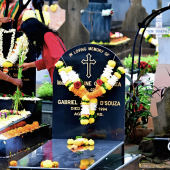
Activities began on October 31 at Old Nurabelen Village, a historic settlement near the summit of Mount Lewotobi Perempuan. The traditional ceremony was led by the Tuan Tanah, or customary land custodian, of the Puka clan.
The ritual began with the welcoming of ancestors at their former residences, expressing the community’s connection with previous generations. It continued with the slaughtering of pigs and goats and traditional prayers known as Koda Adat, including a ritual described locally as feeding the land and the ancestors.
For the people of Nurabelen, these practices express gratitude to God, whom they call Lerawulan, and prayers for protection, peace and well-being.
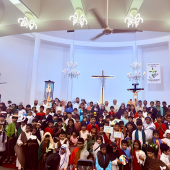
The community’s prayers and hopes were brought into the Catholic celebration the following day, when the Solemnity of All Saints was marked with an outdoor Eucharistic celebration in a garden on the outskirts of the village.
Fr. Moses Watan Boro, parish priest of St. Joseph Lewotobi Parish, presided over the Mass.
In his homily, Fr. Moses said holiness is a calling for everyone, regardless of their position or status in the Church. He encouraged the faithful to pursue holiness by listening to God’s word and putting it into practice.
He also urged residents to preserve the values inherited from their ancestors, particularly brotherhood, family solidarity, love and local wisdom.
He said ancestral heritage should not be limited to the performance of traditional rituals but should continue to guide people's everyday lives.
Custom, government and religion
Following the Mass, residents gathered for a community reception.
Hugo Puka, customary custodian of the Puka clan, encouraged residents to sustain the annual celebration as an important inheritance that expresses gratitude and the community’s hopes for protection and well-being.
Nurabelen Village Head Lambertus Bura Puka said the local administration was willing to facilitate future celebrations, while emphasizing that decisions should reflect the wider community’s agreement.
One consideration is whether future celebrations should return to Old Nurabelen or remain closer to the present village settlement.


The decision is also influenced by volcanic activity at Mount Lewotobi Laki-laki, which, according to the organizers, remained at Alert Level II, or Waspada (Watch).
The venue has been moved closer to the present settlement over the past two years as a precaution against possible volcanic hazards. Future arrangements will take into account government guidance and recommendations from Indonesia’s National Disaster Management Agency (BNPB).
During the gathering, Father Moses highlighted the local philosophy of Tiga Tungku, or Three Pillars, which identifies customary traditions, government and religion as three complementary foundations of community life.
Custom preserves cultural identity and ancestral heritage, government provides protection and supports social life, while religion offers spiritual guidance and moral values, he explained.
He also encouraged participants to wear locally woven sarongs at future celebrations to strengthen cultural identity.
The celebration also featured Do Alu, a traditional dance of the Nurabelen community that expresses joy and preserves the artistic heritage of the Ilebura region.
Men and women dancers formed a circle around a large wooden mortar, holding wooden pestles and striking the mortar in coordinated rhythms accompanied by traditional songs.
Beyond its festive character, the dance reflects cooperation, solidarity and brotherhood, values that remain central to community life.
Residents from different backgrounds participated in the rituals, Mass and communal activities, demonstrating that preserving cultural heritage is a shared responsibility.
The celebration showed how the Nurabelen community brings its ancestral traditions into dialogue with Catholic faith. Through the Tiga Tungku philosophy, residents seek to preserve their cultural identity while allowing Gospel values to shape community life and relationships across generations
Radio Veritas Asia (RVA), a media platform of the Catholic Church, aims to share Christ. RVA started in 1969 as a continental Catholic radio station to serve Asian countries in their respective local language, thus earning the tag “the Voice of Asian Christianity.” Responding to the emerging context, RVA embraced media platforms to connect with the global Asian audience via its 21 language websites and various social media platforms.
Latest News