




As November invites Catholics to pray for the souls of the departed, the story of St. Francis of Assisi’s final days offers a reflection on friendship, gratitude, memory, and the legacy we leave behind.
November holds a special place in the Catholic calendar as a month traditionally dedicated to remembering and praying for the faithful departed. The Church begins the month with All Saints’ Day and All Souls’ Day, inviting believers to reflect on the mystery of death, the communion of saints, and the hope of eternal life.
Death is something everyone knows will come, yet it is rarely something people wish to think about. It often enters our conversations when we lose someone, visit a cemetery, or attend a funeral. But perhaps death deserves our attention even while we are busy living. How we wish to be remembered, after all, says something about how we choose to live.
An intriguing story from the final days of St. Francis of Assisi offers a gentle way into this reflection. As Francis realized that his death was approaching, he asked for his favorite biscuits, known as ricreazione, or “recreation.” He wanted them prepared by Jacopa dei Settesoli, a noblewoman and close friend who had welcomed him during his visits to Rome. Made with almonds, honey, grape must, and spices, the biscuits were among the simple pleasures Francis enjoyed.
It may seem surprising that a man who had embraced poverty throughout his life should ask for biscuits as death approached. Yet his request reveals something beautiful about his understanding of life. Francis did not regard death as a reason to reject the goodness of living. Even in his final days, he could enjoy the taste of food, remember a friendship, and appreciate the gifts of creation.
There is something of the Last Supper in this gesture. Jesus shared a meal with his friends before facing death. Francis, too, found meaning in the ordinary goodness of companionship and shared food. In his Canticle of the Creatures, he called death “Sister Death,” seeing all creation as belonging to the same loving Father. His final days remind us that life is made meaningful not only through great achievements but also through ordinary moments of affection, gratitude, and friendship.
Today, however, the desire to keep people present after death is finding new expressions. Artificial intelligence has introduced what is commonly called a “deadbot.” Using photographs, recorded voices, messages, and personal information, technology can create a digital representation of someone who has died. In some cases, people can even interact with these digital versions through conversations.
The possibility is fascinating, but it also raises important questions. Can a computer-generated voice replace the person we loved? Does hearing that voice help us accept death, or does it make letting go more difficult? Behind these questions lies a familiar human desire: we want to remain in the memories of others. We hope that our lives will not simply disappear when we die.
Yet long before artificial intelligence, people had already discovered ways of keeping memories alive. A mother continues to live in the values she teaches her children. A teacher is remembered through the students whose lives have been shaped by his guidance. A friend's generosity lives on when someone else learns to be generous. These lasting influences do not depend on technology. They are present in the ordinary relationships and choices that shape our lives.
Remembering someone, however, is not always easy. Death can leave behind unfinished conversations, misunderstandings, and regrets. There may be words we wished we had said or opportunities for reconciliation that never came. The Church's remembrance of the faithful departed gives us an opportunity to bring these feelings before God. We can acknowledge the goodness of a person without pretending that every relationship was perfect.
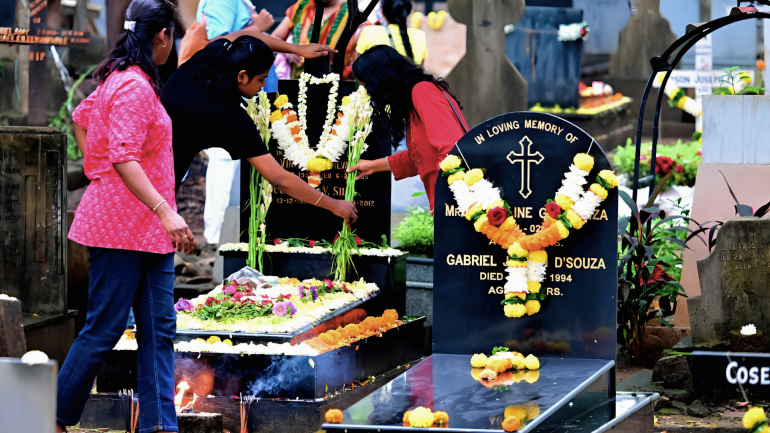
A visit to a cemetery makes this experience tangible. A candle burns beside a grave. Someone places flowers before a familiar name. A family stands quietly, remembering a person whose absence is still deeply felt. These gestures may appear ordinary, but they reveal how deeply human relationships matter. They also express a hope that reaches beyond what the eyes can see.
For Christians, remembering the dead is more than recalling the past. We pray for the departed because we believe that their lives remain in God's hands. Our faith in the resurrection assures us that death does not have the final word. The communion of saints reminds us that our bond with one another in Christ extends beyond death. Prayer for the dead is therefore an expression of faith, love, and hope.
But November's invitation to remember the departed also speaks to those of us who are still living. We often spend considerable time thinking about what we will leave behind: property, savings, achievements, or a good name. Perhaps we should give equal attention to the memories we are creating in the hearts of others.
The story of Francis and his biscuits has survived for centuries, not because the biscuits were extraordinary, but because of the friendship and affection behind them. One day, people may forget what we owned or achieved. But they may remember how we treated them, whether we listened when they needed someone, and whether we were present during their difficult moments.
As we pray for the faithful departed throughout November, we might also ask ourselves a simple question: What kind of memories am I leaving behind today?
Death may bring our earthly life to an end, but the goodness we share can continue through others. The love we give, the kindness we show, and the friendships we nurture can leave traces long after we are gone. Perhaps one of the most meaningful ways to honor the departed is to live in such a way that, when our own time comes, something of our love will continue to make the world a better place.