


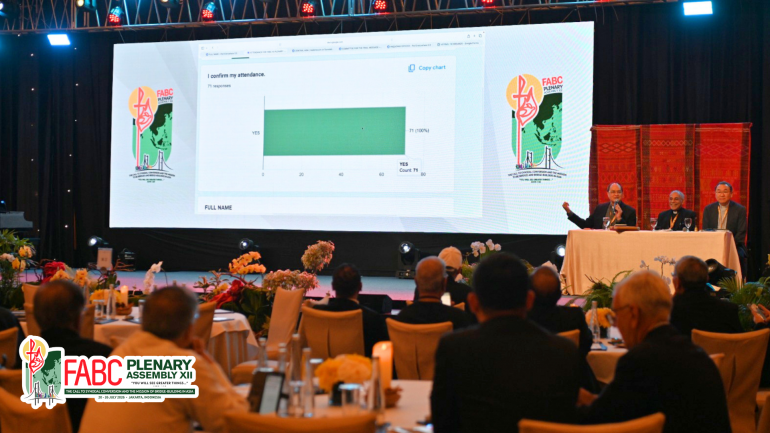
The first day of the 12th Plenary Assembly of the Federation of Asian Bishops' Conferences (FABC) marked a historic first as delegates used an electronic voting system to elect the officials and committees that will guide the Assembly's proceedings and prepare its two principal documents.
Held at Hotel Mulia in Jakarta on July 21, the election saw members choose the Committee for the Final Document, the Committee for the Final Message, and the Presiding Officers through an online voting platform—a first in the history of an FABC Plenary Assembly.
The electronic voting system was developed and managed by the Assembly's media team with the support of the Indonesian Bishops' Conference (KWI) Communications Office and Radio Veritas Asia (RVA) Media.
Voting was conducted through Google Forms, with bishops casting their ballots on their mobile phones. Before voting began, delegates registered electronically by scanning a QR code displayed on the main screen. Volunteers from the communications team assisted bishops who experienced difficulty accessing the system or completing the registration process.
Cardinal Pablo Virgilio S. David, FABC Vice President, served as election officer. Before each round of voting, he explained the committee being elected, identified those eligible to stand for election and those entitled to vote, and announced the results immediately after each electronic ballot closed.
The entire election process was completed in about 30 minutes, demonstrating the efficiency of the digital system. Organizers noted that a traditional paper ballot or voting by a show of hands would likely have required considerably more time.
Before the voting commenced, however, the Assembly addressed a procedural question.


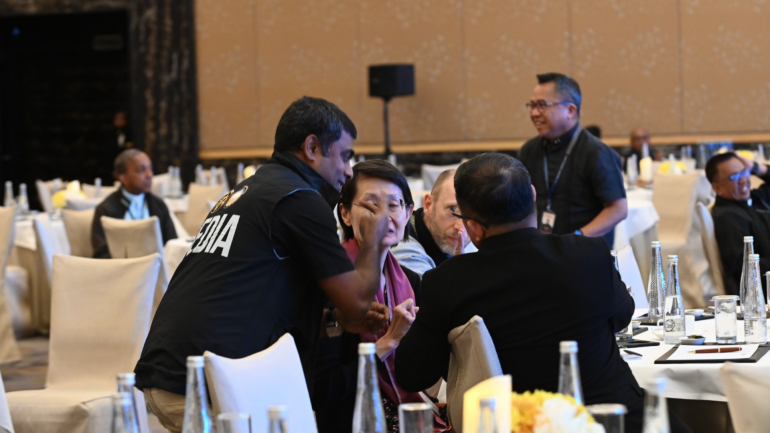

Archbishop Rex Andrew Clement Alarcon of Caceres, Philippines, pointed out that the FABC statutes provide for voting either by paper ballot or by a show of hands and do not explicitly mention electronic voting. He said the Assembly would need to approve the use of the online system before proceeding.
Cardinal David treated the intervention as a formal motion before the Assembly. After the proposal received a seconder and no objections were raised, the members unanimously approved the use of electronic voting, allowing the election to proceed.
Earlier, Fr. Clarence Devadass, Associate Secretary General of the FABC, explained the responsibilities of the three elected bodies. He said the Assembly is expected to produce two principal outcomes: a Vademecum on Synodality in Asia and the Final Message of the 12th FABC Plenary Assembly.
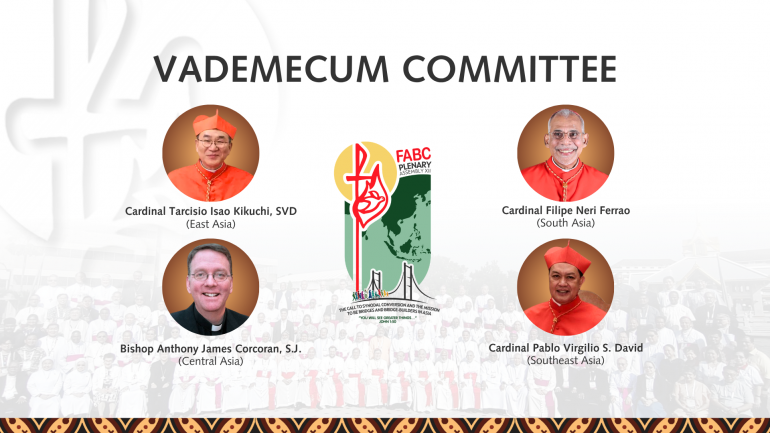
The Committee for the Final Document will prepare the framework for the Vademecum, drawing on plenary interventions, group reports, and participants' contributions. The document is expected to become a practical guide for bishops across Asia in implementing synodality in light of the Final Document of the Synod on Synodality and the FABC Bangkok Document.
Elected to the committee were Cardinal Tarcisio Isao Kikuchi, SVD, Archbishop of Tokyo and Secretary General of FABC; Cardinal Filipe Neri Ferrão, Archbishop of Goa and Daman and FABC President; and Cardinal Pablo Virgilio S. David, Bishop of Kalookan and Vice President of FABC and Bishop Anthony James Corcoran, S.J., Apostolic Administrator of Kyrgyzstan.
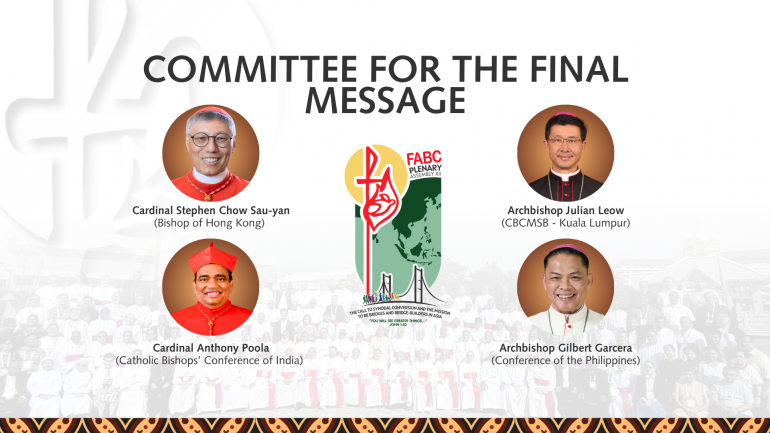
The Committee for the Final Message, tasked with drafting the Assembly's concluding message to the Churches of Asia, comprises Cardinal Stephen Chow Sau-yan, SJ, Bishop of Hong Kong; Cardinal Anthony Poola, Archbishop of Hyderabad, India; Archbishop Julian Leow Beng Kim of Kuala Lumpur, Malysia; and Archbishop Gilbert A. Garcera of Lipa, Philippines.
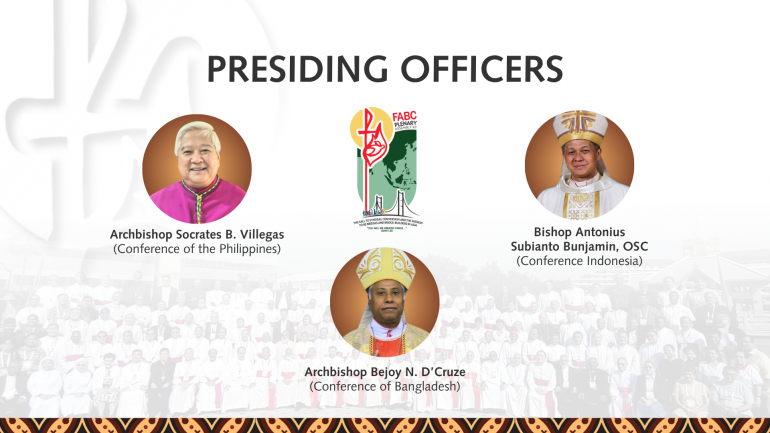
Delegates also elected Archbishop Socrates B. Villegas of Lingayen-Dagupan, Philippines, Archbishop Bejoy N. D'Cruz, OMI, of Dhaka, Bangladesh, and Bishop Antonius Subianto Bunjamin, OSC, Bishop of Bandung, Indonesia, as Presiding Officers. Together with the FABC President, Vice President, and Secretary General, they will form the Steering Committee that will guide the Assembly's daily sessions.
The elections marked the beginning of the Assembly's substantive work on the theme, "Synodal Conversion and Bridge-Building Mission in Asia." At the same time, the introduction of electronic voting reflected the Assembly's willingness to adopt new tools while preserving its synodal commitment to participation, transparency, and shared discernment.
Radio Veritas Asia (RVA), a media platform of the Catholic Church, aims to share Christ. RVA started in 1969 as a continental Catholic radio station to serve Asian countries in their respective local language, thus earning the tag “the Voice of Asian Christianity.” Responding to the emerging context, RVA embraced media platforms to connect with the global Asian audience via its 21 language websites and various social media platforms.
Latest News