The FABC Office of Clergy has reaffirmed its commitment to forming priests who can lead a more synodal and missionary Church in Asia, highlighting more than two decades of formation initiatives during the 12th Plenary Assembly of the Federation of Asian Bishops' Conferences (FABC).
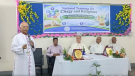
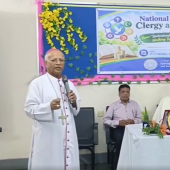
Archbishop Udumala Bala, chairman of the FABC Office of Clergy, presented the office's report on July 21 at Hotel Mulia, Jakarta, outlining its efforts to strengthen priestly formation in response to the changing pastoral realities of the Asian Church.
"Greetings in the name of Jesus Christ, the Good Shepherd," Archbishop Bala said as he opened his presentation.
Established in June 2004, the FABC Office of Clergy supports bishops, priests, and seminary formators across Asia through seminars, consultations, and conferences. Its mission is to form priests with deep spiritual lives, a missionary outlook, and a commitment to servant leadership.
According to Archbishop Bala, priests are called to collaborate closely with their bishops while fostering a participatory Church rooted in Asian cultures and the Church's "triple dialogue" with the poor, people of other faiths, and local cultures.
"We see the Church in Asia as a 'small flock,' yet one that is alive, transformative, and hope-filled. Therefore, priests must continue to be encouraged toward pastoral and missionary renewal rooted in the synodal spirit," he said.
The report traced the office's formation programs over the past 22 years, beginning with a 2006 seminar in Hua Hin, Thailand, on the human formation of priests in the Asian context.
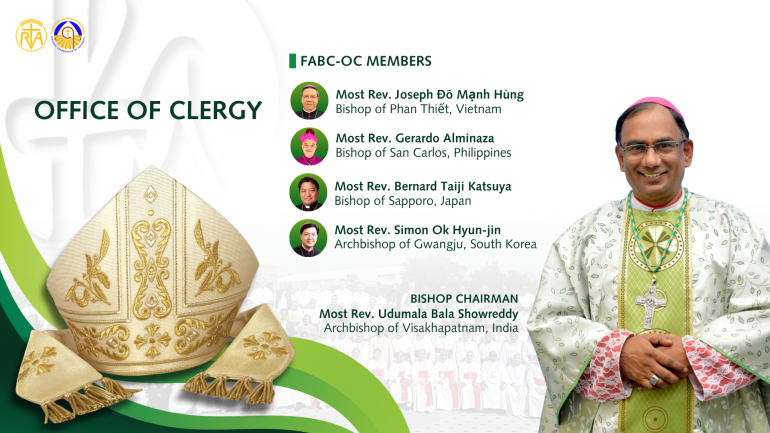
As pastoral challenges evolved, the office expanded its focus to accompany priests facing personal and ministerial difficulties. A 2008 seminar addressed the care of priests in crisis, while another explored priestly identity and the joy of vocation.
In the following years, the office organized programs on safeguarding, priestly celibacy, integral priestly formation, and evangelization. Since the COVID-19 pandemic, it has increasingly emphasized safeguarding, synodality, and seminary renewal. In 2022, it partnered with the Catholic Safeguarding Institute Manila to strengthen the protection of children and vulnerable people, followed by formation programs on synodality for priests and seminary formators in 2023 and 2024.
Archbishop Bala said synodality now serves as the guiding principle for the office's formation efforts. In 2025, it brought together major seminary rectors from across Asia to develop common formation resources inspired by the FABC 50 document, helping future priests embrace synodality as both a way of life and a model of ministry.
Looking ahead, the office plans to deepen collaboration with the FABC Office of Consecrated Life, Office of Laity and Family, Office of Education and Faith Formation, and the Commission for Synodality. Together, they aim to develop theological resources, pastoral guidelines, and formation programs that address emerging challenges, including ecology, artificial intelligence, and digital culture.
The report concluded that priestly formation must continue throughout a priest's ministry, enabling pastors to walk closely with God's people and lead a Church that is increasingly synodal and missionary across Asia.
Radio Veritas Asia (RVA), a media platform of the Catholic Church, aims to share Christ. RVA started in 1969 as a continental Catholic radio station to serve Asian countries in their respective local language, thus earning the tag “the Voice of Asian Christianity.” Responding to the emerging context, RVA embraced media platforms to connect with the global Asian audience via its 21 language websites and various social media platforms.
Latest News