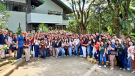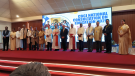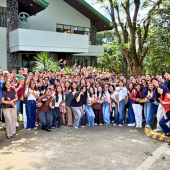



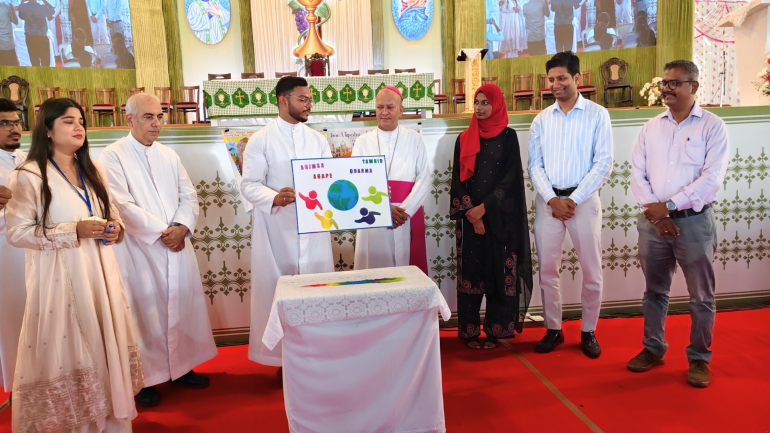
The Archdiocese of Goa and Daman brought together people of different faiths, students and educators at the Basilica of Bom Jesus in Old Goa, western India, on November 26, to promote interreligious dialogue, mutual understanding and peaceful coexistence.
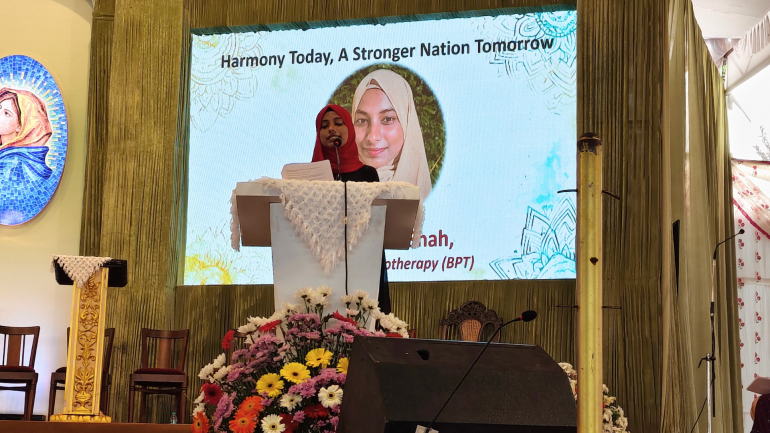
The gathering, held under the theme “Harmony Today, A Stronger Nation Tomorrow,” was organized by the Apostolate of Inter-Religious Dialogue in collaboration with Sadbhav of the Society of Pilar, the Diocesan Society of Education and the Archdiocesan Board of Education.
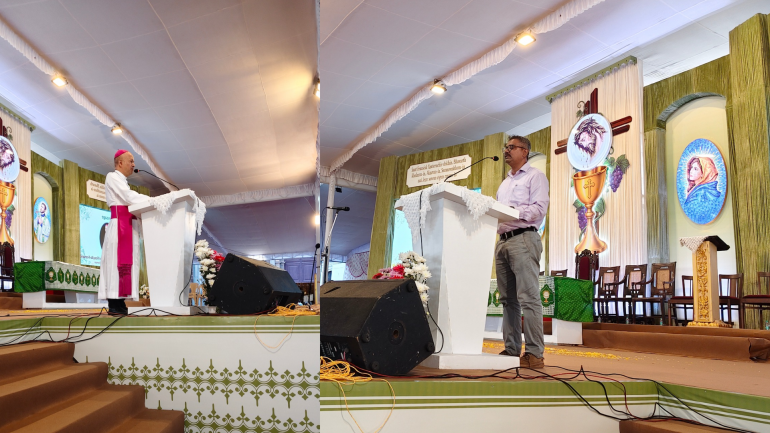
Representing the Muslim community, Mediha Shah highlighted justice, mercy, kindness and respect as foundations of harmony. Citing Quranic teachings and Prophet Muhammad’s respect for a Jewish man's funeral, she emphasized human dignity beyond religious identity.
“Unity does not mean uniformity,” she said, quoting Surah Al-Hujurat, verse 13, and urged young people to reject hatred and discrimination.
Hindu representative Swapnesh Sherlekar, a social activist, researcher and trainer, described friendship and mutual respect as integral to Goa’s social fabric. Recalling shared Hindu-Christian traditions and participation in each other's festivities, he said, “These traditions are our culture” and “We cannot hate each other.”
Christian representative Tyson D’Costa encouraged young people to uphold justice and equality and reject divisions. Quoting Pope John Paul II’s Fides et Ratio, he highlighted the importance of reason alongside faith and advocated philosophical formation before theological study.
Addressing the gathering, Auxiliary Bishop Simião Fernandes of Goa and Daman outlined six values for nation-building through the word “NATION”: noble hearts, acceptance of differences, togetherness, integrity, oneness and national spirit.
Quoting former US President John F. Kennedy, “Ask not what your country can do for you, ask what you can do for your country,” Bishop Fernandes said nation-building was everyone's responsibility.
“Harmony today begins with you and me. A stronger nation tomorrow begins with all of us,” he said, urging participants to promote harmony in homes, educational institutions, workplaces and society.
Teachers Jenifa Dias of Mount Mary High School, Chinchinim, and Mesha Kamat of St. Francis Xavier Higher Secondary School, Siolim, shared their interfaith experiences.
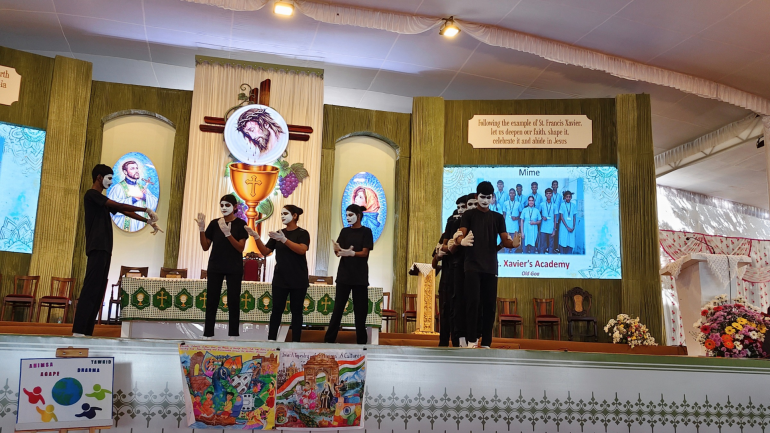
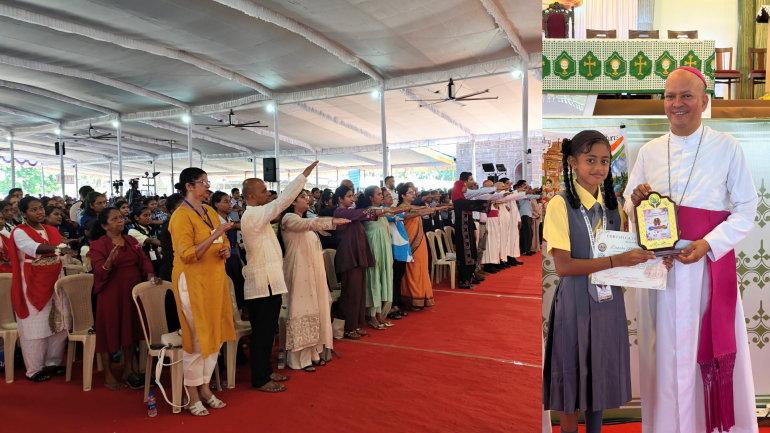
Students presented cultural performances, including prayer dances, a unity hymn, mime, street theater and interfaith talent presentations. A painting competition titled “Hues of Harmony” and a dance by parishioners of Sao Jose de Areal further highlighted the theme.
Speaking to Radio Veritas Asia after the gathering, Shah encouraged people to appreciate different beliefs and traditions, recognize their shared humanity and build friendships across communities.
D’Costa said people of different faiths could learn from one another through kindness, a universal value.
Sandhya Fernandes, a teacher at St. Francis Xavier Higher Secondary School, Siolim, urged people to resist divisive forces, pray for one another and recognize everyone as human beings and God's creation.
Ruzaiya Khan, a Class IX student of St. Joseph’s High School, Aquem, Margao, described the gathering as an opportunity to develop openness, mutual respect and willingness to learn from others.
Sr. Rekha Jadhav, FMCK, said the event helped her appreciate different religions, adding that faith should inspire people to become better persons and contribute to a harmonious society.
Fr. Heston Ferrão, convenor of the Apostolate for Inter-Religious Dialogue, welcomed the gathering.
Radio Veritas Asia (RVA), a media platform of the Catholic Church, aims to share Christ. RVA started in 1969 as a continental Catholic radio station to serve Asian countries in their respective local language, thus earning the tag “the Voice of Asian Christianity.” Responding to the emerging context, RVA embraced media platforms to connect with the global Asian audience via its 21 language websites and various social media platforms.
Latest News