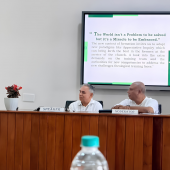



Dalit Christian youth must take a leading role in the campaign to restore Scheduled Caste (SC) status to Christians of Dalit origin, speakers urged at a three-day leadership development workshop organized by the National Dalit Christian Watch (NDCW) in Puducherry, southern India.
The workshop, held on November 13-15 at the Gonzaga Training Centre, brought together young participants from Tamil Nadu, Kerala, Telangana and Andhra Pradesh to discuss caste discrimination, constitutional rights and the role of youth in advancing social justice.
NDCW President Dr. Richard Devadoss opened the discussions by examining what unites and divides Christians. He identified caste, gender and misinterpretation of the Bible as major sources of division within the Christian community.
Fr. Dr. Z. Devasagayaraj explained the Catholic Church's Dalit Empowerment Policy, adopted by the Catholic Bishops' Conference of India (CBCI) in 2015 and officially released in December 2016.
He said Dalits constitute approximately 65 percent of India's Catholic population but continue to experience discrimination and inadequate representation within the Church.
Describing untouchability as a grave social sin, he stressed that the policy requires metanoia, or a genuine change of heart and mindset, alongside concrete measures to promote education, employment and entrepreneurship.
The workshop examined how Dalits who convert to Christianity lose Scheduled Caste recognition under Paragraph 3 of the Constitution (Scheduled Castes) Order, 1950.
Consequently, they are excluded from protections under the Scheduled Castes and Scheduled Tribes (Prevention of Atrocities) Act, 1989, as well as reservation benefits in education and government employment and certain scholarships and welfare schemes.


Fr. Devasagayaraj referred to the Supreme Court's 1985 Soosai judgment, the pending public interest litigation filed in 2004 and the Ranganath Misra Commission's recommendation to remove the religious restriction.
He described the exclusion as a “black mark” on the Constitution.
During group discussions, participants highlighted limited awareness of the Church's Dalit Policy, delays in securing justice, concerns over the use of funds intended for Scheduled Caste communities and inadequate support for young Dalit entrepreneurs.
They proposed leadership training, dialogue with Church authorities, parish-level awareness campaigns, social media advocacy and stronger networks to document discrimination and support legal efforts.
The workshop included sessions on gender sensitivity, the constitutional rights of minorities, women and Dalits, and youth advocacy.
Founded in 2016, NDCW works to eliminate caste-based discrimination within the Church and wider society. Its guiding message is: “Christ and Caste Cannot Go Together.”
Radio Veritas Asia (RVA), a media platform of the Catholic Church, aims to share Christ. RVA started in 1969 as a continental Catholic radio station to serve Asian countries in their respective local language, thus earning the tag “the Voice of Asian Christianity.” Responding to the emerging context, RVA embraced media platforms to connect with the global Asian audience via its 21 language websites and various social media platforms.
Latest News