


Indonesia: Family Commission Webinar Urges Catholic Families to Make Homes Safe Spaces for Mental Health

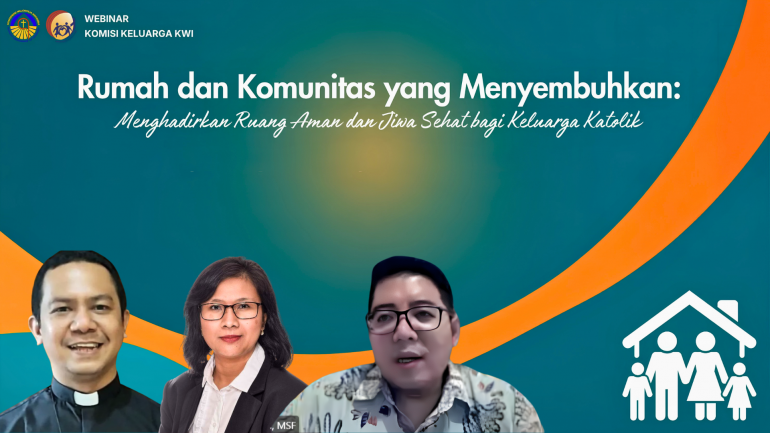
Catholic families need to offer emotional support and acceptance, not just material security, to help children, spouses and parents cope with mental health challenges, speakers said during a webinar organized by the Family Commission of the Indonesian Bishops’ Conference (KWI) on October 22.
The online webinar, titled “Healing Homes and Communities: Creating Safe Spaces and Promoting Mental Health for Catholic Families,” drew more than 300 participants from across Indonesia, the world’s largest archipelago.
Dr. Hervita Diatri, a psychiatrist and lecturer at the University of Indonesia’s Faculty of Medicine, said family well-being depends not only on providing food, education and housing but also on making every member feel loved, accepted and free to express emotions without fear of judgment.
The webinar opened with remarks by Fr. Rufinus Sabtian Herlambang, MSF, executive secretary of the KWI Family Commission. Psychologist Anna Surti Ariani, known as Nina, moderated the discussion, which also featured Fr. Fransiskus Iwan Yamrewav, MSF, a member of the Indonesian Inter-Institute Cooperation Board for the Ongoing Formation of Priests.
Dr. Hervita said families should be understood not merely as biological units but as relationships built through care, affection, affirmation and support for each member’s development.
She highlighted how parental anxiety about finances, employment, bullying and children’s futures can sometimes overshadow their emotional needs. Parents may provide material comforts and educational opportunities yet struggle to understand why their children continue to experience sadness or distress.
Children need opportunities to share their experiences without being dismissed, judged or compared with others, she said. Parents do not have to be perfect; what matters is their willingness to learn, improve and remain present when their children need support.
Dr. Hervita also emphasized the importance of listening before offering advice. When children or spouses share their difficulties, they may need understanding rather than immediate solutions. Repeatedly dismissing their feelings can discourage them from speaking openly.
She encouraged families to pay attention to changes in behavior, such as withdrawal or isolation, and approach struggling family members with care rather than assuming they have a mental health disorder.
Fr. Iwan complemented the psychological perspective with a pastoral approach, stressing that spiritual advice alone may not be enough to address serious emotional difficulties. Prayer and faith can provide hope, but counseling, therapy and medical care may also be necessary.
He outlined three steps for responding to people in distress: observe changes in their behavior, listen without judgment, and connect them with appropriate support, including professional assistance.
People experiencing domestic violence, for example, need protection and practical help rather than advice simply to remain patient, he said.
The speakers also highlighted the role of parishes and wider Church communities in supporting families facing conflict, financial pressure and mental health challenges. Such support can include pastoral accompaniment, practical assistance and referrals to professional services.
In Catholic teaching, the family is known as the ecclesia domestica, or domestic Church, where faith and love are lived out in everyday relationships.
The webinar emphasized that healthy families are not those without problems, but those whose members can acknowledge difficulties, listen to one another and seek help without fear of humiliation or exclusion.
Radio Veritas Asia (RVA), a media platform of the Catholic Church, aims to share Christ. RVA started in 1969 as a continental Catholic radio station to serve Asian countries in their respective local language, thus earning the tag “the Voice of Asian Christianity.” Responding to the emerging context, RVA embraced media platforms to connect with the global Asian audience via its 21 language websites and various social media platforms.
Latest News