


Indonesian Documentary on Fr. Magnis-Suseno Explores Faith, Philosophy and Public Life

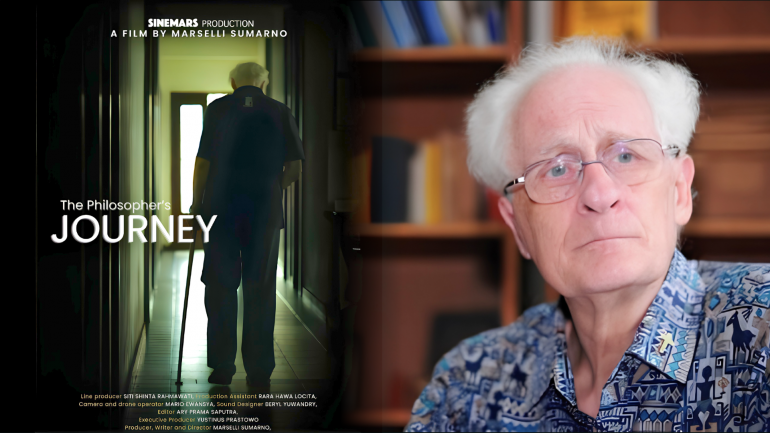
An Indonesian documentary on Jesuit philosopher Fr. Franz Magnis-Suseno, SJ, explores the intellectual and personal journey of the German-born priest and his decades-long engagement with Indonesian society, philosophy, faith and public life.
Fr. Franz Magnis-Suseno, SJ, is a German-born Jesuit priest and philosopher who has lived and worked in Indonesia since 1961. He became an Indonesian citizen in 1977 and has spent decades teaching, writing and engaging in public discussions on ethics, democracy, religion and social responsibility. He has been closely associated with the Driyarkara School of Philosophy in Jakarta and has contributed to Indonesia’s intellectual and interreligious life. At 90, he remains a prominent voice in discussions on faith, philosophy and Indonesian society.
The Philosopher’s Journey, directed by Indonesian filmmaker Marselli Sumarno, was released on YouTube on September 21, making the film accessible to a wider audience beyond the academic and cultural circles where it had previously been screened and discussed.
Rather than presenting a conventional biography, the documentary uses Fr. Magnis-Suseno’s life and work to examine questions of identity, ethics, democracy, religion, culture and human dignity.
The film brings together reflections from Fr. Magnis-Suseno himself and several Indonesian intellectuals and Church figures, including writer and cultural figure Sindhunata, philosopher Karlina Supelli, philosopher Simon Petrus Lili Tjahjadi, Martin Suryajaya, theologian and educator Fahruddin Faiz, and Jesuit priest Benedictus Hari Juliawan.
Their perspectives place Fr. Magnis-Suseno's story within Indonesia's broader intellectual and social experience.
A central theme of the documentary is the relationship between philosophy and everyday life. Rather than treating philosophy as an abstract academic discipline, the film presents it as a way of engaging questions that affect society, justice, freedom, responsibility, political power, human dignity and how people live together.
His philosophical engagement is presented alongside his experience of Indonesian society, where he arrived as a young Jesuit in 1961 and later became an Indonesian citizen in 1977.
The documentary follows the way his intellectual life developed in Indonesia, particularly through his work in philosophical education and public discourse. His association with the Driyarkara School of Philosophy in Jakarta forms part of this story.
The film also explores the connection between intellectual reflection and public engagement. Through books, lectures, articles and public appearances, Fr. Magnis-Suseno has participated in discussions on democracy, politics, religion, human rights and social responsibility.
Another dimension highlighted by the documentary is his engagement with Indonesia's religious and cultural diversity. His work in interreligious dialogue is presented within the wider challenge of building a society in which people of different religious and cultural backgrounds can live together.
The filmmakers also use cinema to explore a subject more commonly encountered through books and classrooms.
The Philosopher’s Journey combines interviews and reflections with images of the places and people connected with Fr. Magnis-Suseno's life. His intellectual ideas are presented alongside personal memories, relationships and experiences, giving viewers a visual entry point into questions that might otherwise remain within academic discussions.
The relationship between Fr. Magnis-Suseno and cinema was also discussed during Bincang Magnis dalam Lensa Sinematografi, a screening and discussion held in May 2026 at the Driyarkara School of Philosophy. The event examined the documentary through perspectives including film aesthetics, biography, cultural identity and popular culture.
The film was released as Fr. Magnis-Suseno turned 90 in 2026. The Driyarkara School of Philosophy marked its 57th anniversary with the theme “Magnis untuk Indonesia,” or “Magnis for Indonesia,” revisiting his contribution to Indonesian intellectual and public life.
The documentary consequently becomes more than a portrait of one philosopher. By following his intellectual journey, it also offers a view of Indonesia through questions that have accompanied the country's social and political development: democracy, freedom, justice, religion, human dignity and responsibility toward society.
For younger audiences, the YouTube release provides an accessible introduction to a figure whose influence has extended across philosophy, education, religious dialogue and public discussion.
The film invites viewers to consider how philosophical reflection can engage real social questions and how faith and reason can contribute to public life.
By bringing Fr. Magnis-Suseno's journey from academic spaces to the screen and now to a wider digital audience, The Philosopher’s Journey presents philosophy not simply as a body of ideas but as an ongoing engagement with people, society and the questions that shape their common life.
Radio Veritas Asia (RVA), a media platform of the Catholic Church, aims to share Christ. RVA started in 1969 as a continental Catholic radio station to serve Asian countries in their respective local language, thus earning the tag “the Voice of Asian Christianity.” Responding to the emerging context, RVA embraced media platforms to connect with the global Asian audience via its 21 language websites and various social media platforms.
Comments

Latest News





- Reply
Permalink