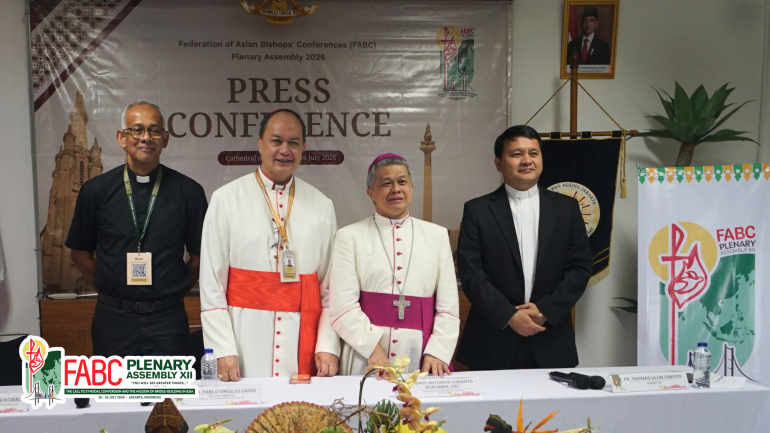
The Church in Asia must move beyond speaking about sharing and become more willing to share its resources, talents, time, and financial support for the common mission of the Church, Bishop Antonius Subianto Bunjamin, OSC, president of the Catholic Bishops' Conference of Indonesia (KWI), said.
Speaking at the closing press conference of the 12th Plenary Assembly of the Federation of Asian Bishops' Conferences (FABC) on July 26 at the Karya Pastoral Building in the Jakarta Cathedral Complex, Bishop Antonius said synodality requires a deeper commitment to walking together and supporting one another.
"We easily speak about spiritual sharing. But what about sharing our resources, our talents, ourselves, and even our financial means?" he asked.
The press conference, held after the conclusion of the weeklong assembly, gave Church leaders an opportunity to reflect on the gathering's outcomes, including the development of a framework for a Synodality Vademecum for Asia and the release of the assembly's final message.
For Bishop Antonius, however, the most important fruit of the assembly was not the documents produced but the experience of fraternity and mutual sharing among the Churches of Asia.
"The most important thing is not the documents we discussed during the assembly, but the sharing of our lives," he said.
He explained that bishops, clergy, religious, and lay delegates from across Asia brought their own pastoral experiences, challenges, and hopes, enriching the entire Church through their encounter with one another.
Indonesia hosted the FABC Plenary Assembly for the second time, 36 years after the fifth assembly was held in Bandung in 1990. Bishop Antonius described the opportunity to welcome participants from across Asia as a blessing and an expression of the Church's spirit of hospitality.
"We did not experience many difficulties. On the contrary, we were joyful. We welcomed all the participants and offered them our hospitality," he said.
He said Indonesia's hospitality reflected the meaning of synodality—building relationships through dialogue, friendship, and openness.
One of the clearest expressions of this spirit was the delegates' visit to the Tunnel of Friendship, which connects Jakarta Cathedral and the Istiqlal Mosque, Southeast Asia's largest mosque.
Bishop Antonius said the visit was more than a cultural experience. The tunnel became a powerful symbol of the assembly's theme of becoming bridges and bridge-builders in Asia.
Walking together through the tunnel showed that dialogue is not merely an idea discussed in meetings but a reality built through trust, respect, and genuine human relationships, he said.
He also highlighted the witness of the Grand Imam of Istiqlal Mosque, whom he described as "a human bridge" because of his efforts to foster friendship and cooperation among people of different religious backgrounds.
Reflecting on the imam's message, Bishop Antonius said authentic religious commitment should bring people closer not only to God but also to their neighbors.
"I believe that the closer a person comes to God, the closer he or she also comes to fellow human beings," he said, echoing Cardinal Luis Antonio Tagle's reflection during the assembly that Christ is the bridge between God and humanity.
Bishop Antonius added that even simple gestures of welcome, such as giving participants Indonesian batik as a gift, expressed the spirit of friendship and sharing. However, he emphasized that synodality must eventually lead to concrete action.
For him, the challenge before the Asian Church is to transform the spirit of communion into practical solidarity by sharing what each local Church has for the mission entrusted to all.