


'Let Us Not Be Threatened by AI,' Says FABC Vice President at Final Assembly Press Conference

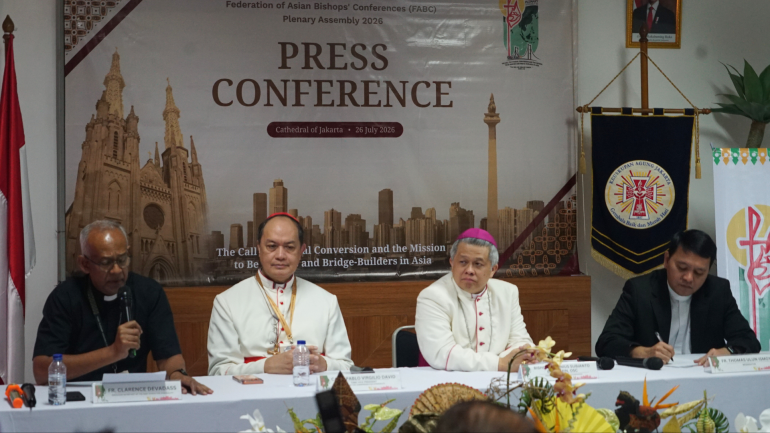
Artificial intelligence should be embraced as a tool for mission rather than feared as a threat, Cardinal Pablo Virgilio David, vice president of the Federation of Asian Bishops' Conferences (FABC), said at the closing press conference of the 12th FABC Plenary Assembly in Jakarta.
Speaking on July 26 at the Pastoral Center of the Cathedral of Our Lady of the Assumption in Indonesia's capital, the cardinal responded to questions from journalists following the conclusion of the weeklong assembly. Also attending the briefing were Fr. Clarence Devadass, associate secretary general of the FABC and executive secretary of its Office for Synodality, and Bishop Antonius Subianto Bunjamin, president of the Catholic Bishops' Conference of Indonesia.
Asked whether artificial intelligence poses a threat to the Church, Cardinal David instead highlighted its potential to support communication and evangelization across Asia, one of the world's most linguistically diverse regions.
He recalled receiving the latest pastoral statement of the Indonesian bishops' conference, written in Bahasa Indonesia, and immediately thinking about how AI-assisted translation could make the document accessible to Catholics throughout Asia. At the same time, the cardinal cautioned against relying on artificial intelligence uncritically.
Having tested several AI translation platforms himself, he said machine-generated translations can still contain significant errors, particularly when translating from local languages or when cultural context is missing.
Instead of treating AI as a substitute for human intelligence, he encouraged people to see it as a tool that improves with thoughtful human guidance.
"You should treat AI like a super-intelligent student," Cardinal David said. "What you put into it helps it become better."
Drawing from his own experience, he explained that translation quality can improve significantly as users refine their prompts and provide clearer context.
For Cardinal David, this demonstrates that technological progress ultimately depends on human intelligence and judgment.
He compared today's concerns about artificial intelligence with the fears that accompanied the arrival of electronic calculators decades ago.
"People thought calculators would make everyone poor at mathematics," he said. "But that didn't happen. Mathematics advanced to a higher level."
Likewise, he believes AI should not be viewed as something that diminishes human abilities but as a technology that can enhance creativity, learning, and collaboration when used responsibly.
"We should not be threatened by artificial intelligence," he said. "There is much more to come. We simply need to use it more intelligently."
The cardinal stressed that people, not machines, remain responsible for ensuring that technology serves the common good.
"We are more intelligent than the machine," he said. "The best users of AI are good prompters—people who know how to bring out its best."
His remarks echoed one of the broader themes of the FABC assembly: that the Church in Asia must engage confidently with the realities of the modern world while remaining rooted in the Gospel. For Cardinal David, that includes embracing emerging technologies with wisdom and discernment so they can strengthen communication, foster collaboration, and advance the Church's mission across the continent.