An exhibition currently running in Penang is drawing attention to the cultural and spiritual consequences of biodiversity loss through the works of Malaysian artists Bright Ong and Christine Das.
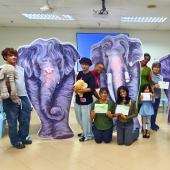
“Project Riwayat: Katha 1: Voices of the Vanishing,” which opened on May 1, examines how environmental degradation affects not only ecosystems but also cultural memory, traditional practices, and social identity. Through puppetry and textile-based installations, the exhibition presents extinction as both an ecological and human crisis.
The exhibition features works that explore the relationship between modern development, traditional craftsmanship, and environmental decline.
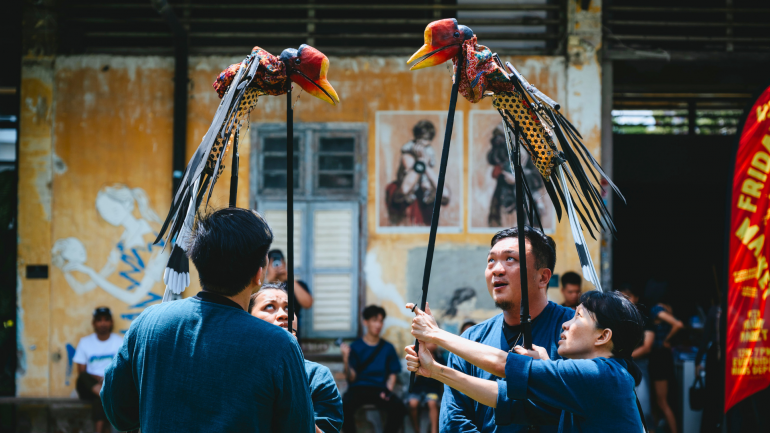
Ong, a puppeteer and artisan, incorporates materials such as carbon fibre, EVA foam, and marine foam into works inspired by traditional lion and dragon dance craftsmanship. One installation depicting dolphins uses marine foam commonly associated with boat construction, highlighting what he describes as the contradictions of modern industrial society.
“There’s an ironic pain in the way the dolphins are made out of marine foam,” Ong told Radio Veritas Asia, referring to the impact of marine industries on ocean ecosystems.
While acknowledging modernization as inevitable, Ong said preserving traditional craftsmanship and cultural memory remains essential.
“Modernisation is a reality. What matters is how we carry the past forward, with respect,” he said.
Ong also expressed concern over what he described as the gradual decline of a “craftsman’s spirit,” as handmade traditions become increasingly marginalized in economies driven by speed and mass production.
Das approaches the environmental crisis through textile art. Her series, “Hanging by a Thread,” reinterprets traditional saree embroidery using disordered black threads rather than decorative gold patterns traditionally associated with continuity and harmony.
“It started from a place of deep sadness and helplessness,” Das said. “And it became a warning.”
Her installations use transparent netting and loosely suspended threads to create an impression of instability and disappearance. According to Das, the work reflects the fragile condition of ecosystems that continue to deteriorate despite surface-level concern.
“It reflects where we are with nature,” she said. “We still show care on the surface, but underneath, things are falling apart.”
Das, who collaborates with Radio Veritas Asia on Laudato Si’-related initiatives, said environmental destruction often unfolds gradually and without immediate public attention.
“Most environmental loss doesn’t arrive with spectacle,” she said. “It happens quietly, a species disappears, a forest thins, but life goes on.”
One of Das’ paintings was recently featured on the cover of RVA’s publication, Voices for Our Common Home, a commemorative volume marking the 10th anniversary of Pope Francis’ Laudato Si’.
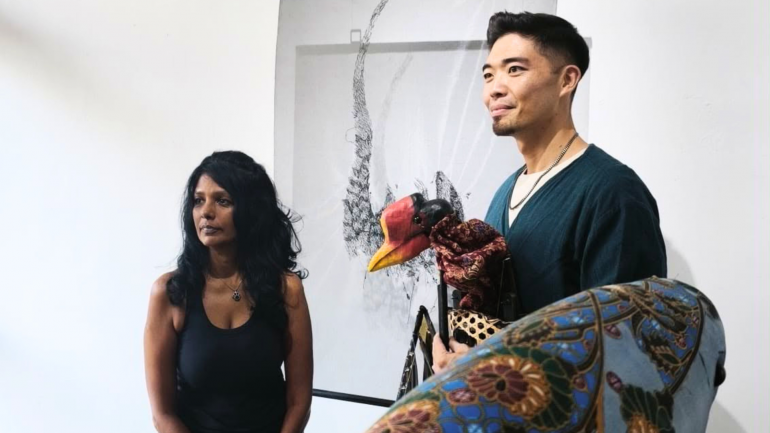
Both artists said their work is intended less as activism and more as a way of translating environmental realities into emotional and cultural experience.
“I’m a storyteller first,” Ong said. “I’m speaking for those that can’t.”
Das frames her role differently, but with similar intent. “I see myself as a translator,” she says. “The crisis is already happening. My role is to make it felt by the audience.”
The artists also reflected on public responses to environmental themes in art. Ong noted that audiences with stronger personal connections to nature often respond more deeply to the exhibition, while Das observed that reactions can sometimes remain subdued despite growing environmental awareness among younger viewers.
“The challenge is moving people from seeing to feeling,” she said.
Despite the scale of the issues addressed, both artists said they view impact in incremental terms, through shifts in perception and sustained reflection rather than immediate social change.
“Success is when something stays with you,” Das said. “A quiet shift in how you see and feel.”
The exhibition also raises concerns about the long-term cultural consequences of ecological collapse. Das warned that future generations may inherit a landscape defined more by memory and absence than by living biodiversity.
“The hardest part is that we may not even notice it disappearing until it’s already gone,” she said.
Ong, meanwhile, pointed to growing social distraction and declining attention to environmental realities as another challenge facing conservation efforts.
As “Project Riwayat: Katha 1: Voices of the Vanishing” continues in Penang, the exhibition invites audiences to consider biodiversity loss not only as an environmental concern, but as a challenge to cultural memory, identity, and human responsibility.
Radio Veritas Asia (RVA), a media platform of the Catholic Church, aims to share Christ. RVA started in 1969 as a continental Catholic radio station to serve Asian countries in their respective local language, thus earning the tag “the Voice of Asian Christianity.” Responding to the emerging context, RVA embraced media platforms to connect with the global Asian audience via its 21 language websites and various social media platforms.
Latest News