



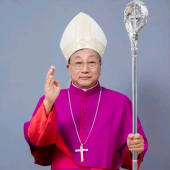
Archbishop Julian Leow of Kuala Lumpur has called on Malaysians to be grateful for the diversity that shapes the Southeast Asian nation, as the country marked its 69th National Day on August 31.
In his Merdeka Day message, Archbishop Leow urged Malaysians to embrace their differences and preserve the harmony shared by the country’s multiethnic, multireligious and multicultural communities.
“Let us embrace our differences, stand united and cherish the harmony we share,” he said. “May God continue to bless and guide our nation, today and always.”
Malaysia gained independence from British rule on August 31, 1957. National Day, known locally as Hari Merdeka, is observed annually as a celebration of the country’s independence and national identity.
The Christian Federation of Malaysia (CFM) also emphasized unity amid diversity in its National Day message.
“Unity does not mean uniformity; it is unity in diversity,” the federation said. “Our strength lies in our capacity to respect, celebrate and work alongside one another while holding on to our distinct identities, cultures and beliefs. This is what makes Malaysia special.”
The CFM brings together the Catholic Bishops’ Conference of Malaysia, the Council of Churches of Malaysia and the National Evangelical Christian Fellowship.
A chance meeting involving two elderly Malaysians offered a personal example of the relationships that can cross ethnic, religious and generational boundaries.
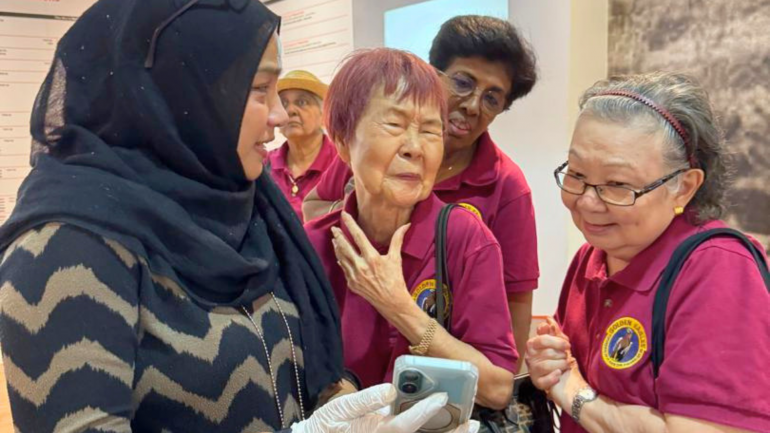
Nancy Emaung Ban, an octogenarian and member of the Golden Eagles, a seniors’ group at the Cathedral of St. John the Evangelist in Kuala Lumpur, was visiting the Telecommunications Museum when she was warmly greeted by its operations manager, Nadya Shahabuddin.
“Godma Nancy Ban,” Nadya called out.
Nancy said the unexpected reunion was deeply meaningful because she had known Nadya’s family for decades. She had taught Nadya physics at a secondary school in Raub, a town in Pahang state on Malaysia’s east coast, in the mid-1980s.
Nadya’s father had also taught at the same school and was a close friend of Nancy’s late husband. Nancy later taught both Nadya and her brother.
“Our relationship goes beyond that of a teacher and student,” Nancy said. “Seeing her again after all these years made the reunion even more meaningful.”
She said she never expected to meet her former student again, particularly in Kuala Lumpur, Malaysia’s capital city, more than 100 miles from Raub.
Nancy connected the encounter with the theme of the 60th World Day of Social Communications, “Preserving Human Voices and Faces,” saying it highlighted the enduring value of personal relationships in an increasingly digital world.
“Every person we meet is more than just a face; they carry memories, relationships and God’s blessings in our lives,” she said, reflecting on the message of Pope Leo XIV for the occasion.
In his message, the pope said that human faces and voices reveal the “unrepeatable identity” of each person and shape encounters with others.
Another member of the Golden Eagles, Charlotte Xavier, also became part of the museum’s storytelling during the visit. When museum staff learned that the octogenarian was a retired telecommunications switchboard operator, they invited her to record a video recalling how telephone calls were manually connected before automated switchboards and digital communications became commonplace.
Switchboard operators once connected callers by inserting pairs of plugs into the appropriate jacks, manually linking people separated by distance.
For Nancy, the reunion and the museum visit offered a reminder that technology may change how people communicate, but personal relationships remain central to community life.
Her experience echoed Archbishop Leow’s National Day message: “May this Merdeka remind us to be grateful for the diversity that makes Malaysia beautiful.”
Radio Veritas Asia (RVA), a media platform of the Catholic Church, aims to share Christ. RVA started in 1969 as a continental Catholic radio station to serve Asian countries in their respective local language, thus earning the tag “the Voice of Asian Christianity.” Responding to the emerging context, RVA embraced media platforms to connect with the global Asian audience via its 21 language websites and various social media platforms.
Comments
Latest News




- Reply
Permalink