No Local Church Walks Alone: Synod Consultor Highlights Communion as the Heart of Synodality

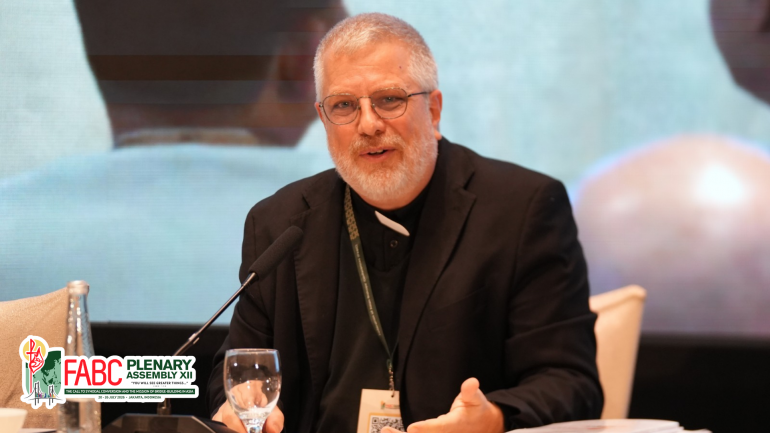
A synodal Church is not one in which local Churches become more independent, but one in which they grow stronger by deepening their communion with one another, a Vatican synod official told bishops and Church leaders gathered at the 12th Plenary Assembly of the Federation of Asian Bishops' Conferences (FABC).
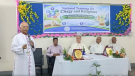
Fr. Giacomo Costa, SJ, a consultor to the General Secretariat of the Synod and one of the principal collaborators in the Synod on Synodality, emphasized that message during his presentation, "Pathways for the Implementation of the Synod," at the Vanda Room of Hotel Mulia in Jakarta on July 24.
Speaking about the next phase of the global synodal process, Fr. Costa stressed that while every local Church is responsible for implementing the Synod within its own context, no diocese or bishops' conference is meant to undertake that journey in isolation.
"The Church is a communion of communities," he said, explaining that communion is not simply a theological concept but the way the People of God are called to live and carry out their mission together.
Fr. Costa reiterated one of the Synod's key principles: the local Church is the principal subject of implementation. Every diocese must discern how synodality can take root within its own culture, history, and pastoral reality.
That responsibility, however, should never be mistaken for self-sufficiency.
Every local Church, he said, possesses unique gifts, experiences, and challenges, but each also has something to learn from others. Synodality, therefore, is not about thousands of dioceses pursuing separate initiatives. Rather, it is a shared journey in which Churches enrich one another through mutual listening, dialogue, and discernment.
To foster that exchange, the implementation process includes local, national, continental, and universal stages, allowing the experiences of individual Churches to contribute to the life of the whole Church.
Referring to Pope Leo XIV's call for the implementation of the Synod to foster "an ever more evangelical style," Fr. Costa said the essential question is not who holds greater authority but how every vocation and ministry can work together more faithfully in the Church's shared mission.
He illustrated this by pointing to the relational nature of ecclesial life. Bishops, priests, religious, lay faithful, parish communities, and pastoral councils all exercise distinct ministries, yet none exists in isolation. Each contributes to the mission of the Church through communion with the others.
That vision, he noted, carries particular significance for Asia, where Catholics often live as minorities in culturally and religiously diverse societies.
Rather than viewing diversity as an obstacle, Fr. Costa encouraged the Churches of Asia to see it as an opportunity to demonstrate that unity does not require uniformity. Local Churches remain rooted in their own languages, traditions, and pastoral circumstances while participating fully in the life and mission of the universal Church.
He also broadened the discussion beyond the Catholic community, describing ecumenical and interreligious dialogue as natural expressions of a synodal Church.
A Church that has learned to listen internally, he said, becomes better equipped to engage Christians of other traditions, followers of other religions, and all people of goodwill with respect and openness.
As the Synod moves into its implementation phase, Fr. Costa reminded the FABC delegates that the goal is not for local Churches to walk separate paths but to journey together, each contributing its own gifts while receiving the gifts of others.
In a world increasingly marked by division and fragmentation, he suggested, that communion among local Churches may itself become one of the Church's strongest witnesses to the Gospel.
Radio Veritas Asia (RVA), a media platform of the Catholic Church, aims to share Christ. RVA started in 1969 as a continental Catholic radio station to serve Asian countries in their respective local language, thus earning the tag “the Voice of Asian Christianity.” Responding to the emerging context, RVA embraced media platforms to connect with the global Asian audience via its 21 language websites and various social media platforms.
Latest News