Before Offices, There Is Baptism, Cardinal Grech Tells Bishops at FABC Plenary Assembly

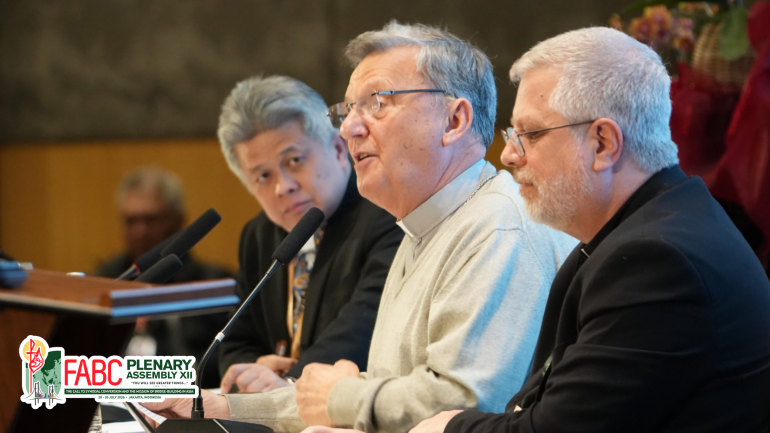
Before there are bishops, priests, cardinals, or lay leaders, there are baptized Christians.
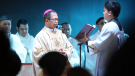
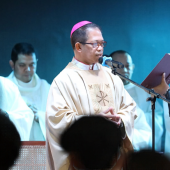
That was the starting point of Cardinal Mario Grech's reflection as he addressed participants at the 12th Plenary Assembly of the Federation of Asian Bishops' Conferences (FABC) in Jakarta on July 24. In a presentation titled "Pathways for the Implementation of the Synod," the Secretary General of the Synod of Bishops reminded Church leaders that baptism—not office or rank—is the foundation of the Church's identity and mission.
His remarks came in the Vanda Room of Hotel Mulia, where bishops from across Asia are gathering to reflect on how synodality can take root in local Churches throughout the continent.
As he was introduced, Cardinal Grech gently interrupted the list of his ecclesiastical titles.
"There was one important thing you forgot," he said with a smile. "You forgot to tell them that we are baptized."
The comment drew warm laughter from the assembly but also set the tone for the rest of his presentation.
"We are here because we are baptized," he continued. "Baptism is the foundation stone of our life."
For Cardinal Grech, the implementation of the Synod on Synodality must begin not with structures or strategies but with recovering the Church's first identity: the People of God united through baptism.
Cardinal Grech said synodality can only flourish when the Church recognizes the equal dignity shared by all the baptized.
Every vocation, he explained, flows from baptism. Bishops, priests, religious, and lay faithful have different ministries, but all share the same baptismal calling to participate in Christ's mission.
"The participation of all could not merely be the content," he said, referring to the Synod process. "It had first of all to become the method."
For that reason, he noted, the global Synod began in dioceses around the world rather than in Rome, inviting bishops to listen to priests, religious, and lay faithful before any universal discussions took place.
While emphasizing the baptismal dignity of every Christian, Cardinal Grech rejected the idea that synodality weakens the ministry of bishops. Instead, he argued, synodality strengthens episcopal leadership by placing it within the life of the community it serves.
"There is no Church without a bishop," he said. "But there is no bishop without a flock."
The bishop's ministry, he explained, is fulfilled not through isolated decision-making but by discerning God's will together with the faithful entrusted to his care. Rather than diminishing episcopal authority, synodality highlights the bishop's essential role as shepherd of a local Church walking together in communion.
Cardinal Grech said this vision carries particular significance for the Churches of Asia, many of which live as small minorities within their societies. Their strength, he noted, does not come from numbers or influence but from the faithfulness of baptized believers who witness to the Gospel in their daily lives.
His emphasis on baptism echoed one of the central themes of the FABC Plenary Assembly, which is exploring how local Churches can become more missionary, synodal, and committed to building bridges across Asia's diverse cultures and religions.
Radio Veritas Asia (RVA), a media platform of the Catholic Church, aims to share Christ. RVA started in 1969 as a continental Catholic radio station to serve Asian countries in their respective local language, thus earning the tag “the Voice of Asian Christianity.” Responding to the emerging context, RVA embraced media platforms to connect with the global Asian audience via its 21 language websites and various social media platforms.
Latest News