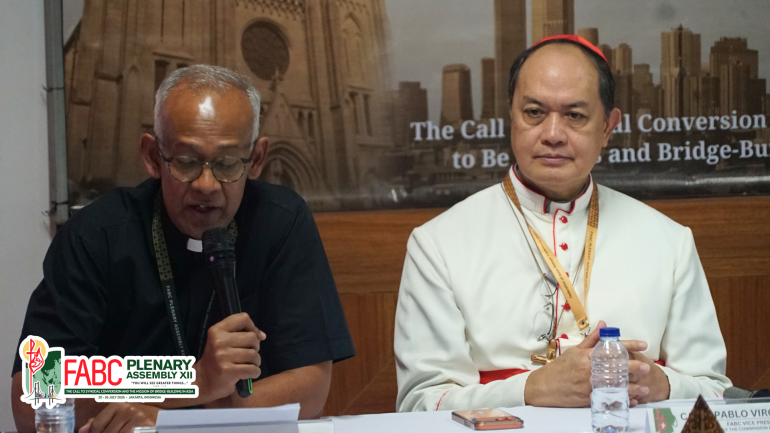
The greatest challenge posed by artificial intelligence is the ability to discern truth from falsehood, Fr. Clarence Devadass, associate secretary general of the Federation of Asian Bishops' Conferences (FABC) and executive secretary of its Office for Synodality, said at the closing press conference of the FABC's 12th Plenary Assembly.
Speaking on July 26 at the Pastoral Center of the Cathedral of Our Lady of the Assumption in Jakarta, Indonesia, Fr. Devadass said the Church should embrace artificial intelligence as a valuable tool while remaining firmly rooted in discernment and the Gospel.
The final press conference, held after delegates completed their symbolic pilgrimage through Jakarta's Friendship Tunnel to the nearby Istiqlal Mosque, also featured Cardinal Pablo Virgilio David, FABC vice president, and Bishop Antonius Subianto Bunjamin, president of the Catholic Bishops' Conference of Indonesia.
Responding to questions from journalists about the growing role of artificial intelligence in the Church, Fr. Devadass emphasized that the Church is not opposed to technological progress.
"AI is a tool," he said, adding that its moral value depends entirely on how people choose to use it.
He pointed to the COVID-19 pandemic as an example of technology serving the Church's mission. During that period, livestreamed Masses enabled elderly Catholics, the sick, and those unable to attend church in person to remain connected to the liturgy and their faith communities.
Fr. Devadass also highlighted AI's potential to strengthen communication across Asia, one of the world's most linguistically and culturally diverse regions.
He said artificial intelligence can help translate Church documents into multiple Asian languages, making pastoral resources and official teachings more accessible to local Churches throughout the continent.
Despite these benefits, he warned that the digital age presents a far greater challenge than simply managing information.
"Our problem today is no longer a lack of information, but the ability to discern what is true," Fr. Devadass said.
He stressed that discernment has become an essential Christian virtue in an era when information, and misinformation, can be created and shared instantly through digital technologies.
Rather than accepting everything generated by artificial intelligence, he said, Catholics must evaluate whether information is truthful, constructive, and respectful of human dignity.
Fr. Devadass's reflections complemented those of Cardinal David, who told reporters that AI should not be viewed as a threat but as an opportunity when guided by moral responsibility and used in service of humanity.
Together, their remarks reflected one of the broader messages of the FABC assembly: the Church in Asia should engage confidently with emerging technologies while ensuring they remain rooted in Gospel values, human dignity, and the synodal practice of listening, dialogue, and shared discernment.
For Fr. Devadass, the future of artificial intelligence is not simply about technological innovation but about forming people capable of making wise and ethical judgments.
As AI becomes increasingly integrated into everyday life, he said, the Church's task is not only to adopt new technologies but also to help people discern truth from falsehood, promote human dignity, and ensure that technology serves the common good.