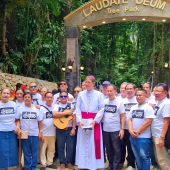




Archbishop Alberto Uy of Cebu, a major island province in the central Philippines, has urged government agencies and local authorities to strengthen preparations for a potentially severe El Niño, warning that delayed action could expose farmers and vulnerable communities to water shortages and livelihood losses, CBCP News reported.
“The preparation should happen now. We should not wait until it becomes extremely hot or there is a serious water shortage,” Uy told Radio Veritas.
He called on local governments and national agencies to strengthen contingency plans, particularly for agricultural communities and households dependent on reliable water supplies.
The Philippine Atmospheric, Geophysical and Astronomical Services Administration (PAGASA), the country's national weather agency, has warned that a very strong El Niño could develop late this year and persist through the first half of 2027.
The agency also warned that heat index readings could reach 43 degrees Celsius, placing affected areas under its “danger” category.
Uy appealed to the Department of Agriculture to provide farmers with guidance on suitable crops and timely assistance to minimize agricultural losses during prolonged dry conditions.
“Farmers should not simply plant whatever crops they choose. They could lose their investments and their crops might not produce a harvest,” he said.
He also called for alternative livelihood programs for farmers unable to cultivate their land because of insufficient water.
At the household level, the archbishop encouraged families to make water conservation part of their daily routine by installing storage tanks for emergencies and avoiding unnecessary water consumption.
Beyond immediate preparations, Uy described the anticipated climate challenge as an opportunity for deeper ecological conversion, calling for lasting changes in people's attitudes and lifestyles.
“Ecological conversion does not end with tree planting. It involves the conversion of the minds, hearts, and lifestyles of the people,” he said.
He encouraged communities to examine patterns of excessive consumption, the use of single-use plastics, and environmentally destructive activities such as illegal fishing, logging, and quarrying.
His appeal comes as the Philippines, an archipelago in Southeast Asia frequently exposed to climate-related hazards, prepares for the possible effects of a strong El Niño, which could place additional pressure on agricultural production, water resources, and communities vulnerable to extreme heat and drought.
Radio Veritas Asia (RVA), a media platform of the Catholic Church, aims to share Christ. RVA started in 1969 as a continental Catholic radio station to serve Asian countries in their respective local language, thus earning the tag “the Voice of Asian Christianity.” Responding to the emerging context, RVA embraced media platforms to connect with the global Asian audience via its 21 language websites and various social media platforms.
Latest News