



The poor have long borne the heaviest burden of environmental destruction and natural disasters, many of which are intensified by human activities. They are often the first to lose their homes, livelihoods and sense of security, yet among the last to be heard when decisions affecting their communities are made. Across Asia, from flood-prone cities and coastal villages to Indigenous communities threatened by mining, environmental degradation is not merely an ecological concern. It is a question of human dignity, justice and survival.
A year after Typhoon Tino devastated Cebu, an island province in the central Philippines, in 2025, many families were still struggling to rebuild their lives. Gina Paumba, a resident of Talisay City in Cebu, lost the home her family had spent years building. By November 2026, she and her family of 10 were living in a makeshift shelter, depending on assistance and their livelihood of making rags sold for around 12 Philippine pesos each. Her experience reminds us that surviving a disaster is only the beginning of a long and uncertain recovery for poor families.
The extreme rainfall that triggered the devastating floods in Cebu also exposed the consequences of environmental neglect. Studies and reports have pointed to the effects of urban expansion and forest loss on surface runoff in parts of Metro Cebu. As forests give way to roads and buildings, and waterways become constricted, communities become increasingly vulnerable to heavy rainfall. Although no single development or environmental factor explains the flooding, the disaster highlights how disregarding natural systems can intensify the impact of extreme weather.
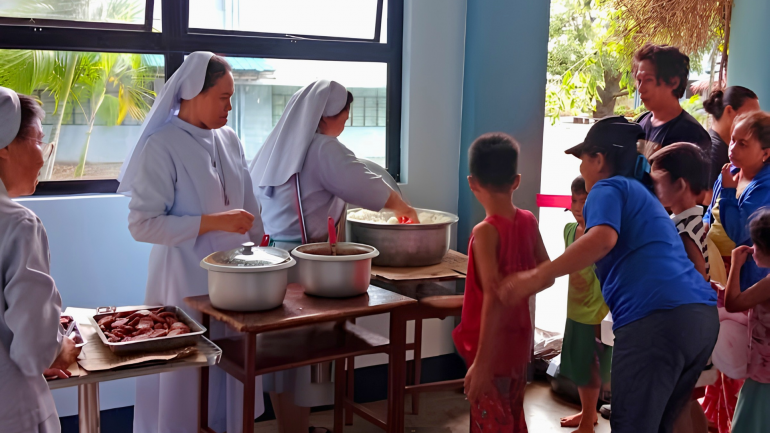
The Church, however, has demonstrated that solidarity can make a difference. In Masbate, another Philippine island province, parish volunteers from Birhen San Kalooy Church mobilized within hours of Typhoon Opong's landfall in September 2025, delivering food, drinking water and house-repair materials to affected communities. Forty families whose homes were completely destroyed received repair kits, while dozens more received essential supplies. Caritas Masbate continued supporting the recovery through transitional shelters for displaced families.
Similarly, in July 2025, when heavy monsoon rains and Severe Tropical Storm Crising flooded parts of Luzon, the Philippines' largest island, several churches in the dioceses of Malolos and Cubao opened their doors as temporary shelters. Santa Lucia Parish in Novaliches, Quezon City, welcomed nearly 200 families, providing refuge to approximately 300 people. Such acts of hospitality demonstrate what the Church's mission means when faith becomes concrete assistance to those in distress.
But the Church's responsibility cannot end when the floodwaters recede. It must also question why communities remain so vulnerable to recurring disasters. In Metro Manila, the Philippine capital region, flooding is aggravated not only by intense rainfall but also by urban development, obstructed waterways, coastal reclamation and land subsidence. These challenges are familiar to many Asian cities experiencing rapid urbanization. Development that disregards environmental limits ultimately places the poorest communities at greater risk.
The Church must therefore go beyond emergency relief. It must help communities understand the causes of their vulnerability and stand with them in demanding responsible development, environmental protection and policies that place human welfare above narrow economic interests.
Environmental responsibility also begins with ordinary people. On our streets, cigarette butts, candy wrappers and plastic packaging are casually discarded as though they will simply disappear. Individually, these acts may appear insignificant, but collectively they contribute to pollution and can obstruct drainage systems and waterways. We cannot demand that governments protect us from flooding while refusing to take responsibility for the waste we leave behind. Caring for creation begins with everyday choices as much as with government policies and environmental programs.
The Church's commitment to protecting creation must also include standing with Indigenous communities whose ancestral lands and livelihoods are threatened by destructive mining. In November 2026, three Catholic bishops visited an Indigenous community's anti-mining barricade in Kasibu, Nueva Vizcaya, in northern Luzon, pledging legal, humanitarian and pastoral support to residents defending their ancestral territory.
For these communities, the struggle is not simply about opposing a mining project. It is about protecting forests, rivers and agricultural lands that sustain their families and future generations. The bishops' presence affirmed that defending creation is inseparable from defending human dignity, cultural heritage and the rights of vulnerable communities.
In Palawan, a Philippine island province known for its forests and marine biodiversity, Bishop Socrates Mesiona raised concerns about government permits covering at least 218,854 trees for cutting or earth-balling in connection with mining projects. He called for a review of the permits and greater scrutiny by government agencies responsible for environmental protection. His concerns raise an important question: What kind of development destroys the very ecosystems that sustain human life?
Across the world, massive open-pit mines reveal the physical consequences of extracting natural resources on an industrial scale. Bingham Canyon in the United States, Chuquicamata in Chile and Mirny in Russia are among the most striking examples of enormous excavations that have transformed landscapes. Their environmental and safety challenges, including waste management, water contamination and mining-related accidents, remind us that the costs of extraction extend far beyond the minerals obtained.
This does not mean that all mining or economic development must be rejected. Rather, development must be responsible, accountable and respectful of ecological limits. The needs of present generations cannot justify destroying the natural resources and livelihoods of future generations.
Pope Francis, in his encyclical Laudato Si', reminded the Church that the cry of the Earth and the cry of the poor are inseparable. Environmental destruction disproportionately affects those who have contributed least to it and have the fewest resources to recover from its consequences.
This is a challenge for the entire Church in Asia, where millions of people depend directly on agriculture, fishing, forests and other natural resources for their survival. From vulnerable coastal communities to Indigenous populations and families living in flood-prone urban settlements, their struggles call for more than expressions of sympathy.
The Church cannot simply open its doors when disasters strike, offer prayers when communities suffer and remain silent when decisions threaten their future. It must be present before, during and after disasters; defend the rights of vulnerable communities; promote responsible development; and encourage ecological conversion among its members.
Ultimately, caring for creation is not separate from the mission of the Church. It is an expression of our responsibility toward God, our neighbors and future generations. To ignore the cry of the Earth is to ignore the cry of the poor. The Church cannot afford to do either.