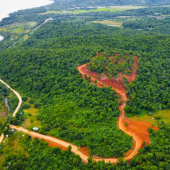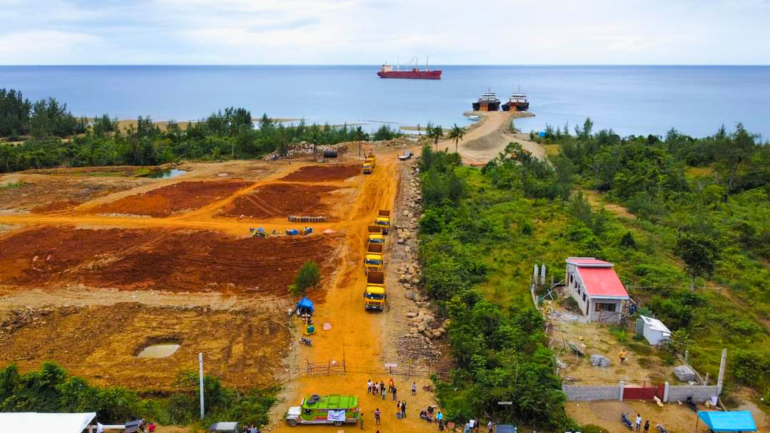
Ten Catholic dioceses representing an estimated 9.63 million Catholics have joined calls to protect Sibuyan Island in Romblon, central Philippines, from the proposed large-scale metallic mining operations of Altai Philippines Mining Corp. (APMC).
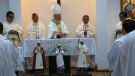
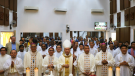
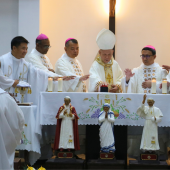
In a joint pastoral statement issued on Aug 24, the bishops expressed their “strong and unequivocal opposition” to the mining project and called for the cancellation of APMC’s Mineral Production Sharing Agreement (MPSA) No. 304-2009-IVB if violations of environmental and mining laws are confirmed.
The statement, titled “Let Sibuyan Live: A Joint Call to Initiate the Cancellation of APMC’s Mining Agreement,” urged President Ferdinand Marcos Jr. and Department of Environment and Natural Resources (DENR) Acting Secretary Juan Miguel T. Cuna to order an immediate, comprehensive, independent, transparent, science-based and participatory review of APMC’s compliance with environmental and mining laws.
The bishops said that if the grounds already raised by affected communities and competent authorities are confirmed, the government should immediately initiate cancellation proceedings for the mining agreement, with full observance of due process.
The Diocese of Romblon, Diocese of San Carlos, Archdiocese of Capiz, Diocese of Kalibo, Diocese of Calapan, Diocese of Boac, Diocese of San Pablo, Diocese of Lucena, Diocese of Gumaca and Diocese of San Jose de Antique signed the statement, together with the Catholic Bishops’ Conference of the Philippines Episcopal Commission on Social Action, Justice and Peace (CBCP-ECSA-JP) and Caritas Philippines.
The bishops declared their solidarity with Sibuyan residents in protecting the island’s mountains, forests, watersheds, rivers, biodiversity, communities, livelihoods and surrounding seas.
They described Sibuyan as an area of exceptional national and global biodiversity importance, where forests, watersheds, rivers, mangroves, coral reefs and surrounding seas form an interconnected ecological system.
“For species found nowhere else on Earth, habitat loss on Sibuyan could mean their disappearance from the planet,” the bishops said.
They also emphasized that “Sibuyanons are rights-holders, not mere spectators,” calling for meaningful community participation, access to information, transparency and social acceptability in decisions affecting the island.
The statement also stressed respect for the rights of Indigenous Peoples, including free, prior and informed consent where legally applicable.
While acknowledging communities’ legitimate aspirations for employment and economic development, the bishops said residents should not be forced to choose between “jobs and water, investment and food security, revenues and biodiversity.”
They instead committed to supporting sustainable agriculture and fisheries, community-based ecotourism, renewable energy, ecosystem restoration, responsible local enterprises and other alternatives identified by local communities.
The statement was led by Bishop Narciso V. Abellana, MSC of Romblon, and Bishop Gerardo Alminaza of San Carlos, who chairs CBCP-ECSA-JP and serves as president of Caritas Philippines.
The other signatories were Archbishop Victor B. Bendico of Capiz; Bishop Cyril B. Villareal of Kalibo; Bishop Moises M. Cuevas of Calapan; Bishop Edwin O. Panergo of Boac; Bishop Marcelino Antonio M. Maralit Jr. of San Pablo; Bishop Mel Rey M. Uy of Lucena; Bishop Euginius L. Cañete, MJ of Gumaca; and Bishop Marvyn A. Maceda of San Jose de Antique.
The bishops concluded their statement with a call to protect the island and the wider marine ecosystem: “Sibuyan is not a sacrifice zone. Protect Sibuyan. Protect our shared seas. Protect our common home. Let Sibuyan live.”
The estimated combined Catholic population of 9.63 million is based on the latest available ecclesiastical statistics published by Catholic Hierarchy, drawing principally from the Annuario Pontificio or Vatican Yearbook. Among the reported figures are 472,660 Catholics in Romblon and 992,732 in San Carlos, based on 2023 statistics published in the 2024 edition of the Annuario Pontificio.
Radio Veritas Asia (RVA), a media platform of the Catholic Church, aims to share Christ. RVA started in 1969 as a continental Catholic radio station to serve Asian countries in their respective local language, thus earning the tag “the Voice of Asian Christianity.” Responding to the emerging context, RVA embraced media platforms to connect with the global Asian audience via its 21 language websites and various social media platforms.
Latest News