

Protect the Vulnerable, Don’t Deify AI: Scholar Calls Asian Church to Ethical Discernment

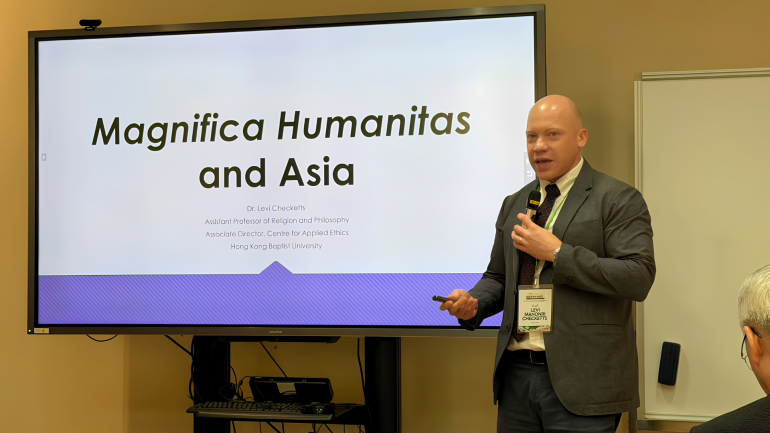
Warning against an uncritical embrace of artificial intelligence and transhumanist ideologies, a leading ethicist urged Asian Church communicators to ground their technological discernment in human dignity and care for the marginalized.
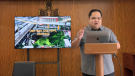
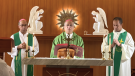
Dr. Levi Checketts, Professor of Religion and Philosophy and Associate Director of the Centre for Applied Ethics at Hong Kong Baptist University, delivered the keynote address on October 28 at St. Joseph’s Seminary in Macau. His presentation immediately followed the opening Mass of the ongoing Federation of Asian Bishops' Conferences Office of Social Communication (FABC-OSC) Assembly, held from October 27 to 31.
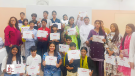
The regional gathering brings together Asian bishops, priests, and communication delegates under the theme, “Magnifica Humanitas and the Synodal Ways of Evangelization in Asia: Communicating Christ in the Age of Artificial Intelligence.”
Highlighting the recent papal encyclical Magnifica Humanitas, Dr. Checketts cautioned against transhumanist ambitions, driven largely by Silicon Valley, that view human limits, vulnerability, and aging as flaws to be eliminated through technology.
“Finitude and vulnerability, when truly accepted, do not diminish us but open us to recognizing the face of God and others,” Dr. Checketts said, quoting the encyclical. He warned that quantifying human worth through artificial intelligence risks reviving historical forms of eugenics, where individuals with "lesser" measured capacities are devalued.
Addressing the unique Asian context, Dr. Checketts emphasized that technology cannot be evaluated solely by economic growth, gross domestic product (GDP), or efficiency metrics. He pointed to the severe human and environmental costs hidden behind AI supply chains in Asia: the toxic environmental degradation caused by rare-earth element mining in Inner Mongolia; hazardous e-waste dumping in South Asian communities; and low-paid, psychologically taxing data-tagging labor performed by underemployed women in the Philippines and South Korea.
“The quality of a civilization is measured not by the power of its means, but by the care it offers and its ability to recognize the other as a face, not merely a function,” Dr. Checketts noted.
Invoking the principle of subsidiarity, the scholar urged delegates to avoid generic, top-down responses. Instead, he called on local churches, Caritas institutions, and parish ministries across Asia to serve as ethical sanctuaries that shield vulnerable populations, such as factory workers, domestic helpers, migrants, and rural poor, from digital exploitation.
Rather than building a technological “Tower of Babel” focused on dominance, Dr. Checketts advocated for a communal model inspired by Nehemiah’s rebuilding of Jerusalem, where Asian Catholics engage in active dialogue with local cultures and faith traditions to build a human-centered future.
Radio Veritas Asia (RVA), a media platform of the Catholic Church, aims to share Christ. RVA started in 1969 as a continental Catholic radio station to serve Asian countries in their respective local language, thus earning the tag “the Voice of Asian Christianity.” Responding to the emerging context, RVA embraced media platforms to connect with the global Asian audience via its 21 language websites and various social media platforms.
Latest News