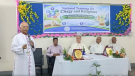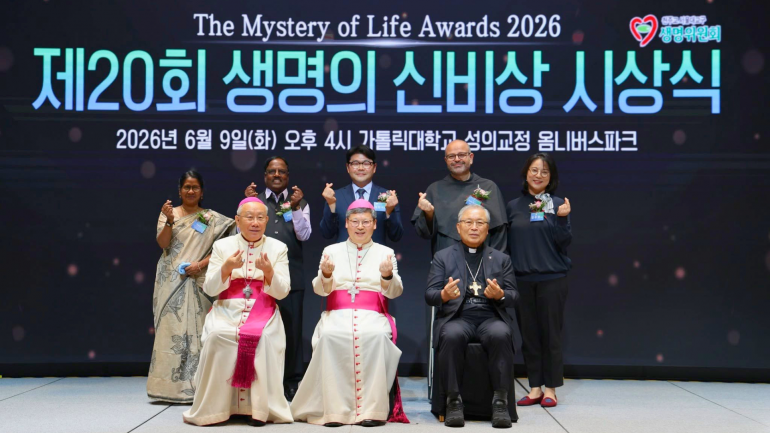
The Archdiocese of Seoul in South Korea honored four individuals and organizations for their contributions to protecting human life and dignity during the 2026 Mystery of Life Awards ceremony held on June 9.
Now in its 20th year, the awards, organized by the Life Committee of the Archdiocese of Seoul, recognize achievements in life sciences, humanities, social sciences, and social action that promote respect for human life.
The 2026 recipients were Professor Jeung Won-seok of South Korea for the Achievement Award in Life Sciences, Fr. Paolo Benanti of Italy for the Achievement Award in Humanities and Social Sciences, Professor Kim Soo-jung of South Korea for the Encouragement Award in Humanities and Social Sciences, and India’s Human Resource Development Foundation (HRDF) for the Encouragement Award for Activities.
Seoul Archbishop Peter Chung Soon-taick, chairman of the Life Committee, said the awards affirm the intrinsic value of every human life.
“The reason human life is indispensable is not because of efficiency, productivity, or any other evaluation indicator, but because the image of God is engraved in it,” he said.
Professor Jeung, a neurologist and researcher at the Korea Advanced Institute of Science and Technology (KAIST), was recognized for pioneering research on brain cells known as astrocytes and their role in maintaining healthy neural connections. His work has also contributed to understanding the early development of Alzheimer’s disease.
Fr. Benanti, a professor of moral theology at the Pontifical Gregorian University in Rome and a member of the Pontifical Academy for Life, was honored for his work on ethics and artificial intelligence. He has promoted the concept of “Human in the Loop,” emphasizing the need for human oversight in AI-driven decision-making.
Professor Kim, of The Catholic University of Korea, was recognized for her research on ethical issues in healthcare, particularly at the beginning and end of life. She has also advocated for better support systems for nurses and greater access to care for marginalized communities.
The HRDF, founded in 1993 by Natesan Thayalan in the southern Indian state of Tamil Nadu, received recognition for its work among Dalit communities, who have historically faced discrimination under India's caste system. Through programs focused on sustainable agriculture, livelihood development, and women’s empowerment, the organization supports about 186,000 Dalit households across villages, towns, and cities.
The awards highlighted efforts from different parts of the world to uphold human dignity amid scientific, technological, and social change.
Radio Veritas Asia (RVA), a media platform of the Catholic Church, aims to share Christ. RVA started in 1969 as a continental Catholic radio station to serve Asian countries in their respective local language, thus earning the tag “the Voice of Asian Christianity.” Responding to the emerging context, RVA embraced media platforms to connect with the global Asian audience via its 21 language websites and various social media platforms.
Latest News