

Sheen Saw ‘Wounded Church’ as Answer to a Doubting World, Says Cardinal Tagle at Beatification Mass


Newly beatified Archbishop Fulton J. Sheen saw the Church’s solidarity with the poor and vulnerable as essential to its missionary witness, telling the Second Vatican Council that only a Church “wounded by poverty” could convert a doubting world, Cardinal Luis Antonio Tagle said at Sheen’s beatification Mass in St. Louis.
“As only a wounded Christ could convert a doubting Thomas, so only a Church wounded by poverty can convert a doubting world,” Sheen said during his address to the Council in 1964, according to Cardinal Tagle, who recalled the statement in his homily at the September 24 celebration.
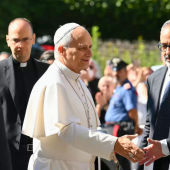
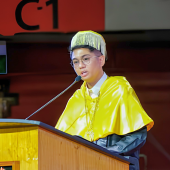
Cardinal Tagle, pro-prefect of the Holy See’s Dicastery for Evangelization, presided at the beatification as Pope Leo XIV’s delegate at The Dome at America’s Center in St. Louis, Missouri, USA. About 50,000 people attended the celebration, during which Pope Leo’s decree formally declaring Sheen Blessed was proclaimed.
Cardinal Tagle said Sheen understood missionary service not simply as proclaiming the Gospel but as entering into communion with concrete people, particularly those who were poor and vulnerable.
“The missionary evangelizer is blessed by the communion with persons and peoples, especially the poor and the vulnerable,” he said.
Cardinal Tagle recalled Sheen’s observation that priests could sometimes administer the sacraments to anonymous groups without sufficiently recognizing the individual people standing before them. Those most likely to remain anonymous, he said, were the poor.
Sheen had already drawn attention to this concern decades before his beatification. During the Second Vatican Council, he spoke about the unequal distribution of prosperity and poverty in the world, noting that much of the world’s poverty was concentrated in Africa, Asia and Latin America.
He also pointed to the experience of bishops who came from countries marked by poverty and persecution.
His words about the “wounded Church” placed poverty within the mystery of Christ himself. Just as Christ’s wounds were not an obstacle to his saving mission, Sheen argued, a Church that allowed itself to be wounded by poverty could become an instrument of conversion for a world that doubted its message.
Sheen also sought to put that conviction into practice. Cardinal Tagle recalled that the archbishop gave to the poor remuneration he received from various commitments and encouraged missionary support for poorer Churches around the world.
The cardinal then recounted an encounter Sheen himself had described during a visit to a center for people affected by leprosy in Buluba, Uganda. About 500 people were living there, and Sheen had brought silver crosses to distribute.
One man who approached him had lost his lower arm and hand to the disease. A rosary hung from the remaining part of his arm.
When Sheen saw the damaged flesh, he recoiled in fear and dropped the cross onto the man’s hand.
The encounter forced him to confront the meaning of the cross he was carrying, Cardinal Tagle said.
The cross represented Christ, who became vulnerable and reached out to people who were suffering. Sheen asked himself how he, as an archbishop and missionary, could do the same.
He eventually overcame his fear and touched and held the man’s damaged flesh. In that moment, Sheen came to see himself not as a visitor standing apart from the people he had come to serve, but as one of them, “the 501st person with leprosy.”
For Cardinal Tagle, the encounter illustrated how missionary service can change the evangelizer as much as those being served.
He connected Sheen’s experience with St. Paul’s image of the evangelizer as an earthen vessel, carrying God’s power rather than presenting personal strength as the source of the Gospel.
“To preach the Gospel from a posture of self-righteousness that prevents you from empathizing with other people’s brokenness is not a mission,” Cardinal Tagle said.
Instead, the missionary must allow encounters with suffering people to reveal Christ in ways that cannot be learned from a distance.
The lesson has particular relevance for the Church in Asia, where Catholics minister among communities marked by wide economic differences and where poverty, migration, displacement and social inequality remain significant pastoral concerns.
For Cardinal Tagle, the beatification of Sheen was therefore not simply recognition of a famous American preacher and Catholic media pioneer. It also offered missionaries and evangelizers a model of a Church willing to encounter the poor and vulnerable and to allow those encounters to challenge and transform its own way of proclaiming the Gospel.
Blessed Fulton J. Sheen’s witness, the cardinal suggested, points toward a Church that does not merely speak about the wounded but allows itself to be wounded with them, and, in doing so, discovers more deeply the presence of Christ.
Radio Veritas Asia (RVA), a media platform of the Catholic Church, aims to share Christ. RVA started in 1969 as a continental Catholic radio station to serve Asian countries in their respective local language, thus earning the tag “the Voice of Asian Christianity.” Responding to the emerging context, RVA embraced media platforms to connect with the global Asian audience via its 21 language websites and various social media platforms.
Latest News