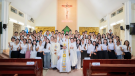
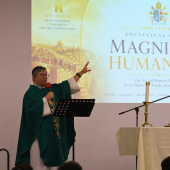
The Institute of Indian Culture (IIC), run by the India Mumbai Province of the Society of the Divine Word (SVD), organized a lecture on August 8 examining India’s anti-conversion laws from a sociological perspective.
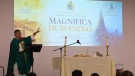
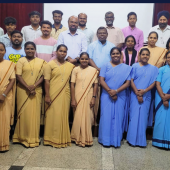
The lecture, titled “Anti-Conversion: A Sociological Perspective,” was held at Stephen Fuchs Hall in Mumbai and brought together academics, researchers, priests, religious women, students, social workers and members of the public for a discussion on the social dimensions of religious conversion.
The program aimed to move the discussion beyond legal and political debates and examine how conversion and anti-conversion laws intersect with questions of identity, caste, culture, social change and individual freedom.
Welcoming the participants, Fr. John Singarayar, SVD, Director of the Institute of Indian Culture, said the institute seeks to provide a space for academic engagement and constructive dialogue on issues affecting Indian society.
The session was moderated by Fr. Scaria, SVD, who introduced the speaker and guided the discussion.
The keynote address was delivered by Prof. Fr. Joseph M. T., SVD, a faculty member in the Department of Sociology at the University of Mumbai. Drawing on his sociological expertise, he examined the historical development of anti-conversion laws in India and their implications for society.
Prof. Joseph noted that religious conversion cannot be understood solely as a legal or theological question. It is also connected with broader social realities, including identity, caste, culture, power relations and personal freedom.


He also examined how anti-conversion laws can affect inter-community relations and public discourse, as well as the exercise of constitutional rights. He encouraged participants to look beyond stereotypes and consider the lived experiences of communities affected by the issue.
The discussion highlighted the importance of dialogue, mutual respect and peaceful coexistence in India’s religiously and culturally diverse society, while recognizing the need to uphold democratic and constitutional principles.
An interactive session followed the lecture, with participants raising questions on the legal, social and ethical dimensions of religious conversion and anti-conversion legislation. Prof. Joseph responded from a sociological perspective, offering examples and insights into the complexities surrounding the issue.
The program concluded with a vote of thanks by Fr. Ivan, who expressed appreciation to the speaker, organizers and participants.
The event forms part of the Institute of Indian Culture’s continuing effort to create platforms for scholarship and dialogue on contemporary social issues in India. For the diverse Catholic community in India and across Asia, such discussions provide an opportunity to engage critically with questions of religion, society, human dignity and peaceful coexistence.
Radio Veritas Asia (RVA), a media platform of the Catholic Church, aims to share Christ. RVA started in 1969 as a continental Catholic radio station to serve Asian countries in their respective local language, thus earning the tag “the Voice of Asian Christianity.” Responding to the emerging context, RVA embraced media platforms to connect with the global Asian audience via its 21 language websites and various social media platforms.
Latest News