


'Synodality Must Lead to Mission,' Says FABC Vice President After Asian Bishops' Assembly

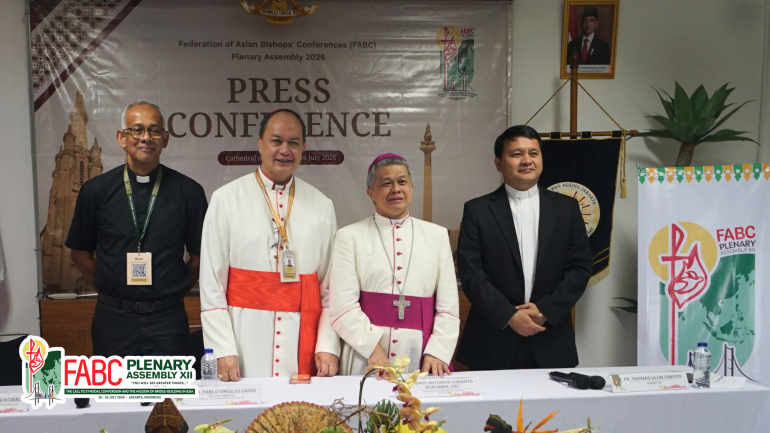
Synodal conversion has meaning only if it leads the Church outward in mission, Cardinal Pablo Virgilio David, vice president of the Federation of Asian Bishops' Conferences (FABC), said as the 12th FABC Plenary Assembly concluded in Jakarta.
Speaking at the assembly's final press conference on July 26 at the Pastoral Center of the Cathedral of Our Lady of the Assumption, the cardinal said the gathering should be remembered not simply for its discussions but for inspiring local Churches across Asia to become "bridges and bridge-builders."
The press conference followed the delegates' symbolic pilgrimage through Jakarta's Friendship Tunnel to the nearby Istiqlal Mosque, one of the world's largest mosques. Joining the briefing were Fr. Clarence Devadass, associate secretary general of the FABC and executive secretary of its Office for Synodality, and Bishop Antonius Subianto Bunjamin, president of the Catholic Bishops' Conference of Indonesia.
Responding to a question about the most practical outcome bishops could bring back to their dioceses, Cardinal David pointed to the assembly's central theme, "You Will See Greater Things," saying it had guided participants throughout the week.
He said the bishops' reflections ultimately centered on two inseparable calls: synodal conversion and missionary outreach.
"Synodality isn't just about the method," Cardinal David said. "It's about spirituality. It's about the lifestyle, the way of being Church."
He explained that synodality is not merely a pastoral strategy or an administrative process but a way of life that shapes the Church's identity and relationships.
For that reason, he said, the conversion envisioned during the assembly extends beyond personal faith to include the renewal of relationships, pastoral practices, and Church structures.
But, he stressed, such renewal cannot remain inward-looking.
"It has to lead to mission," Cardinal David said.
He said that missionary calling was captured in the assembly's vision of becoming "bridges and bridge-builders in Asia," encouraging local Churches to foster dialogue, reconciliation, and fraternity in one of the world's most culturally and religiously diverse regions.
For Cardinal David, the delegates' visit to Jakarta's Istiqlal Mosque after the closing Mass offered a powerful illustration of that mission.
Crossing the Friendship Tunnel linking the mosque and Jakarta Cathedral, he said, was more than a symbolic gesture. It demonstrated how people of different faiths can walk together in mutual respect and friendship.
The cardinal said one of the assembly's most memorable experiences was meeting the Grand Imam of Istiqlal Mosque and witnessing Indonesia's commitment to interreligious harmony.
"We will take that home with us," he said.
Cardinal David said the encounter reinforced the conviction that Christians and Muslims are first and foremost brothers and sisters who share a common humanity.
"The Church's mission is not simply about promoting our religion," he said. "When we promote our common humanity and our common dignity, that is where we truly meet one another."
He said such encounters reflect the Church's broader mission of helping build what he described as a "civilization of love," where dialogue, respect, and cooperation overcome division.
For the bishops returning to their local Churches across Asia, Cardinal David said the challenge now is to translate the spirit of the assembly into concrete pastoral action, ensuring that synodal conversion becomes a missionary way of life that builds bridges within the Church and across the continent's many cultures and religions.