


There Is No Church Without a Bishop: Cardinal Grech Defends Episcopal Authority at FABC

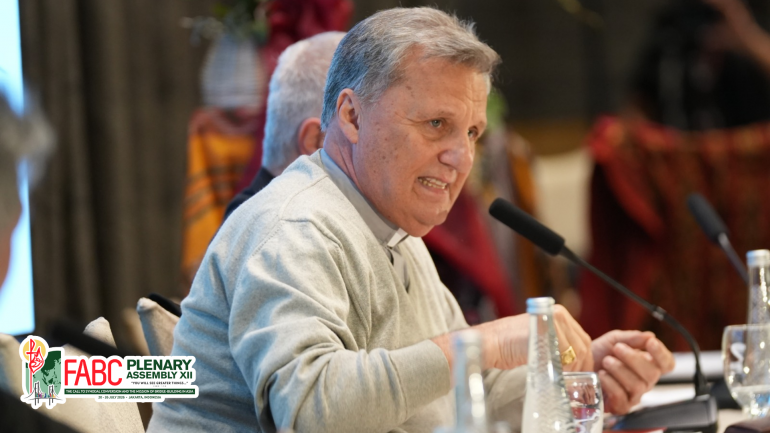
Synodality does not weaken the authority of bishops but calls them to exercise their ministry more faithfully through listening, discernment, and communion, Cardinal Mario Grech told participants at the 12th Plenary Assembly of the Federation of Asian Bishops' Conferences (FABC).
Addressing bishops from across Asia during a presentation titled "Pathways for the Implementation of the Synod" at the Vanda Room of Hotel Mulia on July 24, the Secretary General of the Synod of Bishops responded to concerns that the Church's synodal journey could diminish the role of bishops by placing greater emphasis on consultation and participation.
Instead, he insisted that synodality strengthens, rather than weakens, the episcopal ministry.
"There is no Church without a bishop. But there is no bishop without a flock," Cardinal Grech said, drawing one of the strongest responses of his presentation.
His remarks came as the Catholic Church enters the implementation phase of the Synod on Synodality, following the conclusion of the Synod in Rome. Across the global Church, some have questioned whether broader participation by priests, religious, and lay faithful could blur the distinct role of bishops or reduce their authority.
Cardinal Grech rejected that interpretation, stressing that synodality is not a parliamentary process or a redistribution of ecclesiastical power.
"The bishop remains the shepherd of the local Church," he said, explaining that synodality invites bishops to lead in a more evangelical way by listening attentively to the People of God and discerning the action of the Holy Spirit.
For Cardinal Grech, listening should never be confused with surrendering authority. Rather, it belongs to the very nature of episcopal leadership.
A bishop listens not because he lacks authority, he explained, but because he seeks to recognize how the Holy Spirit is already at work among the faithful.
He emphasized that the Church does not determine truth through opinion polls or majority votes. Instead, bishops are called to listen to what the Church describes as the sensus fidei—the supernatural instinct of faith present among the baptized—before exercising their responsibility to teach, govern, and sanctify.
"The bishop remains the shepherd of the local Church," he repeated, noting that synodality changes the style of leadership, not its nature.
Rather than functioning primarily as administrators, bishops are called to gather the experiences and voices of their people, weigh them prayerfully in the light of Scripture and Tradition, and exercise discernment in communion with the universal Church.
His message carried particular significance for the bishops attending the FABC assembly, many of whom lead local Churches that are small minorities within religiously and culturally diverse societies.
In such contexts, he said, pastoral leadership requires the ability to accompany people, build trust, and foster communion while remaining firmly rooted in the Gospel.
His address offered reassurance to the bishops gathered in Jakarta that the Church's synodal journey seeks to strengthen the episcopal ministry by rooting it more firmly in the example of Christ, the Good Shepherd, who led by walking with his people, listening to them, and guiding them in truth.
Radio Veritas Asia (RVA), a media platform of the Catholic Church, aims to share Christ. RVA started in 1969 as a continental Catholic radio station to serve Asian countries in their respective local language, thus earning the tag “the Voice of Asian Christianity.” Responding to the emerging context, RVA embraced media platforms to connect with the global Asian audience via its 21 language websites and various social media platforms.
Comments

Latest News



- Reply
Permalink