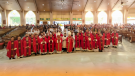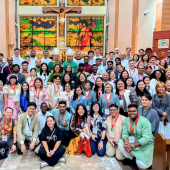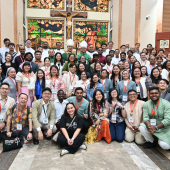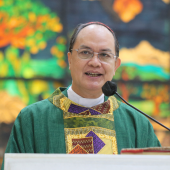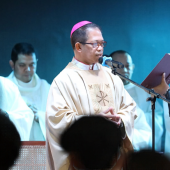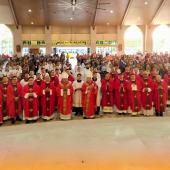



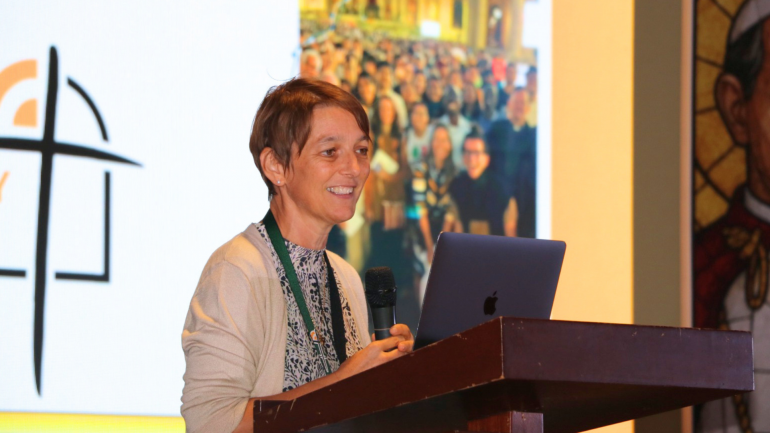
Catholic digital missionaries should look beyond the pursuit of online influence and see their vocation as one of building communion, collaboration and relationships, a Vatican communications official told participants at the Asian Digital Missionary Assembly in Manila.
Dr. Nataša Govekar, director of the Theological-Pastoral Department of the Vatican’s Dicastery for Communication, made the appeal during the second talk of the afternoon session at the Pope John Paul II Auditorium on September 11.
Reflecting on the changing landscape of digital communication, described in the pastoral reflection Towards Full Presence, Govekar said every Christian has the potential to influence others, regardless of the number of followers they have on social media.
“We should take our influence seriously,” she said, emphasizing that Christian influence cannot be measured simply by audience size.
She urged digital missionaries to move beyond thinking of themselves as influencers and instead become “weavers of communion.”
“It’s urgent then to learn this together, as a community and not as individuals,” Govekar said.
For her, this approach is closely connected with synodality.
“Being synodal is working together, moving forward together,” she said, adding that collaboration can help the Church develop a social media presence rooted in communion.
“Because as Christians we know that communion is part of our DNA,” she said.
Govekar placed this vision within the Church’s longstanding teaching on communication, particularly Communio et Progressio, which presents Christ as the “Perfect Communicator.”
Through the Incarnation, Christ identified himself completely with those receiving his message. He communicated not merely through words but through his whole life.
The document states that communication, at its deepest level, is “the giving of self in love.”
For Govekar, this remains the fundamental orientation for Christian communicators even amid rapid technological change.
She referred to the growing use of artificial intelligence and emphasized that technology cannot replace the distinctly human qualities at the heart of communication.
“No computational system, however sophisticated, can create a heart that gives itself, or a conscience that discerns good from evil,” Magnifica humanitas states.
The challenge, therefore, is not simply to acquire new digital skills but to ensure that technology serves human encounter and the Church’s mission rather than displacing them.
Govekar illustrated this also through the Dicastery’s “Faith Communication in the Digital World” program, which trains young Catholic communications professionals through an international and collaborative process.


The program brings together 16 young professionals each year, generally no older than 35, with experience in communications and digital media and a strong connection to Catholic communities.
Participants undergo 11 months of weekly online formation, a residential week in Rome, individual and group work, expert sessions, workshops and communication projects.
Govekar acknowledged that working collaboratively is not easy, particularly across cultures, time zones and different professional approaches.
Yet she said the difficulties themselves became part of the formation.
“The most important outcome of this project is not the final product,” she said, “but the process, relationships.”
This insight led the program to develop a stronger emphasis on accompaniment. Tutors continue to accompany participants who have completed the formation, creating a form of discipleship in which people learn not only from experts but from those who have already undertaken the journey.
“This is why I call it discipleship,” Govekar said.
She said the experience showed the value of investing in young Catholic professionals through practical formation and shared projects.
“Fruitfulness comes from daring to share the vision and hope,” she said.
Govekar encouraged the Asian digital missionaries to develop their own forms of collaboration rather than simply copy an existing model.
“What we try to do internationally can be replicated not in the same way,” she said, but its principles can inspire new experiences locally and internationally.
For Catholic communicators, she said, the task is ultimately to discover what they can create together, bringing professional expertise, experience and human relationships into a shared mission.
Her message placed communion at the center of digital evangelization: the goal is not simply to communicate more effectively, but to build relationships through which the Gospel can be encountered and lived.
Radio Veritas Asia (RVA), a media platform of the Catholic Church, aims to share Christ. RVA started in 1969 as a continental Catholic radio station to serve Asian countries in their respective local language, thus earning the tag “the Voice of Asian Christianity.” Responding to the emerging context, RVA embraced media platforms to connect with the global Asian audience via its 21 language websites and various social media platforms.
Latest News