There are gatherings we attend, and there are gatherings that somehow become an experience.
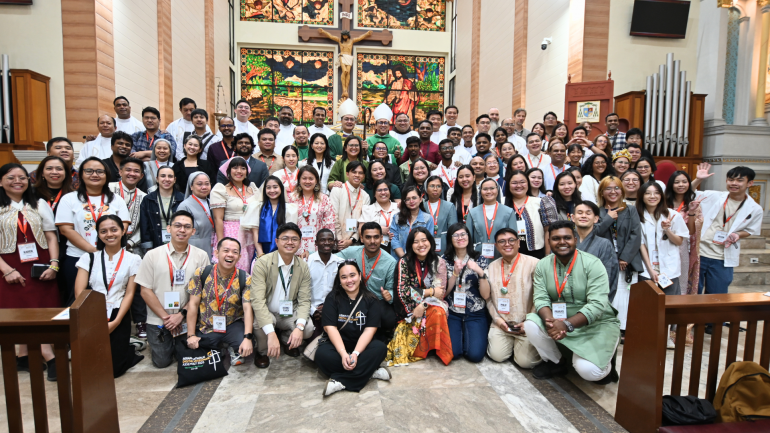
I came to the First Asian Catholic Digital Missionary Assembly 2026 (ACDMA )with expectations of conversations about digital communication, content creation, social media, evangelization, new technologies and artificial intelligence. All of these were indeed part of the assembly.
But somewhere along the way, I began to realize that ACDMA 2026 was becoming something more.
For me, it became an Upper Room experience.
Not because we were literally in the biblical Upper Room, but because something of its spirit seemed to unfold among us: people from different places gathering, listening to one another, sharing stories, discovering one another’s gifts, discerning a common mission and eventually being sent back into the world.
Perhaps that is what the Church needs today, not simply more communicators, but people willing to enter the Upper Room before entering the digital world. We need to gather before we broadcast, listen before we speak, encounter before we create content, discern before we influence, and be sent before asking people to follow us.
FROM INFLUENCERS TO WITNESSES
The theme of ACDMA 2026, “Influencers to Witnesses: A Synodal Way for Digital Mission in Asia,” gave us a question to carry throughout the assembly: Where are we pointing people?
During the opening Mass, Fr. Felmar Fiel, SVD, used a simple Filipino gesture, the act of pointing with the lips, as a powerful image for digital missionaries.
Every post points somewhere. Every photograph, video, caption and story points somewhere.
The question is not simply whether people are looking at us. Where are they being pointed?
If everything points back to ourselves, our personality, popularity, achievements, opinions, numbers or platform, then perhaps we remain influencers. But when our creativity, stories and platforms become a way of pointing beyond ourselves toward Christ, we become witnesses.
A witness does not simply say, “Look at me.” A witness says, in effect, “Come and see what I have seen. Come and encounter the One I have encountered.”
That is why the words of the apostles in Acts 4:20 became meaningful: “For we cannot but speak of what we have seen and heard.”
We came as digital communicators. We leave as witnesses.
FROM SPEAKING TO LISTENING
As the assembly continued, another question emerged: Whom are we listening to?
As a volunteer catechist, this struck me deeply. In parish catechesis, I have learned that sometimes the question a young person asks is not really the question underneath.
“Why do I have to go to Mass?” may really mean, “Does God still care about me?” “Why do I need Confession?” may mean, “Can I begin again?”
A catechist who immediately gives an answer may provide information but miss the person. Perhaps the same happens online.
Behind every screen is a person, a person with a story we do not know, carrying a burden we cannot see, perhaps simply looking for someone to listen.
Digital mission, therefore, cannot only be about speaking more effectively. It must also be about listening more deeply, paying attention, taking another person seriously and making room for another person to be heard.
THE DIGITAL PASSERBY
One image I continue to carry with me is that of the digital passerby.
People scroll past us every day. They may not have searched for Catholic teaching or intended to watch a catechetical video. They are simply passing by. Yet they may be carrying questions about God, purpose, failure, hope or loneliness.
The person passing by our content is not merely a view, reach, engagement or follower.
It is a person.
Perhaps that person is not looking for another lecture but for an encounter.
We are sent into the digital streets. We meet the passerby. We listen. We accompany. And when the opportunity comes, we point toward Christ.
A SEED FROM A CONVERSATION
One of the beautiful surprises of an Upper Room experience is that we may enter carrying one idea and leave carrying another.
During a conversation at ACDMA, Ms. TingTing Therese Tse from Hong Kong shared an idea about creating a podcast people could listen to while driving, commuting, walking or doing ordinary things.
It planted a seed in me.
I began thinking about ordinary moments of life and whether they could become spaces for a small encounter with God. A name began to take shape: Daily Morsel, Stories of Faith, Hope & Love in Ordinary Life.
Not a sermon or theological lecture, but a small portion, a story, reflection or moment through which faith, hope and love might become visible.
I do not know where this seed will lead. But perhaps that is also part of the mission. Sometimes the Holy Spirit works through a conversation, a person we meet briefly, or an idea that refuses to leave us.
NOT MORE CONTENT, BUT MORE PRESENCE
One of the deepest lessons I take away from ACDMA is that communication is not simply about transmitting a message. It is about encounter, relationship, communion and presence.
We can have excellent content and still fail to communicate. We can have thousands of followers and still fail to encounter a single person deeply.
The digital world does not necessarily need more noise. It needs authentic presence.
Perhaps our greatest digital contribution will not always be our most polished video. Sometimes it may simply be our willingness to stop, listen, respond with kindness and treat the person on the other side of the screen as a person created in the image and likeness of God.
The question is not simply, “How can I become influential?” but “How can I become a faithful witness?”
FROM THE UPPER ROOM TO THE DIGITAL WORLD
As I look back at ACDMA 2026, I realize that perhaps we were being invited into a movement: gathered, listening, encountering, discerning, renewed and sent.
That is the movement of the Upper Room.
The assembly may have ended, but the mission has not. We return to our countries, dioceses, parishes, ministries, workplaces and digital platforms.
We may once again create posts, record videos, write captions and answer comments. But perhaps we now do so with different questions:
Not simply, “What should I post?” but, “Whom am I being sent to?”
Not simply, “How can I gain attention?” but, “How can I help someone encounter Christ?”
We came as digital communicators. We gathered as pilgrims. We listened as fellow travelers. We encountered one another as persons. And now we go as witnesses.