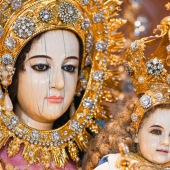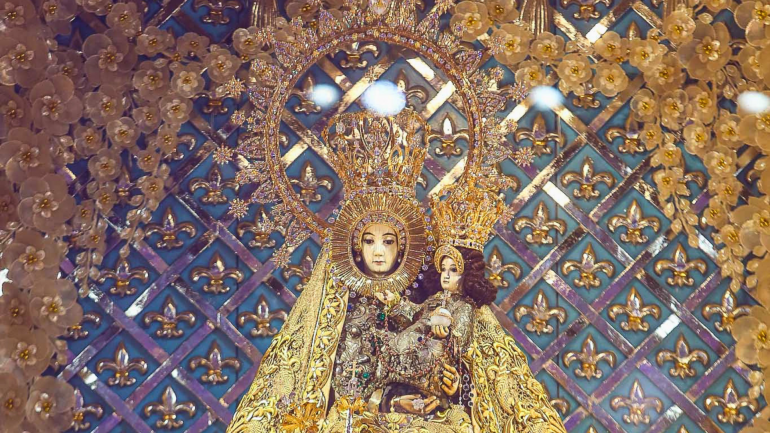
For Filipino visual artist Noli Prinsipe Manalang, being chosen to design the vestments, crown, and carroza of Our Lady of Manaoag for the centenary of her canonical coronation was more than an artistic commission, it was the fulfillment of a long-held devotion.
“For the longest time, it has been our dream to dress Apo Baket (Our Lady),” Manalang shared. “I never expected that we would be the ones called to create for the centenary.”
On April 22, 2026, the Church marked 100 years since the canonical coronation of Our Lady of Manaoag, first held in 1926. The historic celebration took place at the Minor Basilica of Our Lady of the Rosary of Manaoag, drawing thousands of devotees from across the country.
Located in the northern Philippine province of Pangasinan, the basilica remains one of the most visited Marian pilgrimage sites in the Philippines, known for its deep-rooted devotion to the Blessed Mother.
At the heart of this year’s celebration was not only liturgy and tradition, but also artistry shaped by faith.
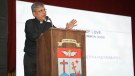
Manalang, together with Rouel Dionisio under the label “Tecnica Bordados Artesanales,” explained that every element of the vestments and crown was carefully crafted to reflect both devotion and local identity. Drawing inspiration from the culture of Pangasinan, he incorporated meaningful symbols into the design.
“We try to look for important symbols from the place,” he said. “Here in Pangasinan, weaving is part of the livelihood, so we incorporated it into the design. We want our Mother to truly be seen as Queen. The roses are like our offering to her.”
The crown, made of silver covered in gold, symbolizes dignity and reverence, an offering that, for Manalang, goes beyond material value.
“We want the best for our Mother,” he said. “Nothing can equal the praise we offer her.”
Beyond the crown and vestments, Manalang also designed and painted the skirt of the carroza, where images of the mysteries of the Holy Rosary are depicted along its base. These visual elements serve not only as decoration, but as a catechetical reminder of the life of Jesus and Mary for the faithful who join the procession.
For the artist, the act of “dressing” the Blessed Mother is itself an offering, an expression of love and faith. He emphasized that such offerings should not be measured by cost, but by the devotion behind them. For many devotees, these expressions of beauty are a way of giving back and honoring the one they call Ina, which means “Mother.”
Beyond his work, Manalang also shared a personal insight into devotion, one that reflects the experience of many pilgrims who return to Manaoag year after year.
“We do not return because our prayers are answered,” he said. “We return to follow up, in God’s perfect time.”
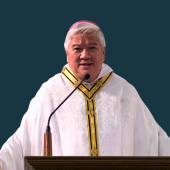
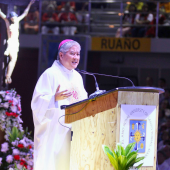
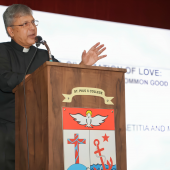
This spirit of trust and perseverance echoed in the homily of Jose Cardinal Advincula, who reminded the faithful that devotion to Mary must go beyond celebration.
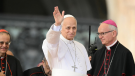
The Eucharistic celebration was presided over by Apostolic Nuncio to the Philippines, Archbishop Charles John Brown, with Cardinal Advincula serving as homilist. They were joined by Archbishop Socrates Villegas of the Archdiocese of Lingayen-Dagupan and other bishops from across Luzon.
In his homily, the cardinal reflected on the deeper meaning of Manaoag, a name derived from the Pangasinan word mantawag, meaning “to call.”
“Manaoag is not only a place,” he said. “Manaoag is Mary. She is our mother. She is our home.”
He described Mary not only as the one who calls (Birheng Tumatawag), but also as the one who was first called (Birheng Tinawag), pointing to her lifelong “yes” to God even in times of uncertainty.
As the faithful gathered in Manaoag for this historic milestone, the celebration became a convergence of faith, art, and community, a reminder that devotion is both expressed and lived.
Radio Veritas Asia (RVA), a media platform of the Catholic Church, aims to share Christ. RVA started in 1969 as a continental Catholic radio station to serve Asian countries in their respective local language, thus earning the tag “the Voice of Asian Christianity.” Responding to the emerging context, RVA embraced media platforms to connect with the global Asian audience via its 21 language websites and various social media platforms.
Latest News