


'Where Do We Go From Here?' FABC Associate Secretary Reflects on Assembly's Way Forward

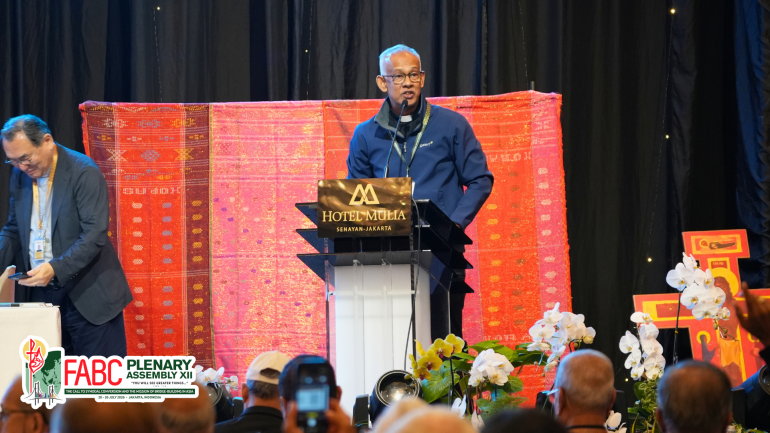
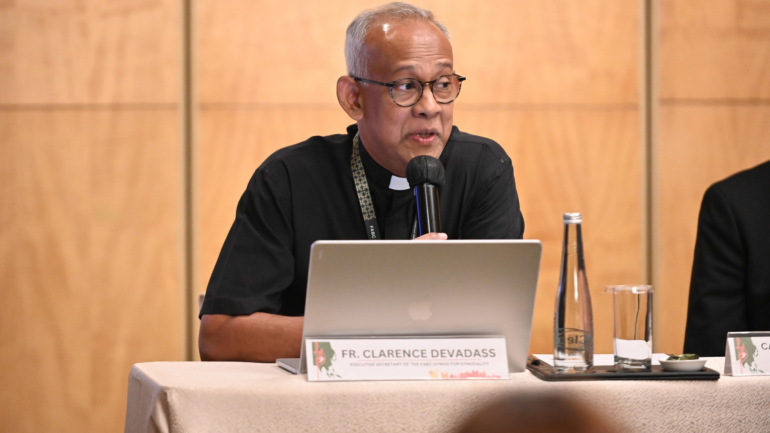
As the 12th Plenary Assembly of the Federation of Asian Bishops' Conferences (FABC) came to a close, Fr. Clarence Devadass, associate secretary of the FABC and executive secretary of its Office for Synodality, posed the question that shaped the gathering's final days: "Where do we go from here?"
Speaking at the assembly's final press conference on July 26 at the Pastoral Center of the Cathedral of Our Lady of the Assumption in Jakarta, Indonesia, Fr. Devadass said the weeklong meeting had moved beyond inspiration and discernment to identifying concrete ways for local Churches across Asia to continue the journey of synodal conversion.
The briefing took place after delegates completed a symbolic pilgrimage through Jakarta's Friendship Tunnel to the nearby Istiqlal Mosque, underscoring the assembly's commitment to dialogue and bridge-building. Also attending the press conference were Cardinal Pablo Virgilio David, FABC vice president, and Bishop Antonius Subianto Bunjamin, president of the Catholic Bishops' Conference of Indonesia.
"Since our last press conference, the assembly has moved from a period of inspiration to one of discernment and visioning," Fr. Devadass said. "As the delegates prepare to return to their local Churches, they have been discerning concrete pathways for continuing the journey of synodal conversion beyond this assembly."
He said the central hope of the gathering is that every participant returns home with a renewed commitment to living synodality in the daily life of the Church.
"Our deepest hope has been that every participant leaves Jakarta with a renewed commitment to the synodal way of being Church," he said.
According to Fr. Devadass, the formal sessions, Conversations in the Spirit, regional meetings, and informal encounters throughout the week strengthened communion among bishops and deepened their commitment to walking together despite Asia's diverse cultures, languages, and pastoral realities.
At the heart of those discussions, he said, was a shared conviction that authentic renewal begins not with new structures but with personal conversion.
"The first step toward becoming a truly missionary synodal Church is the conversion of the heart," he said. "Without personal and pastoral conversion, structural renewal becomes difficult."
He emphasized that synodality is not primarily about changing systems or creating new programs but about allowing the Holy Spirit to transform relationships with God, one another, and the people the Church is called to serve.
Reflecting on the assembly's discussions, Fr. Devadass noted that many local Churches in Asia have long practiced elements of synodality through consultation, vibrant Basic Ecclesial Communities, active lay participation, and interreligious dialogue.
Delegates also reflected on challenges facing both society and the Church, including polarization, migration, ecological degradation, rapid technological change, shrinking democratic spaces, and widening social and economic inequalities.
Rather than seeing these as obstacles, he said, the bishops viewed them as opportunities for renewed missionary witness through dialogue, education, hospitality, care for creation, and a deeper commitment to human dignity.
Within the Church, he acknowledged that clericalism remains an obstacle to communion and shared responsibility. He called for servant leadership, shared discernment, renewed ecclesial structures, and greater participation of the laity in the Church's life and mission.
Looking beyond the assembly, Fr. Devadass announced that the FABC Office for Synodality is preparing a Vademecum to provide practical guidance for local Churches implementing synodality.
"As we conclude this assembly, we leave Jakarta encouraged, united, and inspired," he said. "The conversations begun here will continue in our local Churches, our regions, and throughout Asia."
Before concluding, Fr. Devadass thanked journalists for accompanying the assembly throughout the week, saying their reporting had enabled Catholics across Asia and beyond to share in the hopes and mission of a Church committed to listening, discerning, and walking together.