




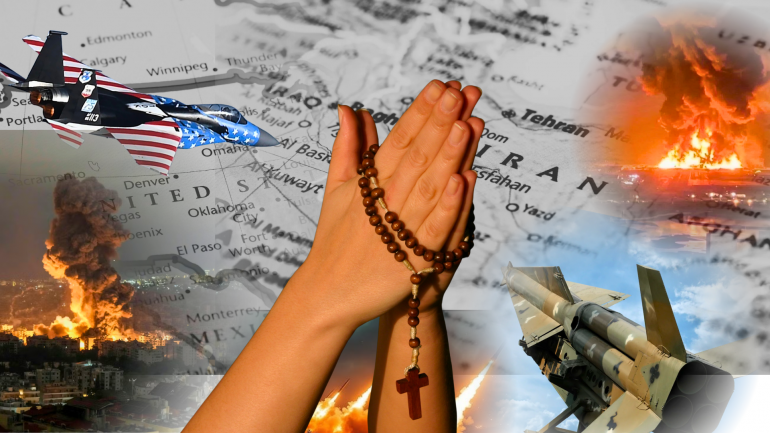
The Middle East, cradle of the world’s great religions and birthplace of countless spiritual traditions, is once again engulfed in the flames of war.
Missiles streak across the night sky, cities tremble under bombardment, and frightened families seek shelter wherever they can. Behind the strategic calculations of governments and the rhetoric of political leaders lies a simpler and more painful truth: ordinary people are paying the price.
A child clutches a toy while running to a shelter. A mother waits anxiously for news of a son serving at the front. An elderly man refuses to leave the home where his family has lived for generations. These are the faces of war that rarely appear in political speeches but remain etched in the conscience of humanity.
War Is Always a Defeat for Humanity
The Catholic Church has long maintained a cautious and morally demanding teaching on war. While acknowledging that nations possess the right to defend themselves, the Church insists that armed conflict must always be the last resort and must never target civilians.
Even then, the Church reminds the world of a difficult truth: war rarely solves the problems that give rise to it. Pope Francis has repeatedly emphasised that “every war leaves the world worse than it was before.” His words echo the conviction of earlier popes who saw modern warfare, with its devastating technology and indiscriminate destruction, as a tragic failure of human imagination and diplomacy.
What begins as a military strategy often ends as a humanitarian tragedy.
A Conflict That Touches the Whole World
The consequences of war in the Middle East rarely remain confined to the region itself. Any disruption in the Strait of Hormuz, one of the most critical oil shipping routes on the planet, could send shockwaves through international markets. Even the threat of blockades, attacks on oil installations, or escalating regional tensions can drive energy prices upward.
When oil prices surge, the consequences ripple across the globe. Transportation costs rise. Food prices increase. Industries struggle with higher operating expenses. For ordinary families already living close to the edge, every rise in fuel prices quietly reshapes daily life, from the cost of getting to work to the price of a simple meal.
A war fought thousands of miles away can eventually reach the kitchen tables of families in Kuala Lumpur, Manila, Mumbai, or Jakarta. In this sense, the suffering of the Middle East becomes the concern of the entire human family.
The Forgotten Victims
In every war, the most vulnerable suffer the most.
Children grow up hearing explosions instead of lullabies. Hospitals struggle to function. Families flee their homes carrying little more than documents, photographs, and memories.
The Catholic Church insists that every human life possesses equal dignity because each person is created in the image of God. This dignity does not change depending on nationality, religion, or political allegiance. The cries of all the communities in the Middle East belong to the same human family. To view the suffering of one people as justified while ignoring the suffering of another is to lose sight of the moral vision that the Gospel demands.
Blessed Are the Peacemakers
The Middle East has long been a crossroads of faith, culture, and power. It is a region where history runs deep, and grievances run deeper.
In such a complex landscape, calls for peace are often dismissed as naïve. Yet the Christian message insists that peace is not naïve, it is necessary.
Jesus himself lived in a land marked by occupation, political tension, and violence. Yet his teaching pointed in a radically different direction: “Blessed are the peacemakers, for they shall be called children of God.”
Peacemaking is not passive. It requires courage, patience, and the willingness to pursue justice without surrendering to hatred. For Catholics around the world, the current crisis must therefore become more than a distant headline. It should prompt prayer, reflection, and a renewed commitment to solidarity with those caught in the crossfire.
In moments such as these, the Church turns instinctively to prayer. Pope Leo XIV appealed to Catholics everywhere to unite spiritually for peace. “I ask all the faithful,” he said, “to pray the Lord’s Prayer and the Hail Mary for the peoples suffering from war, that hearts may be touched and that the path of dialogue and peace may prevail.”
In a world so tightly bound together, no war remains distant for long. When bombs fall in the Middle East, the tremors are felt far beyond the battlefield, in rising prices, in anxious economies, and in the quiet fears of ordinary families everywhere.
In that sense, every person today stands somewhere on the edge of the battlefield. Yet against the thunder of war rises another sound: the gentle murmur of prayer. From candlelit shrines in the Philippines, to village chapels in Borneo, to crowded parishes across Asia and beyond, millions of voices continue to say the same words: Hail Mary, full of grace.
In that prayer lies a stubborn hope that even in a wounded world, peace is still possible.
Let us know how you feel!
Comments



- Reply
Permalink