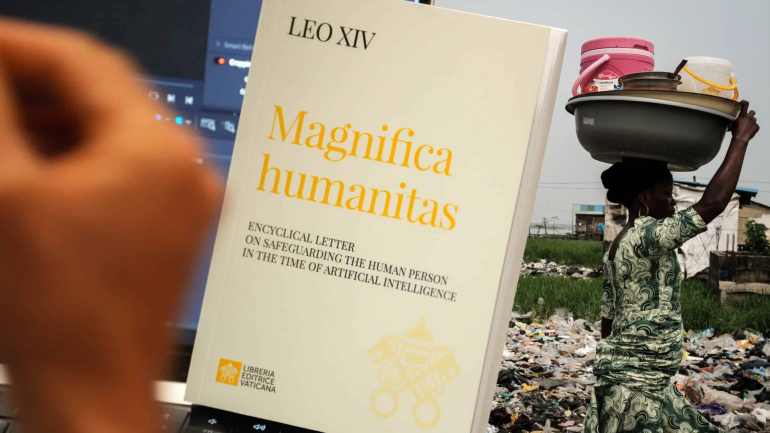
With the publication of Magnifica Humanitas, Pope Leo XIV offers the Church a profound theological response to one of the defining challenges of the twenty-first century: the growing influence of artificial intelligence on human life.
Much like Pope Leo XIII’s Rerum Novarum addressed the social consequences of the Industrial Revolution, Magnifica Humanitas confronts the moral and spiritual implications of the Digital Revolution. Its central concern is the human person and the Church’s responsibility to safeguard human dignity in an age increasingly governed by efficiency, numbers, data, and automation. The document presents a rich theological vision that integrates anthropology and ecclesiology. The sacred dignity of every human person is upheld; technological reductionism is critiqued. The encyclical presents a challenge and a roadmap for the Church in Asia, where technological progress meets deep poverty and social inequality.
Theological Anthropology: The Human Person as Imago Dei
The foundation of Magnifica Humanitas is its affirmation of the human person as created in the image and likeness of God (imago Dei). Pope Leo XIV insists that human dignity does not arise from productivity, intelligence, economic value, or technological competence. Rather, every person possesses an intrinsic worth that comes from being created and loved by God. This teaching directly challenges the dominant assumptions of contemporary technological culture. Modern systems increasingly classify people according to measurable outputs and digital profiles. Human value is often judged through performance and efficiency. But the Pope reminds the Church that persons are ends in themselves, never instruments to be optimised.
Human Vulnerability as a Sacred Place of Grace
Magnifica Humanitas defends human vulnerability. Pope Leo XIV warns against a technocratic mentality that views human limitations as defects to be corrected. In a culture obsessed with optimisation, weakness, dependence, illness, ageing, and poverty are often treated as failures.
The encyclical offers a radically different vision. Human limitations are not obstacles to flourishing but occasions for grace. It is through vulnerability that people learn compassion, solidarity with others, and openness to transcendence. The Pope argues that genuine human growth occurs not through the elimination of limitations but through their integration within relationships of love and care.
For the Asian context, this insight carries significant implications. Communities often marginalized because of caste, tribe, poverty, disability, or social exclusion are frequently viewed through the lens of deficiency. Magnifica Humanitas rejects such perspectives. It presents vulnerability as a sacred place for theological reflection and missionary discipleship.
Seeing Reality from the Perspective of the Poor
The encyclical insists that reality be viewed from below. Pope Leo XIV repeatedly calls the Church to listen to the experiences of those excluded from economic, political, and technological power. This perspective reflects the biblical tradition in which God hears the cry of the oppressed and acts on behalf of the vulnerable. This insight is especially relevant for Asia. Despite remarkable technological and economic achievements, millions continue to suffer from poverty, discrimination, displacement, unemployment, ecological degradation, and social exclusion. The encyclical, therefore, challenges the Church to evaluate social progress not solely by economic growth but by its impact on the most vulnerable members of society.
The Ecclesiological Vision: A Synodal Church of Participation
From its theological anthropology emerges a distinctive ecclesiology. If human beings are created for communion, then the Church must embody that communion in its structures and mission. The encyclical advocates a Church that values relationships over management and participation over control. Synodality is not merely an administrative process but a theological expression of human dignity.
For the Church in Asia, this vision has profound pastoral implications. The voices of the poor and the downtrodden are essential for the Church’s discernment and mission. The poor are active subjects in evangelization, not just recipients of care. A synodal Church listens to those on the peripheries and values their role in God’s mission.
Technology and Justice
A major concern of Magnifica Humanitas is the relationship between technology and justice. Pope Leo XIV acknowledges the immense benefits of technological innovation but warns against systems that concentrate power, deepen inequality, and exclude vulnerable populations. The encyclical identifies dangers such as algorithmic bias, digital surveillance, misinformation, and automated exclusion. Technology lacking ethical principles causes the already marginalized to become “doubly marginalized,” as they are excluded not only by social conditions but also by technological systems.
This challenge is particularly evident in Asia’s rapidly digitiszing society. Access to welfare services, banking, education, and employment increasingly depends upon digital infrastructure. While such systems enhance efficiency, they may also exclude those lacking digital literacy, stable connectivity, or technological resources.
Building a Civilization of Love
Perhaps the most important ecclesiological theme of Magnifica Humanitas is its call to build a “civilization of love.” Pope Leo XIV contrasts this vision with the prevailing “culture of power” that prioritizes control, efficiency, and competition.
A civilization of love is rooted in solidarity, fraternity, justice, and communion. It recognizes that authentic human flourishing occurs within relationships of mutual care and responsibility. The Church is called to be both a sign and an instrument of this alternative social order. For the Church in Asia, this vision requires more than charitable activity. It demands structural commitment to justice, active participation of the marginalized, defense of workers’ rights, ecological responsibility, and advocacy for inclusive development.
Ultimately, Magnifica Humanitas is a theological meditation on what it means to be fully human and fully alive in an increasingly technological world. By placing the poor at the centre of its moral vision, the encyclical offers a prophetic challenge. It calls Christians to defend the dignity of every person, irrespective of the digits, to accompany the vulnerable, to engage critically with technological developments, and to build communities rooted in love rather than power. Thus, the Church becomes a credible witness to the magnificent humanity revealed in Jesus Christ and present in every human person, especially the poor and marginalised.