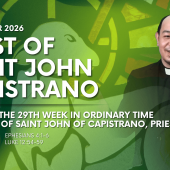
Reflection Date: June 4, 2026 | Thursday of the Ninth Week in Ordinary Time
Memorial of Saint Casimir
Daily Readings: 2 Timothy 2:8-15; Mark 12:28--34
Children of God:
Across the world, the Catholic Church has quietly become the largest charitable network, reaching places no government or organization can fully sustain.
Through Caritas Internationalis, relief operations respond to disasters, wars, and hunger in over 200 countries and territories.
When earthquakes strike, food and shelter arrive through Church networks.
When war displaces families, Catholic agencies provide refuge and hope.
Hospitals, orphanages, and schools stand as silent witnesses of faith in action.
Volunteers risk their safety in conflict zones just to bring aid.
The Church does not only preach compassion; it organizes it.
For example, Caritas Asia is one of the seven regions of the Caritas Confederation, bringing together 23 national Caritas organisations across the continent.
Founded in 1999 during the Caritas Internationalis General Assembly in Rome, it is headquartered in Bangkok, Thailand, and organised into four sub-regions: Central, East, South and Southeast Asia.
Each national Caritas is autonomous and guided by its own Episcopal Conference.
Behind every relief operation are ordinary believers moved by extraordinary love.
In the gospel of Mark, Jesus was asked about the greatest commandment, and He answered by pointing to love: love of God and love of neighbor as the heart of everything.
What are our inspirations for today?
First, love for God is proven by how we love people.
Jesus said, “You shall love the Lord your God with all your heart, with all your soul, with all your mind, and with all your strength” (Mark 12:30).
This is not just spiritual instruction; it is a call for a total commitment.
Loving God means aligning one’s entire life with Him.
It means that faith is not confined to rituals but extended to every decision, every relationship, and every action.
But Jesus did not stop there.
He immediately connected it with loving neighbor (Mark 12:31).
Meaning, love of God should not exist in isolation.
If someone claimed to love God but ignored the suffering of others, that love becomes incomplete.
Real love of God overflows naturally into concern for people, especially the poor and the neglected.
In daily life, this challenges us to examine our priorities.
We may pray, attend Mass, and profess faith, but how do we treat others?
Do we show patience, kindness, and generosity?
Loving God is not measured only by words we say in prayer but by how we treat the person in front of us.
Love for God is proven by how we love people.
Second, love must be shown in action.
This means that love is not just one teaching among many; it is the center of everything.
All laws, all teachings, and all religious practices pointed toward this one reality: love in action.
To be honest, it is easy to say “we care,” but it is another thing to organize relief, to feed the hungry, and to stand with the suffering.
Love requires effort, sacrifice, and sometimes inconvenience.
It demands time, resources, and even personal risk.
This is the kind of love Jesus pointed to.
In our own lives, our love must be expressed in small but concrete ways: in forgiving someone who hurt us, in helping someone in need, in listening when someone is struggling, or in simply being present.
Love must be shown in action.
Now we reflect: Do I express my love for God only through prayer, or also through my actions toward others?
In my daily life, who are the people God is inviting me to love more concretely? What small but real act of love can I begin today that will make my faith more visible?
Children of God:
Love is the simplest command, yet the hardest to live consistently.
The gospel reminds us that love is not optional but essential.
It is a command from Jesus to love.
Love: this is the very heart of the gospel.
So today, let us become living witnesses of the love we believe in.
Radio Veritas Asia (RVA), a media platform of the Catholic Church, aims to share Christ. RVA started in 1969 as a continental Catholic radio station to serve Asian countries in their respective local language, thus earning the tag “the Voice of Asian Christianity.” Responding to the emerging context, RVA embraced media platforms to connect with the global Asian audience via its 21 language websites and various social media platforms.
Latest News