It is painful to see someone who prides in their reason become an agent of injustice.
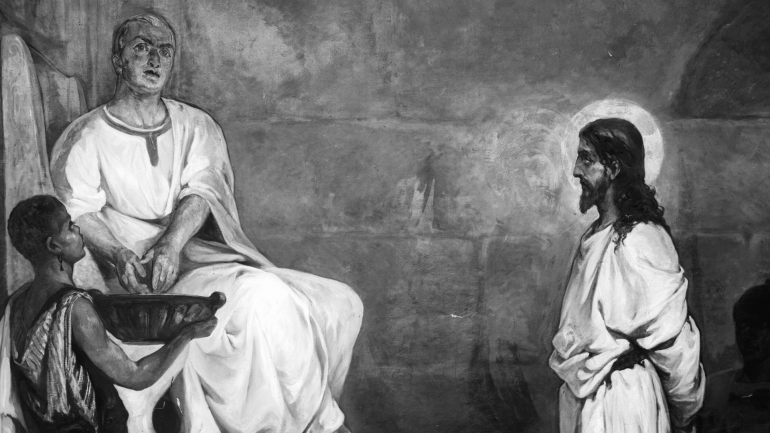
Pontius Pilate, the Roman prefect who questioned Jesus on that fateful Friday morning, is a clear example of this tragedy. His story, found in all four Gospels, offers no comfort to those who believe neutrality exists in moments of moral crisis. As we journey through Lent toward the Passion, Pilate stands before us not as a simple villain but as a mirror reflecting our own temptations toward compromise when the cost of justice seems too high.
The Gospels show a man genuinely confused by the prisoner in front of him. In John's account, Pilate asks, "What is truth?" (John 18:38), as if truth were a philosophical puzzle instead of the living person standing beaten and silent before him. Luke records that Pilate said, "I find no basis for a charge against this man" (Luke 23:4), and even sent Jesus to Herod, perhaps hoping another authority might take the responsibility away from him. Matthew tells us that Pilate's wife sent word about her disturbing dream, adding another warning against this innocent blood (Matthew 27:19).
Psychology sheds light on the Gospel narrative with sharp clarity. Pilate shows what we now call moral disengagement, the slow process through which decent people distance themselves from the effects of their choices. He literally washes his hands before the crowd to perform a ritual of innocence while ordering crucifixion. This isn’t typical hypocrisy; it is something more harmful. Pilate seems to believe his own act, thinking that symbolic gestures can break the link between decision and consequence.
Recent studies in moral psychology, particularly by scholars like Albert Bandura, show how people create complicated justifications for harmful actions:
-
We push away responsibility ("I was just following protocol").
-
We dehumanize victims ("He claims to be a king, but look at him").
-
We shift blame ("You brought me this man; your nation and your chief priests").
Pilate uses all these tactics in quick succession. The Gospels suggest he was not a sadist enjoying cruelty but a bureaucrat stuck between his private judgment and public pressure.
This Lenten season, as we think about Christ's suffering, we cannot overlook how Pilate's compromise echoes through the halls of power today.
Consider the recent political scene around the world: the war in Ukraine, now going into its fourth year, has shown how many Western leaders initially adopted Pilate's approach of washing their hands. Early hesitance, careful management of escalation, and prioritizing economic stability over moral clarity were modern versions of sending Jesus to Herod, hoping someone else would take on the burden of decision. As tensions rise between Iran, the United States, and Israel, we see similar risky behavior: diplomatic statements of "concern" issued alongside arms shipments, sanctions carefully applied to avoid upsetting energy markets, and red lines that keep shifting. Each party claims to seek de-escalation while maneuvering for position, each pretends to show restraint while preparing for conflict. Modern politicians are washing their hands in press conferences as the region braces for another execution of the innocent.
What makes Pilate always relevant is how he represents structural sin.
This is the idea that evil is not just individual but built into systems, bureaucracies, and the accumulated weight of "pragmatic" choices. Pope Francis has frequently warned about the "globalization of indifference," a phrase that captures the spiritual danger Pilate represents. When we treat moral questions as administrative issues, when we prioritize stability over justice, we become part of the same process that turned a confused prefect into an executioner.
For us, the Lenten invitation is to think about our own Pilate moments, times when we have mistaken neutrality for wisdom, when we have pretended to care while avoiding cost, and when we have asked "What is truth?" as if the answer were not already visible in the suffering around us. The Passion narratives do not let us comfort ourselves by thinking we would have acted differently. They place us in the crowd, in the courtyard, in the governor's palace, wherever complicity is possible.
The cross shows that there is no safe middle ground. Jesus tells Pilate that his kingdom is not "from this world" (John 18:36), meaning it does not function by the world’s rules of power and compromise. This isn’t a call for political passivity but for a complete rethinking of what political responsibility means. For Christians, there is no washing of hands that can erase the duty to stand with the crucified.
As we near Holy Week, may we have the courage to confront our own temptations toward Pilate's delusion and the grace to choose, no matter the cost, the side of the condemned over the comfortable neutrality of the judge.